Cross-posting research I’ve led, which examines how to help students complete their qualifications. Our research shows that more apprentices and trainees will complete their training if students are given six behaviourally informed SMS prompts. Messages provided timely and practical advice on workplace rights, and where to seek support if they were struggling. Our results equate to 16% fewer learners dropping out. Our intervention led to a 7:1 return on investment.
Almost 530 researchers (including me) have signed the Open Letter Against Racism. Critical race theory is an academic field under uninformed and unwarranted political attack in Australia and in other nations. See an excerpt below and please read the full letter.
It’s been a long while! Over the past couple of months, in my paid work, I’ve been co-leading a large randomised control trial in public health. Hoping we can publish results in the new year. Our team is also busy researching issues of technology and safety. In my personal research, Associate Professor Alana Lentin and I wrapped up series 1 of Race in Society. We covered media representations; the lockdown and ableism; intersectionality; policing; and economics. I’ll bring you write ups of other episodes soon, or head to our YouTube to watch the videos.
In case you missed it, here are two interviews I gave earlier in the year, on the sociology of COVID-19. Unfortunately, the topics of moral panics and misinformation remain relevant.
In Episode Seven of our Race in Society series—the final episode of season 1 on “Race and COVID-19″—Associate Professor Alana Lentin and I are joined by two guests to discuss The Economics and Social Costs of COVID-19. We examine the impact of the COVID-19 crisis on undocumented migrant workers, whose labour is being exploited.
The economy depends upon the work of racialised people, exposing them to higher risk due to casualised frontline services, which have kept the health system and other businesses going throughout lockdown. At the same time, racialised people are provided inadequate protections against infection, including poor personal protective equipment.
Our first guest, Sanmati Verma, is an Accredited Specialist in Immigration Law. She discusses the legal issues faced by temporary visa holders and migrants, as they lack access to economic security. Our other guest is Professor Sujatha Fernandes, who is Professor of Political Economy and Sociology at the University of Sydney. Her research explores the uses and misuses of storytelling to shape understandings of the political activism of racialised people. She discusses how “curated storytelling” narrows the public’s engagement with economic rights during the pandemic.
In Episode Six of our Race in Society series, Associate Professor Alana Lentin and I focus on Policing the Quarantine. Our racially-driven criminal justice system has been an ongoing feature of colonialism, from invasion in 1788, to the present day. Since the 1991 Royal Commission into Aboriginal deaths in custody, over 434 Aboriginal and Torres Strait Islander People have died in police custody. Policing powers have been extended throughout the pandemic, and disproportionately target Aboriginal and Torres Strait Islander people and other people of colour. This includes the administration of fines, lockdowns, and curfews.
To help us to think through these topics, we are joined by three panellists. First, Roxanne Moore, Executive Officer of the National Aboriginal and Torres Strait Islander Legal Services (NATSILS), discusses police accountability. Second, Professor Megan Davis, Pro Vice-Chancellor Indigenous at the University of New South Wales and Professor of Law, provides insight on constitutional and human rights during the pandemic. Dr Vicki Sentas, Senior Lecturer in the Faculty of Law at the University of New South Wales, discusses racial profiling and police reform.
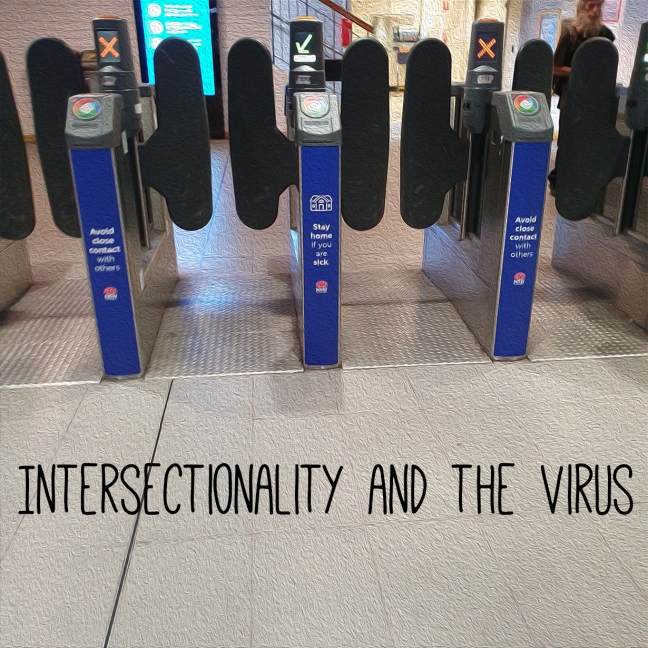
In Episode 5 of our Race in Society series, Associate Professor Alana Lentin and I lead a panel exploring the impact of race, gender, and socioeconomics on COVID-19, through a lens of intersectionality. Writing in 1989, Professor Kimberle Crenshaw showed that industrial law in the USA treated racial and sexual discrimination as distinct experiences. She showed that Black women experience both racism and sexism simultaneously, and so the impact of each is compounded. Professor Patricia Hill Collins and other theorists have also shown that, without using this term specifically, people in the Global South have used intersectionality as an analytical tool, since at least the 1800s, to grapple with the complexity of discrimination. In Australia, we look to the works of Professor Aileen Moreton-Robinson, such as her book, “Talkin’ Up to the White Woman,” which examines how white feminist research has established authority by mobilising whiteness and enacting power over Aboriginal women. Intersectionality is not an identity, but rather a way to understand power relations in society, as well as social inequality, by looking at the interconnections of social division, including race, gender, disability, sexuality, and class.
In the video below, we speak with Karl Briscoe, the Chief Executive Officer of the National Aboriginal and Torres Strait Islander, Health Worker Association (NATSIHWA). His organisation has been proactive in producing resources throughout the pandemic, from advice to Black Lives Matter protesters, as well as the Aboriginal and Torres Strait Islander Health Professionals Resource Toolkit. He discusses how intersections of race and health impact the work by Aboriginal healthcare workers. We then speak with Professor Karen Farquharson, who has studied race in Australia, South Africa, and the United States. She explores how ideas of whiteness are used to dehumanise Black people, and how this has led to disparate health outcomes during the pandemic. Finally, Dr Nilmini Fernando is a Postdoctoral Research Fellow at Griffith University and a scholar of Black and post-colonial feminisms. She discusses a gap in the domestic and family violence sector, with respect to how violence is measured and categorised. Specifically, its inadequate attention to intersectionality. She notes that, by focusing on colonial definitions of violence, women of colour are inadequately protected when trying to rebuild their lives during social isolation.
In Episode 3 of Race in Society (video below), Associate Professor Alana Lentin and I lead a panel about how mainstream media create sensationalist accounts of the pandemic, and the proactive ways in which Aboriginal people and Asian people in particular lead their own responses. We spoke with Dr Summer May Finlay, a Yorta Yorta woman and Public Health Researcher at the Universities of Wollongong and Canberra. In our video below, she details how Aboriginal community controlled health organisations have effectively dealt with COVID-19 using social marketing campaigns. We also chatted with Dr Karen Schamberger, an independent curator and historian. She covers the history of Australian sinophobia (the fear of China, its people and or its culture), and how anti-Chinese racism plays out in media reports on racism and the COVID-19 pandemic.
Media and officials continue to blame racial minorities in a way that does not feature for white-majority communities, some of whom are boldly defying the lockdown. Why does this happen? Our Race in Society series provides broader cultural and historical context.
In Episode 2 of Race in Society, Associate Professor Alana Lentin and I are joined by Jill Gallagher, Chief Executive Officer of the Victorian Aboriginal Community Controlled Health Organisation (VACCHO), who are leading COVID-19 pandemic responses in Victoria. She discusses how the pandemic amplifies existing health and social inequalities. Also on the panel is sociologist, Professor Aileen Moreton-Robinson, who is Professor of Indigenous Research at RMIT University, and author of countless critical race books, including, ‘The White Possessive‘. She demonstrates how her theorisation of Aboriginal sovereignty disrupts how the pandemic is currently understood. Finally, we also speak with sociologist Dr Debbie Bargallie, Senior research fellow at Griffith University, and author of the excellent new release, ‘Unmasking the Racial Contract: Indigenous voices on racism in the Australian Public Service.’ She talks about how Aboriginal people are excluded from social policy, which has compounded poor decision-making on public health during the pandemic.
This is the second of two posts showing how applied sociology is used in a multi-disciplinary behavioural science project to improve social policy and program delivery.
We scaled our previous trials that used behavioural science to increase pre-service teachers’ uptake of professional placements in rural and remote New South Wales (NSW). We used timely and personalised communications, simplified research on placements, and offered a group placement experience. These interventions led to 55 pre-service teachers completing their placements at geographically isolated schools, with 100% of them saying they would consider taking up long-term employment at a rural or remote school in the future.
This is part one of two posts showing how applied sociology is used in a multi-disciplinary behavioural science project to improve social policy and program delivery.
Our randomised control trial (RCT) sought to improve outcomes for apprentices and trainees through a behavioural intervention. Learners and their employers were separately visited to discuss contractual responsibilities and to set goals that were meaningful to the learner. Fortnightly emails to employers and text messages (SMS) to learners then reinforced these themes for a period of three months. At the end of this time, separate phone calls to employers and learners were undertaken to check their progress on goals and to work through any workplace issues. We then stopped further communication and analysed completion rates 12-months later. Though our intervention did not lead to a statistically significant result in the retention rate of learners, we suggest early, behaviourally informed support in the first 12 months can help learners persevere toward apprenticeship completion.








 The Other Sociologist