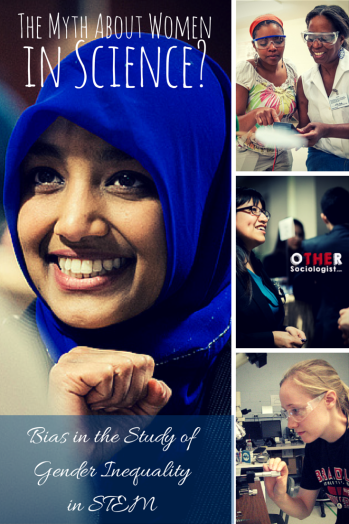
 A new article on CNN by psychology professors, Wendy Williams and Stephen Ceci, boldly proclaims that gender bias in Science, Technology, Engineering and Mathematics (STEM) is a myth. Their research has been published in the Proceedings of the National Academy of Sciences (PNAS). Unfortunately, their work has a flawed methodological premise and their conclusions do not match their study design. This is not the first time these researchers have whipped up false controversy by decrying the end of sexism in science.
Williams and Ceci write on CNN:
Many female graduate students worry that hiring bias is inevitable. A walk through the science departments of any college or university could convince us that the scarcity of female faculty (20% or less) in fields like engineering, computer science, physics, economics and mathematics must reflect sexism in hiring.
But the facts tell a different story…
Our results, coupled with actuarial data on real-world academic hiring showing a female advantage, suggest this is a propitious time for women beginning careers in academic science. The low numbers of women in math-based fields of science do not result from sexist hiring, but rather from women’s lower rates of choosing to enter math-based fields in the first place, due to sex differences in preferred careers and perhaps to lack of female role models and mentors.
While women may encounter sexism before and during graduate training and after becoming professors, the only sexism they face in the hiring process is bias in their favour.
Williams and Ceci’s data show that, amongst their sample, women and male faculty say they would not discriminate against a woman candidate for a tenure-track position at a university. Sounds great, right? The problem is the discrepancy between their study design, that elicits hypothetical responses to hypothetical candidates in a manner that is nothing like real-world hiring conditions, and the researchers’ conclusions, which is that this hypothetical setting dispels the “myth” that women are disadvantaged in academic hiring. The background to this problem of inequality is that this is not a myth at all: a plethora of robust empirical research already shows that, not only are there less women in STEM fields, but that women are less likely to be hired for STEM jobs, as well as promoted, remunerated and professionally recognised in every respect of academic life.
Continue reading The Myth About Women in Science? Bias in the Study of Gender Inequality in STEM


 The Other Sociologist