
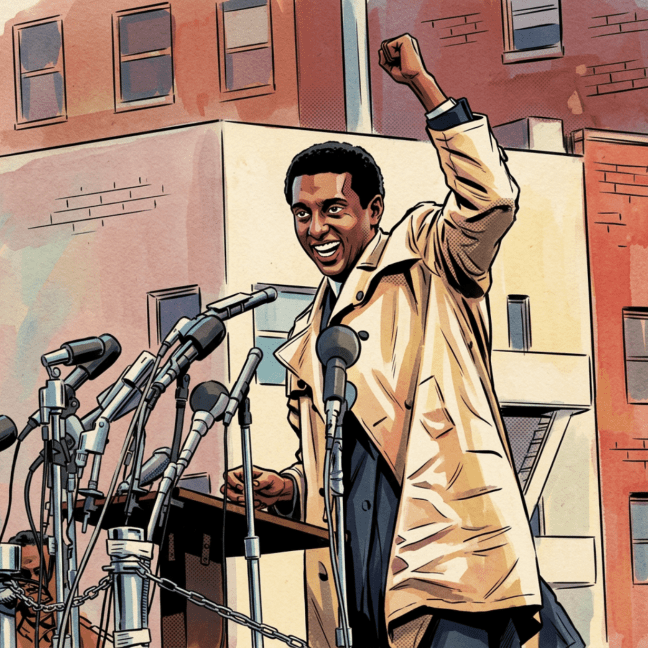
“Some groups in this country, talking all sorts of nonsense, will make you think that white supremacy is a sickness, is a ‘this,’ is a ‘that.’ White supremacy, as far as we’re concerned, just means we’re powerless. That’s all. White supremacy is not an attitude, it’s not a sickness, it’s a question of power. If a white man wants to lynch me, that’s his problem. If he has the power to lynch me, that’s my problem. But as long as I have the power to stop the white man from lynching me, him wanting to lynch me is his problem, and it can remain his problem forever. So the only reason the white man can lynch me is because I am powerless.”
Kwame Ture (previously known as Stokely Carmichael)
Later in his talk, Ture says:
“Consequently, the only way I can fight white supremacy is through power. P. O. W. E. R. And the only way you get political power is through the organised masses… Power cannot come from the individual. It can only come from the organised masses… Organisation is the weapon of the oppressed.”
Ture was born on 29 June, 1941 in Trinidad, and moved to the USA at age 11. He was a civil rights activist, influential in various revolutionary movements. He rose to the national stage while studying philosophy at Howard University, and became one of the original Freedom Riders. He was a leader with the Black Power movement, including the Black Panthers, leading him to be surveilled by the USA and UK governments. In 1969, he moved to Guinea permanently, where he contributed to pan-Africanism. He died on 15 November 1998.
Ture argues that racism is never unconscious, and liberation needs conscious organisation. He discusses the history and impact of violence, colonialism, and capitalism. He notes that Black people do not want to be integrated into American capitalism, because it is immoral and undemocratic. He says the task of revolution is to topple this system.
He argues that pan-Africanism and socialism provide a path to liberation and systemic change.
He also discusses the oppression of the people of Palestine and Ireland (for which he was criticised), as well as the links between racism, capitalism, and sexism.
“Racism gets its power from capitalism. Thus, if you’re anti-racist, whether you know it or not, you must be anti-capitalist. The power for racism, the power for sexism, comes from capitalism, not an attitude.
“You cannot be a racist without power. You cannot be a sexist without power. Even men who beat their wives get this power from the society which allows it, condones it, encourages it. One cannot be against racism, one cannot be against sexism, unless one is against capitalism.”
Watch the whole speech delivered to Cheyney University in the early 1990s. (The quote starts from 32:35. It is often wrongly attributed to his famous 1966 “Black Power” speech, while he was still a student.)
Discover more from The Other Sociologist
Subscribe to get the latest posts sent to your email.


