
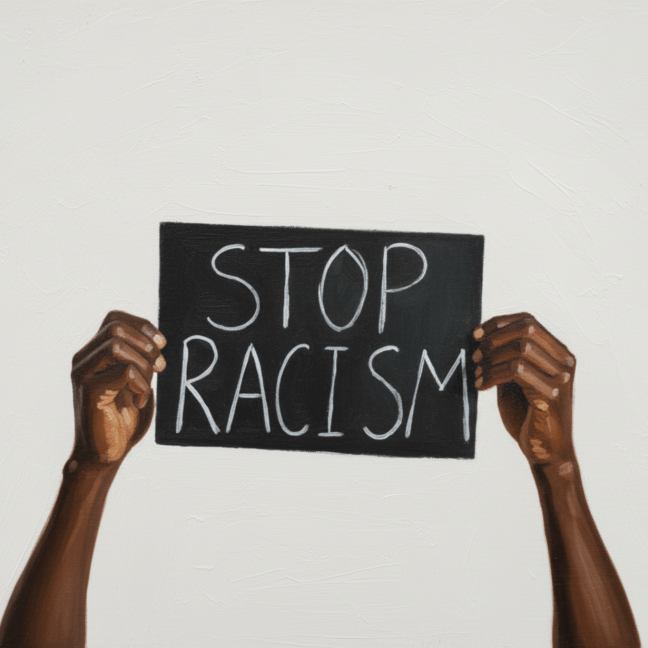
The Australian Government is proposing to remove legal protections against racial abuse. This will make it easier for overt racial discrimination to flourish.
With the support of Prime Minister Tony Abbot, Attorney-General George Brandis is leading a proposal to change Section 18C of the Racial Discrimination Act 1975 (Cth).
Section 18C of the Racial Discrimination Act makes it unlawful to “offend, insult, humiliate or intimidate” a person because of their race, colour, nationality, or ethnicity.
Section 18D of the Racial Discrimination Act contains exemptions to 18C, by protecting freedom of speech for art, scientitic debate, and fair comment on matters of public interest. This must be reasonable and in good faith (see below for full text).
The repeal of Section 18C arises after the 2011 prosecution of right-wing columnist, Andrew Bolt.
Bolt lost a racial discrimination case against author and academic, Dr Anita Heiss, who co-led a vilification suit alongside other prominent Aboriginal people. Bolt built his reputation partly by making racist comments, especially questioning Aboriginal people’s identity based on their appearance.
A Federal Court judge found that Bolt had breached the Racial Discrimination Act because his articles not written in good faith and contained factual errors. The judge found that the articles would have offended a reasonable member of the Aboriginal community.
Three years later, Brandis is using his role in Parliament to support his friend, already demonstrating that the amendments will allow racism to flourish.
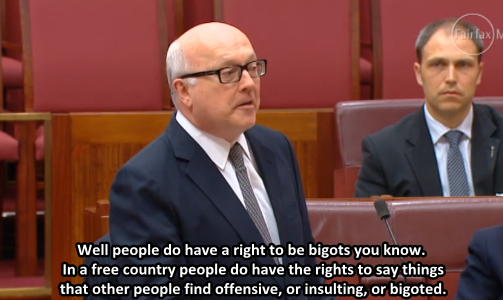
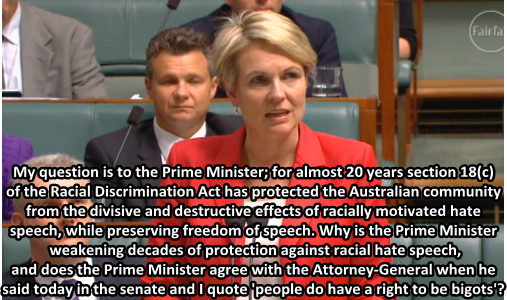
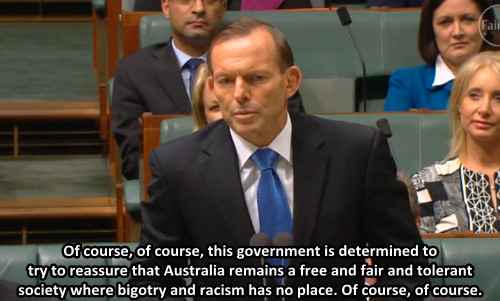
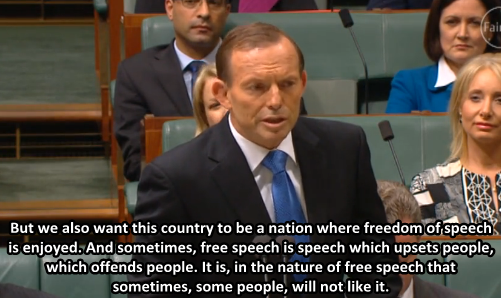
Appearing on Q & A, on ABC TV, Brandis explains the proposed changes to 18C as necessary to protect freedom of speech, and the right to express “opinions,” and to be “outrageous,” “offensive,” “unpopular,” and “offensive.”
“If we don’t repeal Section 18C in its current form, we’re going to say, in this country, that political censorship is okay…
Co-panellist, Professor Marcia Langton, descended from the Yiman and Bidjara nations of Queensland, explains that Bolt’s articles on Aboriginal people are not political commentary, but are instead abusive. She notes these comments have led some Aboriginal people to withdraw from public life. Brandis responds:
“I know Andrew Bolt. Andrew Bolt is not a racist. [The crowd laughs] Andrew Bolt is not a racist. And to accuse him of being a racist is itself a form of vile abuse of the man.”
Later, he once again equates racism with the injury of being “wrongful allegations of racism,” and yet he argues that both are necessary to “civilised society.” He repeats that he is defending “freedom of speech” and “freedom of opinion.”
Brandis’ defence of “the right to bigotry,” under the guise of “free speech,” spells a return to more overt state-sanctioned institutional discrimination from early invasion and the White Australia Policy era.
Under the new proposed racial vilification laws, people like Bolt can continue their hate speech with impunity, while minority groups are conversely labelled anti-democratic for pointing out discrimination.
Learn more: Racial Discrimination Act 1975, Sections 18C and 18D
18C Offensive behaviour because of race, colour or national or ethnic origin
(1) It is unlawful for a person to do an act, otherwise than in private, if:
(a) the act is reasonably likely, in all the circumstances, to offend, insult, humiliate or intimidate another person or a group of people; and
(b) the act is done because of the race, colour or national or ethnic origin of the other person or of some or all of the people in the group.
Note: Subsection (1) makes certain acts unlawful. Section 46P of the Australian Human Rights Commission Act 1986 allows people to make complaints to the Australian Human Rights Commission about unlawful acts. However, an unlawful act is not necessarily a criminal offence. Section 26 says that this Act does not make it an offence to do an act that is unlawful because of this Part, unless Part IV expressly says that the act is an offence.
(2) For the purposes of subsection (1), an act is taken not to be done in private if it:
(a) causes words, sounds, images or writing to be communicated to the public; or
(b) is done in a public place; or
(c) is done in the sight or hearing of people who are in a public place.
(3) In this section:
public place includes any place to which the public have access as of right or by invitation, whether express or implied and whether or not a charge is made for admission to the place.
18D Exemptions
Section 18C does not render unlawful anything said or done reasonably and in good faith:
(a) in the performance, exhibition or distribution of an artistic work; or
(b) in the course of any statement, publication, discussion or debate made or held for any genuine academic, artistic or scientific purpose or any other genuine purpose in the public interest; or
(c) in making or publishing:
(i) a fair and accurate report of any event or matter of public interest; or
(ii) a fair comment on any event or matter of public interest if the comment is an expression of a genuine belief held by the person making the comment.
Discover more from The Other Sociologist
Subscribe to get the latest posts sent to your email.


