
The Abbott Government in Australia has previously stated it does not believe in climate change and it has significantly withdrawn funding for this line of research in its latest Budget (along with funding for most non-medical scientific research). A recent change on the Department of Environment’s website has removed a reference to the link between extreme weather conditions and climate change. The Department says this change reflects the findings of the Intergovernmental Panel on Climate Change (IPCC), which is incorrect. I discuss the Abbott Government’s historical and current position on climate change. I focus on the public discourse by Abbott and his Ministers. They discuss climate change science as both something that is open to interpretation and something that can be fought with selective use of science.
The IPCC describes climate change as:
‘a change in the state of the climate that can be identified (e.g. using statistical tests) by changes in the mean and/or the variability of its properties, and that persists for an extended period, typically decades or longer. It refers to any change in climate over time, whether due to natural variability or as a result of human activity.’
Climate change action is an interdisciplinary effort. It requires the knowledge and contribution of scientists, community planners, health workers, and experts from many fields. It requires research as well as social policy intervention at the local community, state, federal and international levels.
Research shows that political interests shape the extent to which climate change science is accepted. This is magnified when individuals have a vested interest in an economy of fossil fuels. I discuss the sociological consequences of extreme weather events on community planning and community resilience. That is, the knowledge, resources and planning necessary to deal with extreme events.
Abbott Government Position on Climate Change
Abbott’s position against climate change science is well-documented. Consider this interview from 2008:
‘I refuse to be terrified of the future. I think that humankind has been pretty good at coping with the challenges that we’ve been given. If you look at Roman times, grapes grew up against Hadrian’s Wall – medieval times they grew crops in Greenland. In the 1700s they had ice fairs on the Thames. So the world has been significantly hotter, significantly colder than it is now. We’ve coped. I don’t say there aren’t problems, haven’t been problems, might not be problems, but I refuse to be terrified of the court [of scientific opinion]…I am always reluctant to join bandwagons. I think there are fashions in science and in the academe, just as there are fashions in so many other things.’
Abbott expresses “scepticism” about science, positioned as conflicting opinions, rather than engaging with scientific evidence.
In 2010, Abbott said, “Climate change is absolute crap.” In 2011, he said, “I don’t think we can say that the science is settled here.” He now says that climate change is important, but it’s “not the biggest issue” facing the world.
Abbott’s subsequent actions contradict this position that we should take preventative action to address climate change.
Abbott continues to communicate the idea that Australia is “a land of droughts and flooding rains,” evoking a line from Dorothea Mackellar’s 1911 poem. Abbott insists that our history means we can cope with future extreme weather, despite the scientific evidence showing otherwise.
Climate Change Discourse in 2014
Speaking in a TV interview in late April 2014, Abbott’s key business advisor, Maurice Newman, said that the scientific evidence on climate change was inconclusive. Newman argues that science is open to interpretation:
Newman: We know first of all that the survey which came out with the 97 per cent number was flawed in the first place. So we don’t pay any attention to that. What we do look at…
Emma Alberici (ABC Journalist): There have been roughly three that have come up with that.
Newman: They all come up with flawed methodologies. So we don’t pay any attention to that. We know that there are a whole host of scientists out there who have a different point of view, who are highly respected, reputable scientists. So the 97 per cent doesn’t mean anything in any event because science is not a consensus issue. Science is whatever the science is and the fact remains there is no empirical evidence to show that man-made CO2, man-made emissions are adding to the temperature on earth.We haven’t had any measurable increase in temperature on earth for the last 17.5 years. If you look back over history, there’s no evidence that CO2 has driven the climate either. So I know that this is a view which is peddled consistently, but I think that the edifice which is the climate change establishment is now starting to look rather shaky because mother nature is not complying.
Newman dismisses the conclusion of 97% of climate scientists globally, in favour of one scientist Roy Spencer. Newman insists that if you look at history, climate change is not fixed: “if you go back in history, and you look at when the sun has been active and when the sun has been inactive, will you find the climate on earth responds accordingly.”
Newman uses science selectively. At one stage of the interivew, he says: “I just look at the evidence. There is no evidence.” Later he argues, “But it isn’t a question of consensus. It’s a question of science.”
In May, Treasurer Joe Hockey, argued that wind mills were “utterly offensive” and a blight on his scenic drive to work in Canberra.
In June, Abbott tried to push a climate change alliance with Canadian Prime Minister Stephen Harper. This alliance aims to push Australia and Canada to oppose the Obama-led global agenda on climate change. Australia and Canada hoped to encourage the U.K., New Zealand and India to join them. Abbott refused to put climate change on the agenda for the November G20 Summit. He says that this is the United Nation’s job, and that the G20 should only deal with economic issues.
Last month, Abbott tried to remove Tasmanian forests from the World Heritage Site listing. This would enable deforestation, a request that the United Nations has denied. Abbott has tried to repeal a carbon tax (a move that has suffered significant drawbacks this week). Abbott has significantly withdrawn funding for a renewable energy program. Ahead of his recent visit to meet with President Obama in June, Abbott said he would not support renewable energies. He explained: “I’m not going to take climate change action which does clobber the economy.”
Removing Official Reference to Climate Change
One of the first decisions that Prime Minister Tony Abbott implemented during the first 24 hours following his political win was to cut science programs. He abolished the Climate Change Commission, he cut the position of Science Minister and soon thereafter, he slashed science funding. The former Climate Commission is now operating as an independent not-for-profit organisation as The Climate Council. Their Chief Executive, Amanda McKenzie, has spoken out against the decision to remove the Department of Environment website’s link between extreme weather and climate change. She says:
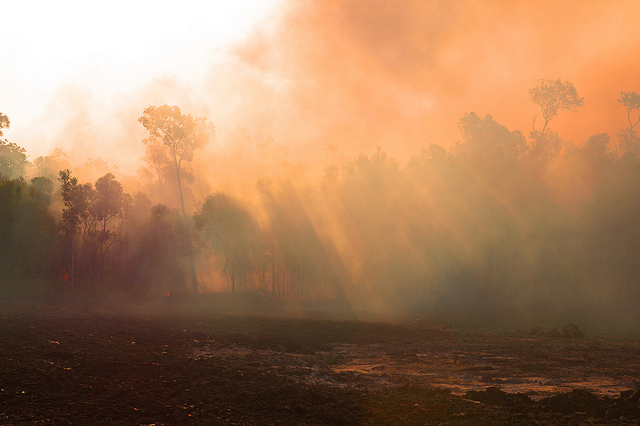
‘There is a common misconception that Australia has always had extreme weather so we should not be concerned now, but we are already seeing more forceful, extreme weather. Bushfires have increased in south-east Australia in the past 30 years, and we’ve just had our hottest 12 months on record. The evidence is absolutely unequivocal on the link. We know bushfire conditions are getting worse. We have to take the government on its word that it takes climate change seriously but there have been inaccurate statements made around extreme weather and it’s critical the public is provided the right information on these matters.’
The Abbott Government is positioning its environmental policies through an anti-science ideology. Economic growth is pitted against sustainable practices. Climate change becomes something to be rejected on the basis of personal belief. As I’ve noted previously, anti-science belief is a value-laden position, guided by pre-existing world-views and political affiliation.
Let’s now see the connection between climate change and extreme weather. My interest is on the sociological impact on community planning.
Scientific Consensus on Climate Change & Extreme Weather

The international scientific community agrees that extreme weather events “have changed in frequency and/or intensity over the last 50 years.” For example, the IPCC notes that cold weather and frosts “have become less frequent over most land areas, while hot days and hot nights have become more frequent.” The effects vary according to location. Heat waves have become more frequent in some places; heavy rainfall has increased in other areas; and extreme high sea level has increased.
The IPCC has produced a series of reports documenting the effect of climate change on extreme weather. Extreme weather produces increased vulnerabilities that climate scientists model so that we might plan for, and reduce, the risks (see here and here). The latest IPCC report for example looks at adaptations and vulnerabilities. The IPCC notes that the impact of extreme weather events depend not just on changing weather conditions but also on “exposure and vulnerability.” Socio-economic patterns, such as age, health, disability, location and education can impact on the ability of communities to prepare for extreme weather events.
Different world regions require different disaster management strategies and public health responses. In brief, these include:
- Australasia: addressing sea level rise, and reduced water availability in Southern states.
- Africa: adjustments in technology and infrastructure to improve ecosystems, basic health, and diversification of livelihood (such as to address food insecurity).
- Europe: coastal and water management, environmental protection and land planning.
- Asia: “development planning, early warning systems, integrated water resources management, agroforestry, and coastal reforestation of mangroves.”
- North America: municipal-level adaptation and planning and “longer-term investments in energy and public infrastructure.”
- Central and South America: ecosystem adaptation and conservation, community management, the development of resilient crops, strengthening climate forecasts, and “integrated water resources management.” (IPCC)
The IPCC further notes that the connection between climate change and extreme weather significantly impact sustainable development amongst local communities, with global consequences:
‘Climate extremes, exposure, and vulnerability are influenced by a wide range of factors, including anthropogenic climate change, natural climate variability, and socio-economic development… The interactions among climate change mitigation, adaptation, and disaster risk management may have a major influence on resilient and sustainable pathways.’
Misinformation has real consequences for how communities deal with and prepare for bushfires and other disasters. Why do Liberal Government policy-makers refuse to acknowledge the connection between climate change and extreme weather events?
Climate Change Denial as Ideology
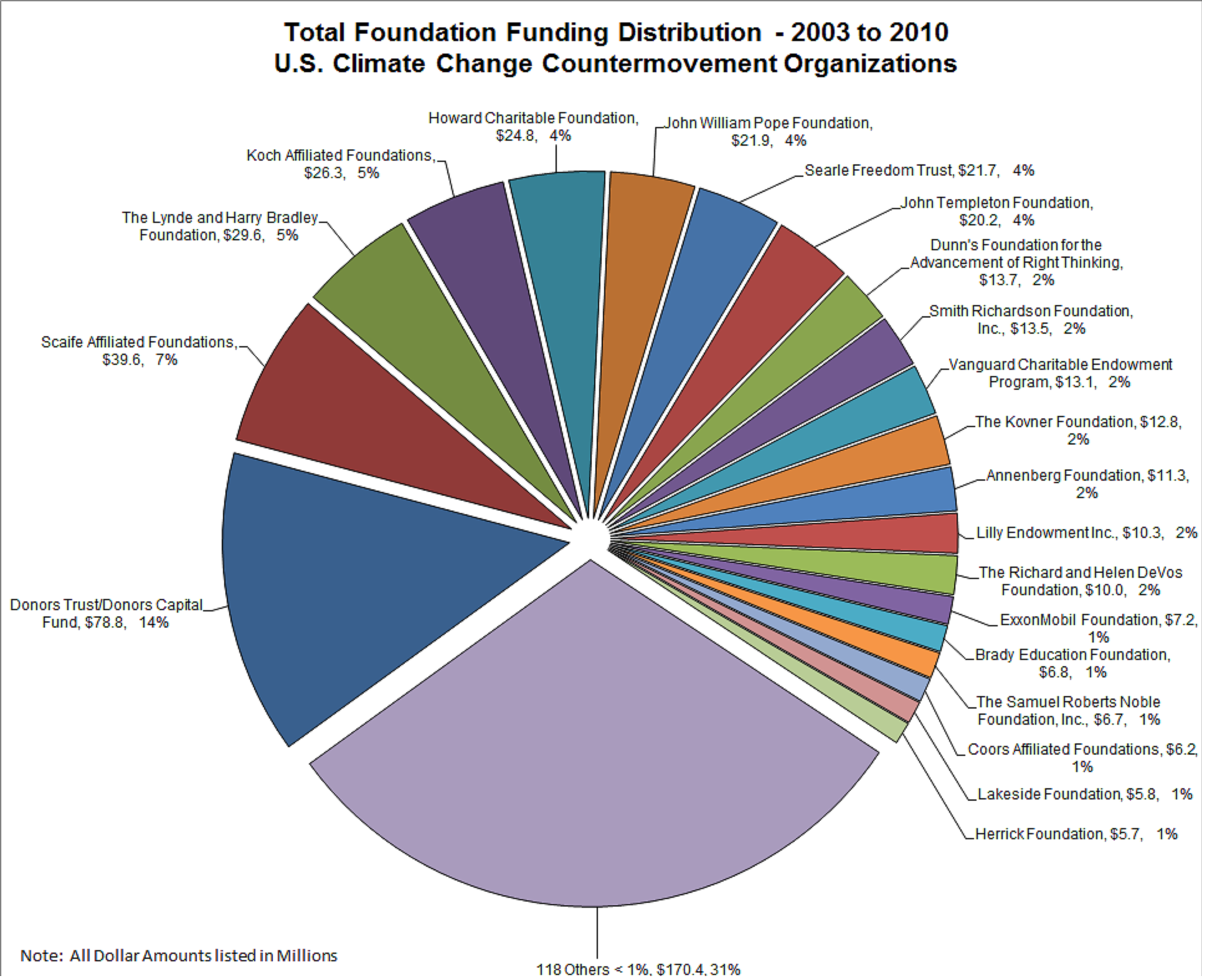
Environmental sociologist Robert Brulle has shown that climate denial propaganda is funded by fossil fuel companies (see below). He argues: “The debate over climate change involves a political and cultural dispute contest over the appropriate field frame that governs energy policy.”
Social scientists Lianne Lefsrud and Renate Meyer studied how beliefs about climate change are related to personal identities and professional interests. They surveyed 1,077 professional engineers and geoscientists in Alberta, Canada, who are also members of the professional self-regulatory authority in their region, the APGA. The study notes that the largest employer in Alberta is the petroleum industry. Their employees make up a hefty proportion of the APGA: “In oil and gas companies, almost half of CEOs are professional engineers or geoscientists and most senior management teams and boards have at least one licensed professional [who are members of APGA].”
In Lefsrud and Meyer’s study, the participants who dismiss the idea that climate change is impacted by human activity also argue that governments should not support national or international initiatives to target climate change. Specifically they were asked about the Kyoto treaty. The study was published in 2012, well ahead of the IPCC’s 2013 landmark international study on anthropogenic (human-caused) climate change.
The participants who oppose the idea of human-caused climate change fall into two groups (or “frames”). The economic responsibility group who believe we can never know whether climate change is caused by either humans nor by nature. The argue that climate change poses no significant personal risk to humans’ daily lives. They believe that climate policies should protect the economy. To put it another way, that climate policies should protect them and their employers. A typical statement cited in the study exemplifying this group: “Don’t we pay enough taxes as it is?”
The nature is overwhelming group believe that climate change is “natural” and unavoidable. They believe humans are insignificant in affecting nature. They make scientifically erroneous statements in the study such as, “‘If you think about it, global warming is what brought us out of the Ice Age.” The researchers write:
‘adherents of those frames that are more defensive and oppose regulation (‘nature is overwhelming’, ‘economic responsibility’) are significantly more likely to be more senior in their organizations, male, older, geoscientists, and work in the oil and gas industry. Adherents of these two frames comprise 33.7% of our respondents overall, but 63.3% of top managers in the oil and gas industry as opposed to 19.1% supporting regulation.’ [My emphasis]
Abbott and his Cabinet might be seen to embody these two frames of references. They reject climate change action on the basis of selective science, and economic concerns.
The IPCC propose a model of effective action that includes reducing exposure and vulnerability to extreme weather risks and increasing community resilience. A big part of resilience is public awareness about climate change and its impact on extreme weather. The idea that Australia has always had bushfires does not take into consideration our changing population over time, and how industrialisation impacts our landscape. The Government’s failure to educate on these shifting dynamics encourages citizens to be complacent about changing conditions in our environment. Now is the time for Government to take greater lead in encouraging communities to be ready for extreme weather shifts.
Discover more from The Other Sociologist
Subscribe to get the latest posts sent to your email.

 The Other Sociologist