

White supremacy is an ideology promoting the racial superiority of white people. One of the key ways white supremacy retains its power is through language that “naturalises” white dominance, making the current social order seem natural, normal, and logical. The recent editorial direction by the New York Times of how to refer to the “alt right” plays into white supremacist ideology, by sanitising its political aims and making its ideology more palatable.
Ideology is a set of beliefs, attitudes, and opinions that transmit central values, such as fascism. One of the ways that ideology is established is through hegemony: the cultural beliefs, ideas, and processes through which elite groups maintain domination. Hegemony is established through consent (that is, without the use of violence). For example, through the media and propaganda, the ruling classes define and redefine issues in ways that maintain the status quo.
Using hegemony, white supremacist language softens, expands, co-opts, and morphs according to social and political changes.
In recent decades, white supremacy has publicly moved away from explicitly racial language, to align itself with current political trends. In the USA, the Ku Klux Klan (KKK), and other “alt right” groups publicly distance themselves from the term “white supremacy,” preferring terms like “white nationalist.” They understand outright racist terms are both socially unacceptable, and that explicit references to white supremacy often leads governments to formally label and sanction these groups as terrorists. To avoid sanctions, white supremacist groups use new media to organise public marches and recruit new members, portraying themselves as a rights movement.
American sociology professor, David Cunningham, argues that “these actions are part of a long lineage of chequered efforts by the Klan to achieve public legitimacy” (my emphasis). He shows that even in the 1920s, the KKK used targeted public relations techniques, hiring two marketing experts to visit white communities, and sell their organisation as a solution to their problems. In the 1960s, as Black people made significant impact with civil rights, the KKK once again reshaped their image. Cunningham says:
“They were trying to be a new, respectable Klan. They would show up at [rallies and marches] in shirts and ties. They would say [the Klan was] not about race and racism and more about these other local problems.”
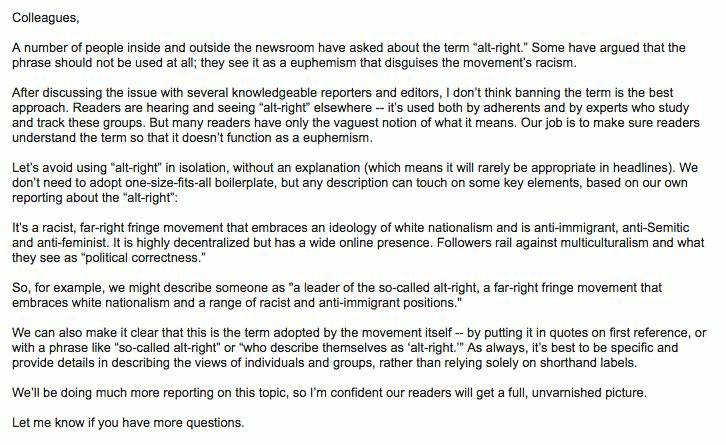
Now, The New York Times has issued an editorial direction to refer to the “alt right” as a “fringe movement.” The directions say the reference should be explained as “a far-right fringe movement that embraces white nationalism and a range of racist and anti-immigrant positions.” However, this term is exactly how neo-Nazi and other white supremacists groups have publicly rebranded themselves.
Even with qualifying an introductory sentence of them as a fringe movement, using the term “alt right” plays into the white supremacist agenda: legitimation.
The term alt right is set up as a corrective push-back (“solution”) to the perceived rising influence of the “left.” The latter is defined by detractors as “politically correctness,” a critique of over-correcting inequality, to the point where white men in particular are missing out on their imagined entitlements. American sociologist, Prof Michael Kimmel, calls this “aggrieved entitlement,” an appeal to the threatened masculinity of white straight men, who feel they are missing opportunities due to feminism, queer liberation movements, equity and diversity initiatives, and other progressive changes.
The linguistic pivot to “alt right” has been used as a hook by white supremacists to reel in more supporters, especially disenfranchised working class and lower middle class men.
The “alt right” label shoehorns itself on a political continuum, literally as an alternative to social justice movements, and therefore masquerading its political aims as equally valid. This position camouflages extremist positions, and glides over how white supremacy operates across both “left” and “right” politics.
To the New York Times audience, reading about the “alt right” makes stories seem more reasonable than if they were reading about neo-Nazis and white supremacists, even though all these phrases describe the same goal, simply re-packaged for different white audiences.
To not name a problem makes it harder to eradicate. White supremacy must be called by its proper name, not the white supremacist whitewashed rebrand currently being peddled.
Discover more from The Other Sociologist
Subscribe to get the latest posts sent to your email.


