
On Twitter, on 21 March 2017, celebrity chef Adam Liaw started a great conversation, by tweeting: “It’s #HarmonyDay so I want to be a bit frank about race.” Australia celebrates multiculturalism on Harmony Day annually, the same day as (the frankly more significant) International Day for the Elimination of Racial Discrimination. Liaw’s conversation was more aligned with this international event. Off the back of proposed changes to legal protections against racism, and two cases of racism in the arts and academia, it’s never been clearer, the importance of maintaining a sustained focus on proactively working to end racial discrimination.
Bill to amend racial protections
This year, Harmony / Racial Discrimination Day is marred by the Liberal Government announcing that they seek to strip away protections from the Racial Discrimination Act (Section 18C). The amendment to the Act seeks to implement less precise language of “harassment,” while removing protections against racial “offence”, “insult” and “humiliation.” Essentially, it will be even harder for Indigenous people and migrants to be protected against racial abuse.
Public supporters of the move to weaken the 18C law include right wing personality Andrew Bolt, who lost a racial discrimination law suit co-led by author and academic, Dr Anita Heiss.
Section 18C of The Racial Discrimination Act has been under threat for years. The following examples illustrate why these protections are necessary.
Racist cartoon and “free speech”
In August 2016, on National Aboriginal and Torres Strait Islander Children’s Day, Bill Leak published a cartoon mocking Indigenous fatherhood. This led to public condemnation by Aborginal and Torres Strait Islander organisations and other non-Indigenous commentators. But there was also a swell of support, including Leak’s editor at The Australian newspaper, who stood by the cartoonist.
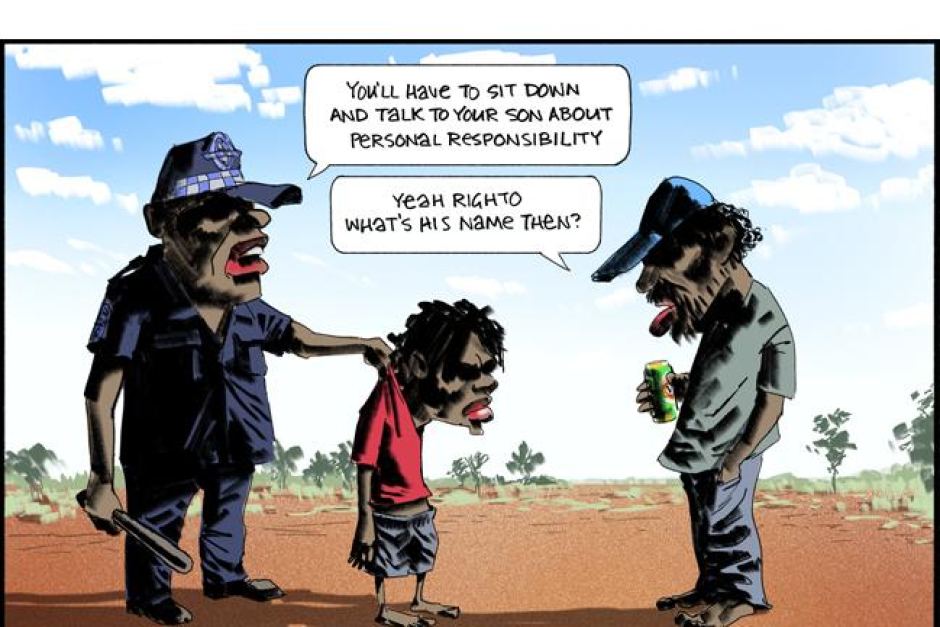
In October, a formal complaint was launched. Leak and The Australian were investigated for breaching Section 18C of the Racial Discrimination Act. Leak says his cartoon is a response to the Four Corners report on the abuse of children at the Northern Territory’s Don Dale detention centre (below), many of whom are Indigenous. The Four Corners investigation showed that staff are torturing and restraining children, however, that’s not Leak’s focus. His response demonstrates that he, like many people called out for racism, choose not to understand racism, when it suits them:
“I think 18C is an abomination. Look, I can only assume that a lot of people genuinely believe that freedom of speech means the legal right to hurl abuse. In fact, nothing could be further from the truth. Freedom of speech is what created our civil and free society. It is all about the exchange of ideas, about letting people express their views in the marketplace of ideas.
“I have been hammered with this [of racism] ever since the cartoon was published. But I honestly say to you that when the accusations of racism were directed at me, the only word I can use to express how I felt was just totally bewildered. I thought, how could anyone interpret it as racist? A lot of people obviously did. But I can only say what I was thinking when I drew it. My concern was for these children and I think right from the get go, even as a child, I think I have always been a very colour-blind person. A lot of these kids are coming from the most desperate circumstances. I thought to myself, well, it comes back ultimately to parents. We all know that’s true.
“But a lot of people would prefer to … I think a lot of people have got this idea that our Aborigines [sic] are sort of safely tucked away in remote communities and let’s face it, not many of us city dwellers venture out there and actually see for ourselves what’s going on.”
The complainant, a Western Australian white woman, Melissa Dinnisson, dropped the case in November, as she felt Leaks would be uncooperative. She additionally felt The Australian were hoping to use the case to campaign against 18C.
Workplace racism
In 2013, Cindy Prior, an Aboriginal woman working at Queensland University of Technology (QUT), informed three non-Indigenous students that they were in a computer lab designated for Indigenous students. They retaliated by posting racist comments on Facebook. She launched a racial discrimination case under 18C.
Earlier this month, on 3 March 2017, prior lost her case after four years of fighting. It was dismissed by the Federal Court, on the grounds it did not have reasonable prospects of success. The defendants were awarded $200,000 in costs against her. Prior sought to appeal the decision, but her request was denied. The case prompted the federal government to set up an inquiry into changing section 18C of the Racial Discrimination Act.
SBS reports that, last year, The Australian newspaper published 96 articles critiquing the Racial Discrimination Act, one third of which focussed on Prior’s case. These articles generated over 19,000 comments, including 26 opinion pieces.
Prior has received online threats and abuse, detailed in a 5000-page dossier provided to Australian Federal Police.
She has suffered mental health problems and cannot find employment as a result of the case and subsequent public abuse.
#FreedomOfSpeech
In this context of 18C under threat, and racism disguised as “freedom of speech,” Liaw shared various examples of racism he experienced throughout his life. He shared racial epithets that he’s been subjected to, as well as examples that sociology calls microaggressions (brief and subtle daily insults that denigrate people of colour) and everyday racism (the connection between routine interactions and structural racism). He says:
“I’ve had my accent (do I have one?) mocked THOUSANDS of times. I’ve been told to go back to where I came from THOUSANDS of times…
“The racism I worry about is systemic. It’s under-representation media, boardrooms, or the slightest inkling that kids with brown skin are less Australian than if they were white..”
Resharing Liaw’s thread, writer, Dr Benjamin Law, shared his own stories of racism, and encouraged other people of colour to do the same using #FreedomOfSpeech – referencing the democratic cloak under which 18C is being undermined.
“At the age of 10, I was at the local pool as a group of white boys held my head underwater, laughing at me for being Asian… Last week a white Australian said about a speech I gave, ‘You speak better English than me and I’ve been here all my life.’”
In response, many people of colour posted their own reflections of racist incidents they’ve experienced.
Weakening the Racial Discrimination Act is a troubling policy development. Unfortunately, it follows countless racist policies since invasion, which target Aboriginal and Torres Strait Islander people, and migrants. Our laws establish white supremacist ideology as the foundation of our nation; ideals which live on in the modern day.
Discover more from The Other Sociologist
Subscribe to get the latest posts sent to your email.


