In Episode Six of our Race in Society series, Associate Professor Alana Lentin and I focus on Policing the Quarantine. Our racially-driven criminal justice system has been an ongoing feature of colonialism, from invasion in 1788, to the present day. Since the 1991 Royal Commission into Aboriginal deaths in custody, over 434 Aboriginal and Torres Strait Islander People have died in police custody. Policing powers have been extended throughout the pandemic, and disproportionately target Aboriginal and Torres Strait Islander people and other people of colour. This includes the administration of fines, lockdowns, and curfews.
To help us to think through these topics, we are joined by three panellists. First, Roxanne Moore, Executive Officer of the National Aboriginal and Torres Strait Islander Legal Services (NATSILS), discusses police accountability. Second, Professor Megan Davis, Pro Vice-Chancellor Indigenous at the University of New South Wales and Professor of Law, provides insight on constitutional and human rights during the pandemic. Dr Vicki Sentas, Senior Lecturer in the Faculty of Law at the University of New South Wales, discusses racial profiling and police reform.
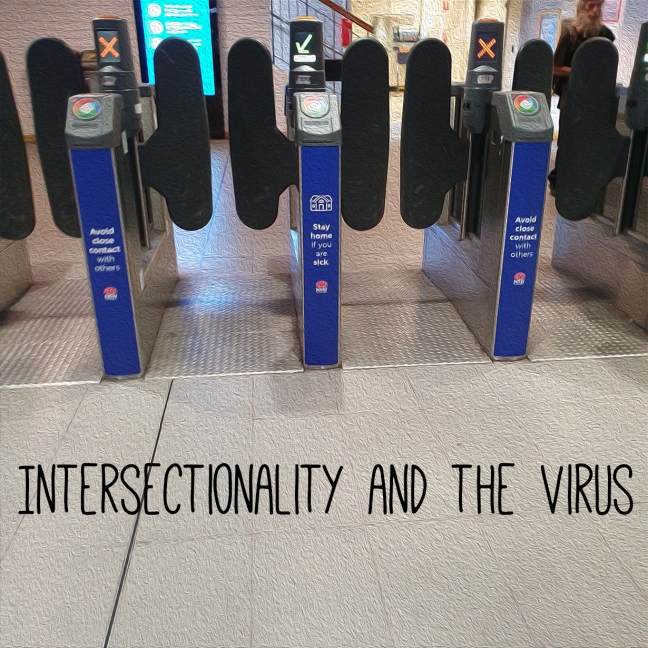
In Episode 5 of our Race in Society series, Associate Professor Alana Lentin and I lead a panel exploring the impact of race, gender, and socioeconomics on COVID-19, through a lens of intersectionality. Writing in 1989, Professor Kimberle Crenshaw showed that industrial law in the USA treated racial and sexual discrimination as distinct experiences. She showed that Black women experience both racism and sexism simultaneously, and so the impact of each is compounded. Professor Patricia Hill Collins and other theorists have also shown that, without using this term specifically, people in the Global South have used intersectionality as an analytical tool, since at least the 1800s, to grapple with the complexity of discrimination. In Australia, we look to the works of Professor Aileen Moreton-Robinson, such as her book, “Talkin’ Up to the White Woman,” which examines how white feminist research has established authority by mobilising whiteness and enacting power over Aboriginal women. Intersectionality is not an identity, but rather a way to understand power relations in society, as well as social inequality, by looking at the interconnections of social division, including race, gender, disability, sexuality, and class.
In the video below, we speak with Karl Briscoe, the Chief Executive Officer of the National Aboriginal and Torres Strait Islander, Health Worker Association (NATSIHWA). His organisation has been proactive in producing resources throughout the pandemic, from advice to Black Lives Matter protesters, as well as the Aboriginal and Torres Strait Islander Health Professionals Resource Toolkit. He discusses how intersections of race and health impact the work by Aboriginal healthcare workers. We then speak with Professor Karen Farquharson, who has studied race in Australia, South Africa, and the United States. She explores how ideas of whiteness are used to dehumanise Black people, and how this has led to disparate health outcomes during the pandemic. Finally, Dr Nilmini Fernando is a Postdoctoral Research Fellow at Griffith University and a scholar of Black and post-colonial feminisms. She discusses a gap in the domestic and family violence sector, with respect to how violence is measured and categorised. Specifically, its inadequate attention to intersectionality. She notes that, by focusing on colonial definitions of violence, women of colour are inadequately protected when trying to rebuild their lives during social isolation.


 The Other Sociologist