
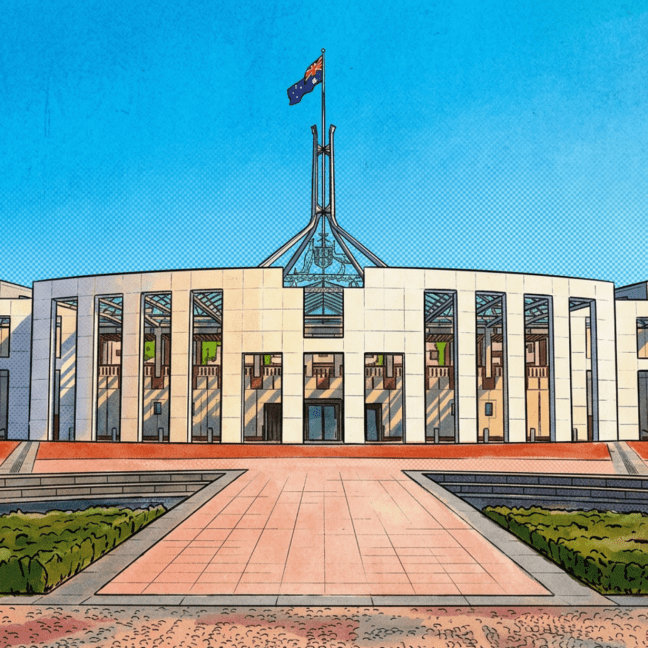
Politicians embody state power. They create laws and are elected to represent democracy, however, many of their decisions maintain racism and social inequality. In this sense, they personify institutional racism. A clear example is former Attorney-General George Brandis, who was one of the key drivers to amend 18C of the Racial Discrimination Act 1975. He worked alongside Prime Minister Malcolm Turnbull (considered a “moderate” Liberal politician), to weaken racial protections.
Section 18C of the Racial Discrimination Act falls under “Prohibition of offensive behaviour based on racial hatred.” This section says it is unlawful to act in a way that is reasonably likely to “offend, insult, humiliate or intimidate” a person because of their race, colour, nationality, or ethnicity.
The Australian Human Rights Commission notes that Australia has obligations to implement antiracism protections under the International Covenant on Civil and Political Rights (ICCPR) and the International Convention on the Elimination of All Forms of Racial Discrimination (ICERD). Sections 18C and 18D of the Act were introduced in response to the National Inquiry into Racist Violence (1991) and the Royal Commission into Aboriginal Deaths in Custody (1991). These inquiries found that racism and discrimination causes harm. Furthermore, the Australian Law Reform Commission report, Multiculturalism and the Law (1992), recommended the introduction of legislation to deal with racial hatred.
Read the full text of Section 18C
18C Offensive behaviour because of race, colour or national or ethnic origin
(1) It is unlawful for a person to do an act, otherwise than in private, if:
(a) the act is reasonably likely, in all the circumstances, to offend, insult, humiliate or intimidate another person or a group of people; and
(b) the act is done because of the race, colour or national or ethnic origin of the other person or of some or all of the people in the group.
Note: Subsection (1) makes certain acts unlawful. Section 46P of the Australian Human Rights Commission Act 1986 allows people to make complaints to the Australian Human Rights Commission about unlawful acts. However, an unlawful act is not necessarily a criminal offence. Section 26 says that this Act does not make it an offence to do an act that is unlawful because of this Part, unless Part IV expressly says that the act is an offence.
(2) For the purposes of subsection (1), an act is taken not to be done in private if it:
(a) causes words, sounds, images or writing to be communicated to the public; or
(b) is done in a public place; or
(c) is done in the sight or hearing of people who are in a public place.
(3) In this section:
public place includes any place to which the public have access as of right or by invitation, whether express or implied and whether or not a charge is made for admission to the place.
Section 18C, Racial Discrimination Act 1975 (Cth)
In 2014, Brandis had tried, and failed, to amend changes to this legislation.
The recent legislative changes proposed by the Liberal Government sought to replace the words “insult,” “offend,” and “humiliate” with “harass.”
Aboriginal and Torres Strait Islander organisations and antiracism experts argued that these changes would once again make it legal to discriminate against racialised, cultural, and religious groups. Over 50 councils lobbied Brandis to drop the amendments.
During his campaign for support of the changes, Brandis gave a speech in parliament stating that bigotry is a protected right. This is untrue, but it speaks to why he proposed these changes in the first place. Due to intense backlash, he later walked back this statement, saying he simply seeks to protect freedom of speech.
This is a frequent cover for racism and other forms of discrimination, as if hate speech is simply an opinion. However, as Kwame Ture (AKA Stokely Carmichael) famously noted, ‘White supremacy is not an attitude… it’s a question of power.’
The proposed changes were debated for three heated days, ending on the 30 March 2017. Various senators, all white people, presented false equivalences (“Why not religion; the height of a person…”), conflating racism with bullying (children being bullied for having red hair), to minimise the impact of racial discrimination. These politicians indulged in non-factual and dismissive references to “political correctness,” “alt-left ideology,” “a war against tyranny,” “political censorship,” Nazism, the Soviet Union, and the Holocaust. Senator David Leyonhjelm said migrant community leaders lobbying against the 18C changes are against “Australian values.” Senator Malcolm Roberts evoked a moral panic, suggesting racial protections are used to hide the criminality of Muslims. Senator Jonathon Duniam said only a minority of people are racist and so the laws are unnecessary. Three senators used racist slurs in their speeches: Eric Abetz, Barry O’Sullivan, and Senator Pauline Hanson. Hanson argued such terms are faced by all new migrants, implying racism is not a big deal, but more of a rite of passage.
Two senators (Hanson and Brandis) said they had experienced racism as white people. This is impossible, as racism is a system of racial inequality and discrimination, based on the belief that white people are innately superior to other groups.
There is no such thing as reverse racism. Nevertheless, Brandis listed examples of three senators who had called him a “white man,” which he falsely equates to racism. (See further below)
While the bill was marginally defeated 31 to 28, with the Coalition and some independents supporting the amendment, and Labor and the Greens opposed, this political rhetoric illustrates how whiteness works. White people in power do not like to be called white when they are reminded of their privilege, or when they are called out for their racism. Yet they racialise people of colour (both through slurs, and also by evoking stereotypes and moral panics). White people also use race in slippery ways. Migrants are un-Australian because they want human rights protection, but they are also a threat that need to be controlled (political correctness, ideology, tyranny, censorship), by taking away the imagined right to bigotry.
Read Brandis’ comments in full
“It is the crowning irony of this debate that those who champion section 18C have actually, in this very debate, attacked those of us who favour reform because of the colour of our skin.
“When, on Tuesday, I said that I did not believe that Australia was a racist nation, what did [Labor senator Catryna Bilyk] say by way of interjection?
‘Coming from a white man,’ she said.
“[Labor senator Malarndirri] McCarthy in her contribution said that I would not understand the issue because I was, quote ‘a white man growing up in Petersham’.
“And [Greens] Senator Di Natale said that this bill, quote ‘has everything to do with allowing a very small group of very privileged, largely older white folk in this place to be more racist than they might otherwise be’.
“Those remarks are, of course, deeply offensive and insulting.
“It is deeply offensive and insulting to me for Senator Bilyk and Senator McCarthy to suggest the reason that I support this bill is the colour of my skin.
“It is even more offensive to everyone in this chamber for Senator Di Natale to suggest that older white folk in this chamber support this bill so as to allow them to be, in his words, ‘even more racist than they otherwise might be’.
Source.
Discover more from The Other Sociologist
Subscribe to get the latest posts sent to your email.


