The Egyptian Revolution as a Spectacle for the West

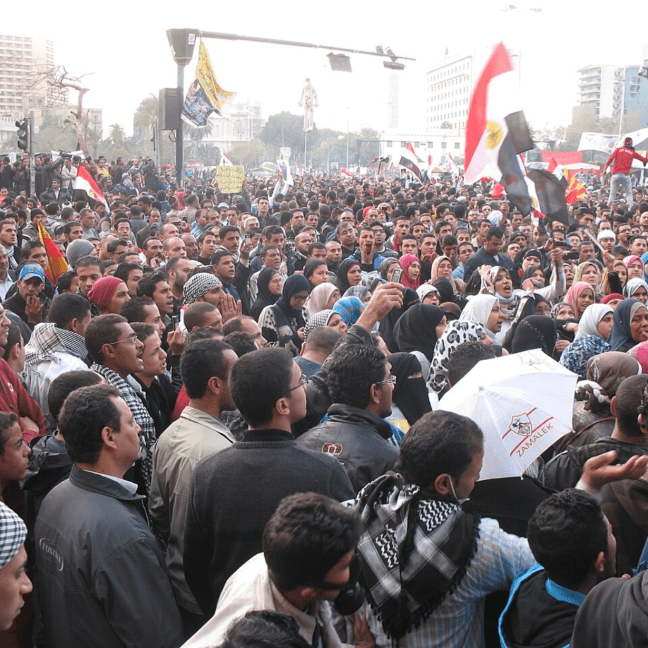
Egyptians hold flags and umbrellas in a protest

Julia Elyachar and Jessica Winegar have published a special edition of Cultural Anthropology on the Egyptian Revolution. Highlights include reflections on how the Revolution has impacted ethnography and anthropological writing and an exploration of the notion of martyrdom in the context of counter-revolution. My favourite piece is Mona Abaza’s critique of Western ‘academic tourists‘.

Abaza reports that she and her colleagues have been inundated with requests for research expertise, but without serious consideration of the ‘international division of labour’. That is, the resources, time, commitments and personal costs of lending knowledge and data to researchers from Britain and the USA who work in the safety of well-funded universities. Egyptians are hired as research assistants or translators, but their labour and subjective perspectives serve a Western reading of revolution. As a result, Abaza sees that Western academics have a tendency to discuss the Arab Spring through a lens of Orientalism.

Continue reading The Egyptian Revolution as a Spectacle for the West
The Wrap Up: Media Coverage of the 10th Anniversary of the September 11 Attacks

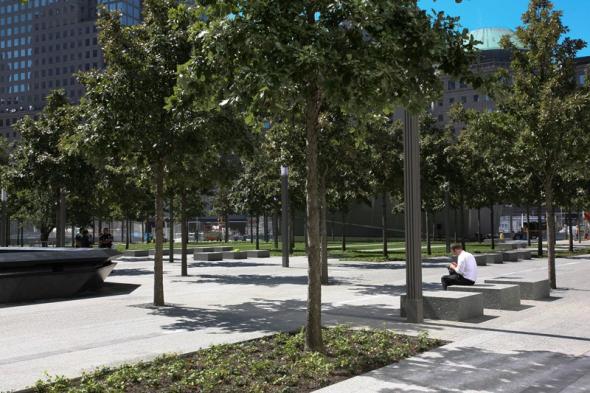
Image Credit: 9/11Memorial.org

This is the third and final post in a series covering the lead up to the 10th anniversary of the September 11 attacks. This one focuses on news coverage; technology and social media issues; and media discourses about the so-called ‘Decade 9/11’ and ‘Gen 9/11’.

Continue reading The Wrap Up: Media Coverage of the 10th Anniversary of the September 11 Attacks

Impact of the September 11 Attacks on Australian-Muslims

Image credit: Sailor Coruscant 2010 Im not even sure Flickr

This is the second post in a three-part series reviewing the media and research released in commemoration of the 10-year September 11 Anniversary. Without doubt, the ongoing trauma and health issues faced by the survivors of the September 11 attacks have high ongoing social costs for American society. This article focuses on the impact that the September 11 attacks had on the lives of Australian-Muslims. I was inspired by a SBS Radio vox pop with Muslim and Sikh Australians, which I will go on to analyse.[i] The people interviewed talked about how they managed the increased racism and stigma they have faced since 2001. Ten years after the attacks, studies show that a high proportion of Australians perceive Muslims as ‘outsiders’ who do not fit in with Australian society.[ii] My analysis shows that living with racism requires a lot of ‘emotion work’, particularly because Muslims mostly deal with racist encounters on a one-on-one basis.

Continue reading Impact of the September 11 Attacks on Australian-Muslims

Public Health Impact of the September 11 Attacks

Public Health Impact of the September 11 AttacksThis is Part One of a three-part series summarising some of the public discussions about the September 11 Anniversary. This one focuses on renowned scientific journal, The Lancet, which recently published a special edition on the ongoing health problems arising from the suicide attack in the USA and from the consequent ongoing War in Iraq.

The Lancet reports that in addition to the 3,000 people who died in the September 11 attacks in 2001, there has been a reverberating impact on the physical, mental and public health of over 200,000 Americans.I review papers on the health outcomes on the victims and the rescue crews who worked on the World Trade Centre site. I also discuss findings on the 43,000 suicide attack civilian casualties resulting from the Iraq war and a further 200 coalition soldiers. Finally, I include a brief review of the public health preparedness in the USA. Though this has drastically improved since the September 11 attacks, the ongoing economic crisis remains a challenge.

Continue reading Public Health Impact of the September 11 Attacks