The discipline of sociology has grappled with several overlapping issues regarding the purpose and utility of our profession beyond its intellectual pursuit. Debates about the social impact of sociology have been historically centred on three questions relevant to applied sociology – which I define here as sociology conducted outside universities for particular clients. These questions are: sociology for what?; sociology for whom?; and sociology for where? In today’s post, I will discuss the who, what and where of sociology, before introducing a fourth question that is so taken-for-granted we don’t spend much time talking about it in any concrete way. That is: how do we actually do sociology outside traditional academic research? We assume sociologists can go out into the world and apply their training to different problems. But what kind of problems do we work on and how do we actually carry out the work in different places? I argue that applied sociology is set up as the “other” of academic sociology because of the context in which we practice our craft. This stops sociologists from engaging with one another effectively, and hinders the transformational work we do separately with our respective audiences.
I seek to build upon the framework discussed in this post for a series exploring the practicalities of doing sociology outside academia. I hope that the ideas explored here and in future posts can open up dialogue about how to better address collaboration between academic and applied sociologists.
Last month, The New York Times gave a disheartening insight into Google’s Executive hiring practices. Google is predominantly staffed with young men,* and they have trouble hiring and retaining women. Google turned to its “famous algorithms” to work out why this was the case, developing spreadsheets to help address the matter. In Google Executive land, it seems, engineers and computer scientists are characterised as “guys” who are proactive in advancing their careers, while women are seen as failed “business” people who don’t ask for promotions. Google has taken some measures to address their hiring practices, but its Executives seem to accept that their gender imbalance (30% women to 70% men) is unlikely to change much. While I focus on Google as a case study, my analysis deconstructs the flaws in the gender logic that large companies have about workplace inequality. Studies find that it is not the fact that women do not ask for promotions that impede their career progression; nor is it simply the decision to exit the workplace to have children. Instead, empirical data show that when employers are faced with equally qualified and experienced candidates who put in the same amount of work and who have the same outcomes, they are more likely to hire, promote and remunerate men over women. I argue that there is a resistance in workplaces to understand how their organisational practices are structured in ways that impede women from thriving professionally.
Gender imbalance and inequality are not inevitable. These are the outcome of daily interactions, organisational practices, policies, and unexamined norms and values. Sociology can help workplaces address gender inequalities by taking an organisational approach to gender. Such a framework makes gender biases visible and involves everyone in addressing inequality – not just women, but people of all genders, as well as the Executives who hold ultimate power in organisational change. Continue reading Google’s Glass Ceiling: A Case Study of Why Organisations Lose Innovative Women
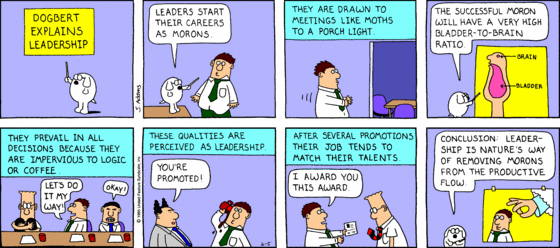
Ever heard someone complaining about how people in management roles do not work as hard as those in less senior roles? Years ago, a friend told me that people are promoted to the highest level of their incompetence. This is otherwise known as the Peter Principle, Laurence Peter and Raymond Hull’s satirical view of organisations, as laid out in their 1969 book of the same name. Or as this comic explains, The Dilbert Principle, works just as well.
This 1969 Time Magazine review describes the Peter Principle through the theory of hierarchiology, which is the ‘the study of hierarchies in modern organisations’. The last tenet is: ‘Final Placement Syndrome… [or] what the ordinary sociologist calls “success”‘. Funny stuff.
The Peter Principle (PP) has longevity. The video below explains how this humorous principle has more serious applications for American governance. The PP is apparently relevant to the modern day business world and in management. It’s been used to critique the Former USA Federal Emergency Management Agency director Michael Brown’s handling of Hurricane Katrina. Physicists have created computational models to study the PP.
Though it was conceived as a satirical application of social scientific analysis over four decades ago, the Peter Principle continues to have useful resonance to serious critiques of organisational hierarchies. The PP simplifies bureaucracy, organisational structures and status in a way that Karl Marx, Max Weber, Talcott Parsons, Peter Blau and most other social stratification and organisational sociologists may object. Nevertheless, the PP offers an engaging starting point from which to begin unravelling public dissatisfaction – and misunderstanding – of organisational structures.
My opening anecdote was about my friend being frustrated over what they perceive is an unfair, non-merit-based system of promotions in their workplace. This frustration stems from a subjective perception about what knowledge, skills, experience and leadership traits should be rewarded. Subjective perceptions about what is fair, what makes a good leader, and what types of professional competencies are necessary in middle and upper management are going to vary from one organisation to the next, from one society to another, and in different points in time.
Satire and Sociology
The examples I provided about the PP being applied to governance, businesses, natural disaster responses and even computational models by physicists show that the PP provides a way to frame critical analyses of organisational hierarchies. In an earlier post, I reflected on Duncan Watts‘ point that sociologists need to show society our disciplinary strengths – one of which is that we are trained to go beyond ‘common sense’ understandings of the world. My argument was that sociologists still have a long way to go in showing the utility of sociology to wider publics. In the case of the PP, I’m all for starting off with satire and drilling in deeper.
I see that applied sociology is about making sociological insights useful in achieving practical outcomes for particular groups in society. I also believe that we need to do this in easy to understand language rather than relying on sociological jargon. Using comedy, satire and examples that people can relate to are all useful tools to this end. So I say: viva la PP!


 By Zuleyka Zevallos