Despite dire predictions, researchers forecast that few industries will lose a substantial number of jobs due to artificial intelligence (AI). Instead, AI is more likely to alter the way humans work. The AI industry may also create new roles, but this may amplify inequality. In this third post in my Sociology of AI series, I explore the perceived impact of AI on jobs, and the stratification that may follow increased automation of the labour market. I analyse evolving policy directions, including a new report by Jobs and Skills Australia, on AI-related job losses. I then review sociological understandings of AI and work, and recent examples of job redundancies. I analyse a much-publicised study by Microsoft, which claims AI can replace 40 professions, including translators, historians, artists, and customer service workers. This case study shows that AI companies distort evidence to overstate the functions, utility, and accuracy of AI technology. I argue that AI discourse hinges on eliminating competition from human professionals. Sociology uncovers the ways in which scientific models and customer data are used to make unethical and spurious claims.
In this second post in my Sociology of AI series, I show that AI companies position automation as being superior to human labour. I review the Australian Government’s recent announcement that is considering changing the law to allow AI to mine copyrighted works. I will show that the economic model used to justify this decision lacks robust testing. I analyse the ways in which AI discourse is ‘manufacturing consent’ to control the labour market. I argue that AI discourse establishes economic power by marketing technological supremacy, using science selectively, eliminating competition, and suppressing issues that undermine AI domination.
This is the first in a series of posts exploring the sociology of artificial intelligence (AI). I cover definitions of AI, before exploring sociological issues of public awareness, ethics, and regulation. I discuss how AI models replicate race, class, and social inequality. I show why First Peoples’ leadership must be central to the development AI policies. I discuss how sociology can address structural change and ethical use of AI. The rest of this series will examine how AI may transform work, and how AI companies are using customer data to grow their market dominance and policy influence.
I have published two new book chapters. In ‘Critical Race Studies and Intersectionality Responsesto COVID-19,’ I provide practical guidance for educators and researchers on how to apply insights from the webseries, Race in Society. The series featured First Peoples scholars and practitioners, and other people of colour researchers discussing issues of race and the pandemic. In ‘Race at Work Within Social Policy,’ I analyse how anti-racism and intersectionality work is co-opted and suppressed in social policy. Read about both chapters below, including where to order the books and upcoming events.
This post explores how race and class impact media discourses of public health during the COVID-19 pandemic. Media reports have selectively focused on migrants and working class people linked to specific infection chains. Race and class are absent from media narratives involving white, middle class, and wealthy people, even when these events account for high rates of infection and trangression of COVID-19 rules. This analysis shows how inequality is reproduced and normalised through institutions, such as the media.
It’s been a long while! Over the past couple of months, in my paid work, I’ve been co-leading a large randomised control trial in public health. Hoping we can publish results in the new year. Our team is also busy researching issues of technology and safety. In my personal research, Associate Professor Alana Lentin and I wrapped up series 1 of Race in Society. We covered media representations; the lockdown and ableism; intersectionality; policing; and economics. I’ll bring you write ups of other episodes soon, or head to our YouTube to watch the videos.
In case you missed it, here are two interviews I gave earlier in the year, on the sociology of COVID-19. Unfortunately, the topics of moral panics and misinformation remain relevant.
In Episode Seven of our Race in Society series—the final episode of season 1 on “Race and COVID-19″—Associate Professor Alana Lentin and I are joined by two guests to discuss The Economics and Social Costs of COVID-19. We examine the impact of the COVID-19 crisis on undocumented migrant workers, whose labour is being exploited.
The economy depends upon the work of racialised people, exposing them to higher risk due to casualised frontline services, which have kept the health system and other businesses going throughout lockdown. At the same time, racialised people are provided inadequate protections against infection, including poor personal protective equipment.
Our first guest, Sanmati Verma, is an Accredited Specialist in Immigration Law. She discusses the legal issues faced by temporary visa holders and migrants, as they lack access to economic security. Our other guest is Professor Sujatha Fernandes, who is Professor of Political Economy and Sociology at the University of Sydney. Her research explores the uses and misuses of storytelling to shape understandings of the political activism of racialised people. She discusses how “curated storytelling” narrows the public’s engagement with economic rights during the pandemic.
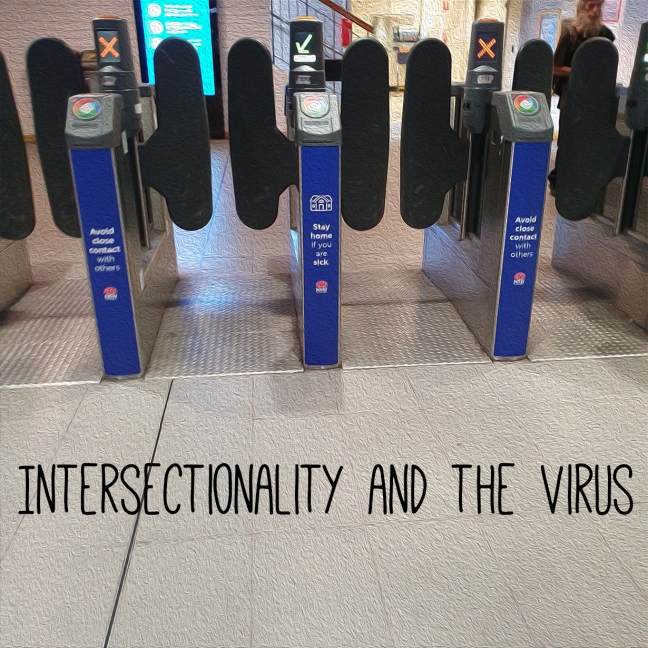
In Episode 5 of our Race in Society series, Associate Professor Alana Lentin and I lead a panel exploring the impact of race, gender, and socioeconomics on COVID-19, through a lens of intersectionality. Writing in 1989, Professor Kimberle Crenshaw showed that industrial law in the USA treated racial and sexual discrimination as distinct experiences. She showed that Black women experience both racism and sexism simultaneously, and so the impact of each is compounded. Professor Patricia Hill Collins and other theorists have also shown that, without using this term specifically, people in the Global South have used intersectionality as an analytical tool, since at least the 1800s, to grapple with the complexity of discrimination. In Australia, we look to the works of Professor Aileen Moreton-Robinson, such as her book, “Talkin’ Up to the White Woman,” which examines how white feminist research has established authority by mobilising whiteness and enacting power over Aboriginal women. Intersectionality is not an identity, but rather a way to understand power relations in society, as well as social inequality, by looking at the interconnections of social division, including race, gender, disability, sexuality, and class.
In the video below, we speak with Karl Briscoe, the Chief Executive Officer of the National Aboriginal and Torres Strait Islander, Health Worker Association (NATSIHWA). His organisation has been proactive in producing resources throughout the pandemic, from advice to Black Lives Matter protesters, as well as the Aboriginal and Torres Strait Islander Health Professionals Resource Toolkit. He discusses how intersections of race and health impact the work by Aboriginal healthcare workers. We then speak with Professor Karen Farquharson, who has studied race in Australia, South Africa, and the United States. She explores how ideas of whiteness are used to dehumanise Black people, and how this has led to disparate health outcomes during the pandemic. Finally, Dr Nilmini Fernando is a Postdoctoral Research Fellow at Griffith University and a scholar of Black and post-colonial feminisms. She discusses a gap in the domestic and family violence sector, with respect to how violence is measured and categorised. Specifically, its inadequate attention to intersectionality. She notes that, by focusing on colonial definitions of violence, women of colour are inadequately protected when trying to rebuild their lives during social isolation.
In Episode 3 of Race in Society (video below), Associate Professor Alana Lentin and I lead a panel about how mainstream media create sensationalist accounts of the pandemic, and the proactive ways in which Aboriginal people and Asian people in particular lead their own responses. We spoke with Dr Summer May Finlay, a Yorta Yorta woman and Public Health Researcher at the Universities of Wollongong and Canberra. In our video below, she details how Aboriginal community controlled health organisations have effectively dealt with COVID-19 using social marketing campaigns. We also chatted with Dr Karen Schamberger, an independent curator and historian. She covers the history of Australian sinophobia (the fear of China, its people and or its culture), and how anti-Chinese racism plays out in media reports on racism and the COVID-19 pandemic.
Media and officials continue to blame racial minorities in a way that does not feature for white-majority communities, some of whom are boldly defying the lockdown. Why does this happen? Our Race in Society series provides broader cultural and historical context.
In Episode 2 of Race in Society, Associate Professor Alana Lentin and I are joined by Jill Gallagher, Chief Executive Officer of the Victorian Aboriginal Community Controlled Health Organisation (VACCHO), who are leading COVID-19 pandemic responses in Victoria. She discusses how the pandemic amplifies existing health and social inequalities. Also on the panel is sociologist, Professor Aileen Moreton-Robinson, who is Professor of Indigenous Research at RMIT University, and author of countless critical race books, including, ‘The White Possessive‘. She demonstrates how her theorisation of Aboriginal sovereignty disrupts how the pandemic is currently understood. Finally, we also speak with sociologist Dr Debbie Bargallie, Senior research fellow at Griffith University, and author of the excellent new release, ‘Unmasking the Racial Contract: Indigenous voices on racism in the Australian Public Service.’ She talks about how Aboriginal people are excluded from social policy, which has compounded poor decision-making on public health during the pandemic.







 The Other Sociologist