LGBTQIA Inclusion at Work

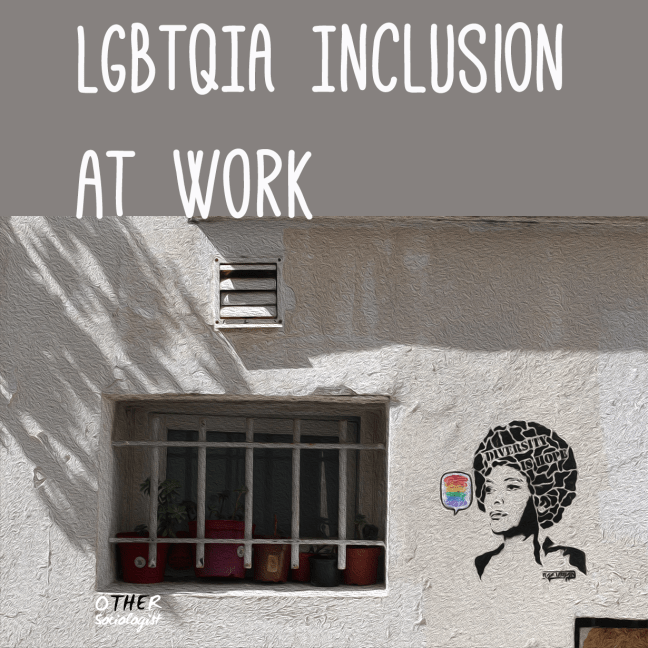
A window with bars and a wall with a stencil of a Black woman's face. Text reads: LGBTQIA inclusion at work

Ending discrimination against gender and sexual minorities requires major social transformation. Institutional change is paramount. As you keep fighting to make your organisation accountable, here are three small but impactful things you can do at your workplace to end this form of discrimination.

Continue reading LGBTQIA Inclusion at Work

Heterosexism in a Scientific Study of Lesbian Attraction

a White woman, shot only from the upper torso, holds candles arranged in the colours of the LGBTQIA or pride flag

An evolutionary psychology study that gained much media attention in May 2017 claims to show women’s sexual attraction to other women is the outcome of evolution, specifically for the pleasure of heterosexual men. The study was reported widely as ‘homosexual women evolved for men’s pleasure.’ Journalists have not read the study nor linked to it. The study is published in the journal Personality and Individual Differences. The study is led by Associate Professor Menelaos Apostolou. The team is based at the University of Nicosia, with apparently only one woman co-author.

Here, I show why the study is flawed and why the conclusions are premised on dangerous heterosexism. Heterosexism is the prejudiced belief that heterosexuality is ‘natural’ and ‘normal,’ and that heterosexuality uniformly structures all aspects of social life.  Heterosexism also presumes that gender is a binary (there are only two groups, men or women), and excludes the lived experiences of transgender people. Heterosexism brings to light the social construction of sexuality, and in this case, the values and social dynamics that impact on what is taken-for-granted about heterosexuality.

I focus my discussion on cisgender heterosexual and homosexual people as the authors of the study have presumed men and women can either be homosexual or heterosexual, to the exclusion of other gender and sexual identities. They have done this without explicitly saying so (it is a facet of heterosexism to reinforce binaries, because variations of sexuality disrupt the idea that heterosexuality is natural and normal). Experiences for transgender lesbians would vary, however, the authors presume a gender binary in thinking about lesbian desire.

With these cautions in mind, let’s dive into the study.

https://twitter.com/OtherSociology/status/868139704226635779

Continue reading Heterosexism in a Scientific Study of Lesbian Attraction

Interview: Queer People of Colour, Racism and Dating

A Black man hugs a White man from the back with another man hugging them from the side

I was interviewed on Triple J ‘s ‘The Hook Up‘ program (listen from 1:12:49) about sexual racism in queer communities.

Nat Tencic: We’re talking about racism and the experiences of queer people of colour in dating. And to answer some of those more big picture questions, like why are we seeing this internal minority struggle, we’re joined right now by sociologist, Dr Zuleyka Zevallos. She specialises in issues of gender and sexuality, culture, discrimination and diversity. Dr Zevallos, welcome and thank you for joining us.

Zuleyka: Hi. Thanks for having me.

Nat: I think that first big picture question is something that really interests me: why do we see this happening in the queer community? Why when you’re already discriminated against do you see that next level of discrimination come through so loudly?

Zuleyka: I think for some people it seems counterintuitive because, obviously, queer communitites are facing discrimination along sexual lines. But at the same time, all of us live in the same society that is dominated by whiteness. We have a long history of discrimation against Indigenous communities and against migrant people, especially migrant people of colour. When we look at it in a social context, LGBTQIA communities are surrounded by the same social influences when it comes to race, [same] as straight people.

Continue reading Interview: Queer People of Colour, Racism and Dating

Rethinking Gender and Sexuality: Case Study of the Native American “Two Spirit” People

Sociology and anthropology have long used the experiences of “third sex” cultures, such as the Native American Two Spirit people, to teach students about the social construction of sex and gender. In many cultures around the world, people are allowed to live their lives beyond conventional binaries; they need not adhere to the biological sex they were born into. These people are usually revered and there are special circumstances where individuals are allowed to shift their gender position. These groups, including the Two Spirit people, are used as examples in the sociology of Lesbian, Gay, Bisexual, Transgender, Queer and Intersexual (LGBTQI) issues. Recent scholarship, however, has questioned this practice, demonstrating that social scientists are applying Western concepts to misunderstand the Two Spirit phenomena.

Continue reading Rethinking Gender and Sexuality: Case Study of the Native American “Two Spirit” People

The “Cult of the Clitoris”: Policing Women’s Sexuality in England During WWI

By Zuleyka Zevallos

Cult of the ClitorisThis story is engrossing: Maud Allan was a Canada-born dancer who found fame in Germany in the early 1900s. She performed in the Oscar Wilde play, Vision of Salome, famous for “the dance of the seven veils.” When Allan was in her 20s, her brother was executed for killing two girls. She changed her name to escape this notoriety but later found herself the subject of infamy, drawn into a litigation case defending her name against charges of “sexual perversion.” Allan’s artistic sensuality and the fact that she was a lesbian were weaved into a conspiracy plot involving the highest office of British parliament. The Daily Mail recently reported on Allan’s life as a new play is being produced in San Francisco which is based on this salacious court case.

Allan’s story makes an excellent historical case study of the criminalisation of femininity and homosexuality in Britain at the end of World War I. I discuss the contradictory meanings of Allan’s dancing and her embodiment of the character Salome, a figure that has come to represent the dangerous qualities of female heterosexuality. The cultural significance of Allan’s dancing and her court case takes on multiple meanings in light of Allan’s reality as a lesbian woman in the 1920s.

I use Allan’s story to examine the history of the clitoris and its cultural mystique in relation to cis-women’s* bodily experiences of pleasure in connection to dancing and sex. Continue reading The “Cult of the Clitoris”: Policing Women’s Sexuality in England During WWI