In case you missed this on my other social media, in January 2019, Lady Science published a podcast about my career and feminism. I was interviewed in late 2018 by Leila McNeill, one of the editors-in-chief. Below is an excerpt where you can learn a little about my professional history. I discuss how racial minority sociologists are challenging knowledge production in our field. I show how the concept of otherness is feeding the overt political resurgence of White nationalism. Then I cover the importance of intersectionality in sociological practice.
<!–more–>
Z. Zevallos: Yep, so my name’s Zuleyka Zevallos. I’m a sociologist, and I’ve got a PhD in sociology. I started off doing research on the intersections of identity from migrant background women. I was really interested in how their experiences of gender, sexuality, ethnicity and also religion made their sense of identity, and how that also interconnected with their experiences of racism and multiculturalism, and how all of that affected their sense of belonging to their communities, as well as broader Australian society.
Z. Zevallos: After I finished my PhD I’ve been teaching the whole way through, and then I was an academic for a little while. I taught the sociology of gender and sexuality as well as leading courses on ethnicity and race. I also looked at the impact of technology on society…
Z. Zevallos: I spent the first few years working with an interdisciplinary social modelling team. That was a really great experience because it really taught me different applications of sociology, but also how to speak to scientists from the natural and physical sciences, from computer sciences, and how to blend their disciplines with mine.
Z. Zevallos: After that I have done quite a lot of different things. I tend to be a very passion-oriented, very project-based, so I’ve done things like … I led a research team working on an investigation looking at health and safety issues in the workplace for emergency service workers who had contracted high rates of cancer in Country Victoria.
Z. Zevallos: I’ve also worked with a couple not-for-profit organisations looking at gender equity in STEM, as well as gender violence and domestic and family violence against women and their children. That leads me to the present day where I’ve come back into public service.
Z. Zevallos: Now I’m working with a behavioural science team. We’re looking at, essentially, how to use social sciences, behavioural sciences, to improve services, programs and social policy. My areas have been working with vulnerable people, as well as the educational and employment outcomes of vocational students – so apprentices and trainees.
What is sociology?
Sociology is the study of society
Leila: Awesome. I guess people might have an idea of what sociology is based on what you were just talking about, but if you could give a brief explanation of what sociology is.
Z. Zevallos: Sure. Sociology is the study of society, but more specifically we look at how social structures shape people’s sense of belonging as well as experiences of inequality and power.
Z. Zevallos: We’re really looking at the nexus between personal biography, history, and culture. There are other social sciences that will look more at the individual in terms of their personality or group interactions. That’s an aspect of psychology for example, whereas we look at individuals in their social context, so we’re looking at how societies are organised across time and place, and how individuals are making choices within that context.
Z. Zevallos: Most people will have a sense that their lives are very unique, which of course every individual’s understandings of their own lives is going to vary, and it’s informed by them, families, just their own experiences growing up and whatever’s happening to them at the time, however sociologists are able to look at the broader social patterns that informs the social behaviour of individuals.
Z. Zevallos: For example, we tend to feel like when we’re making choices they’re very intimate, they’re very personalised, but at the same time sociologists are able to show that there are patterns in this behaviour when we’re making decisions, whether it’s something like our finances or our families or our personal health. All of that is socially influenced, even when we’re not conscious about those influences.
Z. Zevallos: Sociology’s about unpacking what we take for granted, about everyday life. We’re looking at things like culture, to non-verbal cues, to looking at how people can resist social dynamics or how they go along with particular trends that are set up by social institutions.
Z. Zevallos: We’re also looking at some of those bigger influences, like institutions like the media, education, as well as social dynamics like class, race, gender, sexuality, and so on.
Racism in sociology
Racism
Leila: Like most scientific fields, sociology has historically been predominantly white and male to the exclusion of women of color, and to a lesser extent white women, and also of course, racial minorities, sexual minorities, so many others. How has this exclusion shaped the field?
Z. Zevallos: Yeah, this is a question that I and many other minority sociologists think a lot about. One of the things that’s distinct about sociology compared to a lot of other sciences is that we’re not just founded to observe document and understand social phenomena. We’re actually set up from the beginning to transform society.
Z. Zevallos: Our discipline is about driving social change, fighting inequality. We do say our charge has really been about shaping better outcomes for other people. We’ve developed these really important ways to think about and promote social justice, but at the same time sociology does suffer from the same afflictions as all the other social sciences, physical and other sciences, and the natural sciences as well.
Z. Zevallos: The fact is that sociology was founded by White men operating from Western European traditions, and our founders did work very deeply engaged with how sociology needed to be applied outside of scholarly racial, so that we could affect policy and lay public change.
Z. Zevallos: At the same time, there’s been ongoing work since the beginning by Black, Indigenous, and other people of color across the world who took up sociology, however our work has generally pushed the periphery of our discipline. Even if we look back to the early 1900s with the Black American sociologist, Du Bois, who was thinking about the double consciousness of Black Americans or even to the present day works of Professor Aileen Moreton-Robinson who was looking at Aboriginal women’s challenges to White feminism.
Z. Zevallos: We’ve always had minority sociologists who have challenged the way that we look at social problems, what it means to be a sociologist and how sociology needs to be undertaken.
Z. Zevallos: I guess what we do, minority sociologists, whether ethnic racial minorities, or sexual minorities, gender minorities, we’re really trying to question whose interests are being served by the way in which sociology’s being positioned.
Z. Zevallos: We’re looking at questions like who leads the research. What examples are being used in our textbooks in classrooms? Who’s being cited? Who’s not being cited? Whose work is funded and why? How are research and policy questions being framed?
Z. Zevallos: Were really using, I guess the tool of sociology to question the way in which White, male-dominated frameworks are being used by our colleagues. Even though sociologists really place quite a lot of emphasis on reducing inequality, one of the things that minority sociologists try to do is to encourage White sociologists and people in dominant groups to turn the sociological gaze to themselves. Sociologists are very good at doing that for other groups and we tend to not do it very well for ourselves as practitioners…
Z. Zevallos: A lot of us are very committed to decolonizing sociology, so unpacking how colonial history has impacted the way in which we think about knowledge and our methods…
Otherness
Zygmunt Bauman on Otherness
Leila: I wanna talk a little bit about how otherness functions in sociology, and how it functions in your work specifically. Your blog is titled The Other Sociologist, so I know that it’s pretty integral to what you do.
Z. Zevallos: Otherness has always been a theme in my thinking and in my interests from when I was actually still very young. My blog is … it always has a central factor on otherness because it’s a way to push us to always think about who’s, I guess, how social relationships and dynamics are framed. I guess to take a step back, the concept of otherness is a way to think about how different social relationships are set up as oppositional forces.
Z. Zevallos: There’s been a lot of work from Simone de Beauvoir to Zygmunt Bauman and other theorists who have tried to capture the way in which we as a society categorise difference. Otherness is about these dichotomies where the primary reference point, so it might be man, is set up as having more power than the secondary social identity.
Z. Zevallos: The opposite of man might be woman for example. The second reference point is being degraded, is being oppressed, and that first social reference point is the one that becomes the norm, the one that’s seen as universal. If woman is the other of man, then stranger is the other of native, enemy is the other of friend. It’s them versus us.
Z. Zevallos: That’s what the concept of otherness is really trying to get at. It’s an important concept because it has applications in every social realm we could think about. The work on the sociology of gender for example, otherness allows us to think about how humanity’s being defined as being male throughout history.
Z. Zevallos: It’s men who define what it means to be both a man, and what it means to be a woman. Women don’t really have a value other than being a reference point for men. Women regarded as not being autonomous. Women are being defined and differentiated in reference to men. Women are basically not essential. Women are subjects. Women are different, less than, other to men.
Z. Zevallos: It’s important in bringing out ideas of power as well, so otherness is about how if we have one group, in terms of race it might be white people, a group of people who are dominant either in numbers or dominant due to their resources and social standing. Their identity becomes naturalised. It’s just taken for granted.
Z. Zevallos: Others, people who don’t conform to that ideal, who can’t belong to that dominant group, they tend to be punished. They tend to be seen as not worthy of the same respect. Otherness is also important in showing us who owns material wealth, who owns symbolic power in society.
Z. Zevallos: Symbolic power are things like the benefits that we get through our social networks. Otherness is important in thinking about how social institutions reproduce, who is the ideal versus the other. Media, education, religion, tend to have particular representations of who is the authority, and then everybody else is subservient to that ideal group.
Z. Zevallos: In terms of racism, basically a group of people who will always have more power than other groups, even if they as individuals feel like they’re not particularly powerful, and again in a Western country it might be White people. Certainly that’s the case in Australia, United States and other colonial nations. There’s a lot of power that comes with being the group that is never going to be defined as the other, as different, in Australia, which are very reminiscent of ongoing characterisations of race, in the United States and in the U.K.
Z. Zevallos: For example we’re really seeing these resurgence of White nationalism. We’re seeing a senator who tried to bring in a motion of … literally says that they wanted to discuss that ‘It’s okay to be White,’ and that person is White. Almost all of our politicians are White. So there’s this resurgence of nationalism which is trying, it is working through a notion of otherness because they’re taking the fact that there are multiple platforms for minority groups to challenge whiteness that’s seen as a threat to the authority, the power of the primary reference group, so that’s White people.
Z. Zevallos: Even though White people continue to have decision making power, continue to have all of the resources, including the fact that White people can bring in these motions to discuss, to defend their whiteness in our Parliament, this functions through otherness because it’s trying to reassert oppression that White nationalism has always perpetuated in trying to make it normal, so trying to invert this idea of reverse racism, which doesn’t actually exist. This idea that White people are being disadvantaged because minority groups are using social media in their own publications, their own media to actually question narratives of whiteness that that’s somehow taking away the power of white people, when in fact we have such a long way to go.
Z. Zevallos: Our parliament doesn’t reflect the diversity of Australia. We have a very low number of Indigenous people in Parliament and other decision-making roles. The importance of understanding otherness is that there’s always a group that uses resources and public dialogue to continually reassert that their reign is natural, that their power is preordained, that the only way that we can establish law and order, it’s the only way we can have stability, and it’s a way of really reinforcing oppression in 2018, as it always has been since colonial times.
Intersectionality
Intersectionality
Leila: One of the things that you emphasise in your work is that you approach it from an intersectional feminist point of view, and this is different from the White feminist that you were speaking about earlier. Could you explain a little bit about how an intersectional framework shapes the research that you do, and how that makes your work different from a sociologist who does not adopt that point of view.
Z. Zevallos: Yeah, so intersectionality is a concept that was developed by Professor Kimberlé Crenshaw, who is a professor of law by training. She is a Black American woman. The concept of intersectionality looks at how gender inequality’s impacted by racism and by other types of structural inequalities.
Z. Zevallos: It’s important to understand that it was first and foremost developed by a Black woman to better understand the disadvantages that are faced by other Black women. In that early work published in 1989, it was about industrial relations law, and it used a case study of Black women in the workplace showing that even in the late 1980s the law was forcing Black women to choose when they sought support, that they could only choose bringing forward a case on the grounds of sexism or on the grounds of racism, when in fact Black women face both of those dynamics at the same time.
Z. Zevallos: One of the things that often gets confused in the way people now use the term intersectionality is that, White women in particular, continue to remove the racial dynamic out of that. It’s really important to always have a focus on both race and gender, and then to also think about other issues like sexuality, class, age, location.
Z. Zevallos: Intersectionality’s really encouraging us to look at problems as being multifaceted. It’s really a framework for thinking about how multiple social dynamics have a compounding disadvantage for minority women. That’s not to say that white women can’t use intersectionality usefully. In fact it would be advantageous for everybody to adopt these lens when looking at social problems, but it just means that we also need to interrogate our own race, our own gender position, and other social dynamics when we’re thinking about problems.
Z. Zevallos: It’s interesting actually to watch, particularly in social media, when white women will adopt these phrase of being an intersectional feminist, which is a label that doesn’t really make sense and that’s really rejected by women of color because it’s not a label, it’s not an identity, it’s not something you can crown yourself to be intersectional feminist.
Z. Zevallos: Intersectionality is a theory that needs to be applied. It’s a verb. It’s about putting those ideas into practice into the way in which we position our own situation, as well as how we look at social inequality more broadly…
Z. Zevallos: I did also want to point out that intersectionality’s not actually about identities, and Crenshaw has always made that point really explicit. People who think about this as identity politics in the negative way, or people who, even when they’re trying to show solidarity will adopt intersectionalities and identity, it doesn’t actually make sense because the power of intersectionality is a framework. It’s that it’s allowing us to think about social structures and how they lead to very material outcomes.
Z. Zevallos: For Black women in the workplace who are experiencing multiple forms of disadvantage, that impacts on their health, that impacts on their job prospects, it impacts on their income. It impacts on their ability to raise complaints when negative things are happening to them in the way in which they’re being managed.
Z. Zevallos: One approach of using intersectionality in sociology, although sociology in the way in which we are set up as I mentioned about social justice, it’s very compatible to intersectionality, and sociologists have for many decades studied the intersections of social oppression.
Z. Zevallos: In Australia this work began in the 1970s and built up over the 1980s and 1990s, looking at the intersections of race, gender, class for Aboriginal women, and for migrant background women. That is the work that I draw on for my honors thesis and my PhD thesis.
Z. Zevallos: It impacts my work because rather than looking at these things in isolation, it’s important to look at how, let’s say migrant background woman in Australia, how she experiences her family is intimately woven into how both the migrant community and border Australian community sets up gender dynamics, sets up powers of racial relations, and how religion as an institution also has both gender, class, and racial and other dynamics built in.
Z. Zevallos: It’s about having a more complex understanding of social institutions and their impacts on all people, but especially Black women and other minority women as well.
***
We talk more on my research on migrant women, science and inequality. Listen to the rest on Lady Science.
I was interviewed on Triple J ‘s ‘The Hook Up‘ program (listen from 1:12:49) about sexual racism in queer communities.
Nat Tencic: We’re talking about racism and the experiences of queer people of colour in dating. And to answer some of those more big picture questions, like why are we seeing this internal minority struggle, we’re joined right now by sociologist, Dr Zuleyka Zevallos. She specialises in issues of gender and sexuality, culture, discrimination and diversity. Dr Zevallos, welcome and thank you for joining us.
Zuleyka: Hi. Thanks for having me.
Nat: I think that first big picture question is something that really interests me: why do we see this happening in the queer community? Why when you’re already discriminated against do you see that next level of discrimination come through so loudly?
Zuleyka: I think for some people it seems counterintuitive because, obviously, queer communitites are facing discrimination along sexual lines. But at the same time, all of us live in the same society that is dominated by whiteness. We have a long history of discrimation against Indigenous communities and against migrant people, especially migrant people of colour. When we look at it in a social context, LGBTQIA communities are surrounded by the same social influences when it comes to race, [same] as straight people.
I was interviewed by SBS News on microaggressions. Below is an excerpt featuring my comments.
“When people point out the impact of microaggression they also hear ‘I didn’t mean it like that’ or ‘can’t you take a joke?’” says Dr Zuleyka Zevallos, an applied sociologist who has studied microaggressions in Australia. She says confrontation isn’t the best way out of these situations.
“There’s a lot of psychological stress when you’ve been injured by their comments and then they tell you what you experience is invalid.”
The best way is get the other person to be reflective. “Questions stop the other person because they have to think, rather than be defensive.”
“And you shouldn’t expect a minority to always speak for themselves, it’s on all of us to tackle together.”
Another effective way is to express disappointment if it was done by someone you know well.
“We know from research most people hold a positive view of themselves,” says Dr Zuleyka [sic].
“When you say “I always thought you were a reasonable person” or “I can’t believe I’m hearing this for you” it turns the mirror around.”
I’m featured in the first episode of Making New Worlds, a podcast inviting experts from different fields to discuss the ethics of colonising other planets.
The issue we discuss is not about scientific space exploration (collecting data about other planets), but whether it is ethical for humans to settle in Mars or other planets. My responses represent sociological considerations about the inequality that is inherent in colonialism. The quotes below are excerpts from me; listen to the entire podcast in the link.
In October 2017, I was interviewed about racial preferences in dating for the Triple J show, “The Hook Up,” along with Dr Denton Callender, a research fellow at the Kirby Institute, and Dr Ian Stephen.
The podcast included calls from listeners who shared what it’s like to be fetishised on dating apps, as well as the racial biases that White people exercise.
I am featured at the beginning, when host Hannah Reilly asks me to comment on ethnic preferences. (Note that ethnicity is about culture, and race is about physical traits. To illustrate this distinction: there are Black Latin people – they’re classified as Black in terms of race, and Latin in terms of culture.)
Below is my transcription of the segment that features me.
[From 2.19 mins]Hannah: I asked sociologist, Zuleyka Zevallos, where these ethnic preferences might be coming from.
Zuleyka: It goes back to the way we think about beauty. We’re socialised from a really young age to be looking out for certain types of physical traits – and a lot of them are associated with Whiteness. It’s about: having very light skin; having a particular type of nose – various types of features that are more common amongst people who are White.
Hannah: So you think beauty is a cultural idea, not a physical one?
Zuleyka: It is very much shaped by culture. We know that because there are patterns. You talked about the patterns on dating apps. There are patterns in which people couple more generally, in marriage – those types of patterns. If it wasn’t culturally shaped, there wouldn’t be patterns because everyone would have an equal chance of hooking up with people, and having relationships with, people outside of their own racial group. Continue reading Racial Preferences in Dating
In September 2017, writer and social justice coordinator with the American Humanist Association, Sincere Kirabo, interviewed me about misunderstandings of intersectionality and the problems with the term “identity politics.” He writes:
…White identity politics go “undetected,” as we’re socialised to regard the sustaining of dominant culture as “what is expected” or “the way things ought to be.”
Dr. Zuleyka Zevallos, sociologist with Swinburne University, echoes this sentiment, stating:
‘If the phrase has any value at all — and it really doesn’t — “identity politics” calls attention to the ways that people from majority groups, especially White people, do not “see” how their identities are governed by politics. This is how Whiteness works: White culture is embedded into all fields of public life, from education, to the media, to science, to religion and beyond. White culture is constructed as the norm, so it becomes the taken-for-granted ideal with which other cultures are judged against by White people.
Excuse me while I migrate various content to a central place on my blog! This post was first published on 11 July 2017.
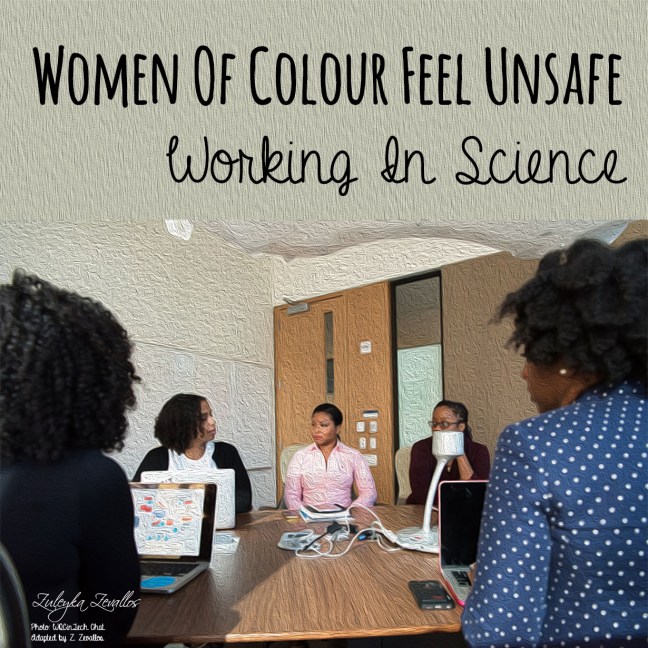
I was interviewed by Buzzfeed, about a new study by Professor Kate Clancy and colleagues, showing women of colour scientists are more likely to experience race and gender harassment. Women of colour scientists are also excessively critiqued for being either too feminine or masculine enough, they have their physical abilities questioned, and they are more likely to miss professional opportunities like conferences, fieldwork, classes and meetings because their workplaces are unsafe. My comments from the interview:
“The study really reinforces a lot of what the literature already tells us — that women of colour are more likely to experience multiple forms of harassment and feel more acutely the impact of a hostile work environment in the sciences,” Zuleyka Zevallos, a sociologist at Swinburne University in Australia, told BuzzFeed News.
Although this isn’t the first study to show evidence of the “double bind” of racial- and gender-based harassment, some critics continue to deny that the effect is real.
“A lot of the pushback that we see in the individual scientific communities —astronomy or any other science — is that scientists want data,” Zevallos said. “And even though there’s a plethora of data, it’s like they need to see more data for themselves.”
In their study, Clancy and colleagues surveyed women and men from various racial backgrounds, focusing on academics working in the field of astronomy and planetary science. The study finds that 88% of their respondents heard negative language from peers at their current job, 52% from supervisors, and 88% from other people at work. Thirty-nine percent report experiencing verbal harassment at their current position and a further 9% experienced physical harassment. Around a third of the overall sample feel unsafe at their current role (27%), however, women of colour were the most likely group to feel unsafe in their place of work due to their race, gender, and religion (although the latter was not statistically significant).
Breaking this figure down by race, 40% women of colour and 27% of White women, feel unsafe in their current role due to gender. Further, 28% of women of colour feel unsafe due to race.
Clancy and colleagues note a meta-analysis of 343 studies has established that people are less likely to participate in counterproductive workplace research. This suggests that, despite their stark findings, people are likely to underreport negative experiences for fear of professional repercussions. So experiences may be far worse in reality.
The study concludes that astronomy creates an hostile environment with profound impact on junior scholars, White women, and the greatest problems for women of colour.
The study proposes four solutions to workplace inequity.
A code of conduct/education for all trainees and employees at all levels;
Diversity and cultural awareness training on challenges faced by women of colour and underrepresented minorities;
Leaders need to model appropriate behaviour;
Swift, just and consistent sanctioning for perpetrators of harassment in the workplace.
Moreover the study concludes that better support networks for women of colour are needed.
Both in the academic literature and in my professional equity and diversity work, experts see a reticence in equity programs to deal with racism alongside gender imbalance. As I’ve detailed elsewhere, the astronomy community, along with other disciplines, deals with sexual harassment and gender inequity in haphazard ways, but still ignores racism. The present study by Clancy and colleagues might be used to better shape policy and programs. Bias awareness training is the bare minimum needed; to make positive changes to attract, retain and promote women of colour, structural reform is necessary.
Too many scientific societies feel that tackling gender equity is “a good start” but still see diversity and inclusion of people of colour and other underrepresented minorities is the “next step.” Some leaders perceive that diversity work undermines gender equity programs. This study, and many others before it, show that intersectionality is pivotal in making lasting change. Intersectionality describes how gender inequality is impacted by racial inequality and other forms of disadvantage like sexuality, disability, class and beyond. We cannot address gender inequity separate from racial inequity as both issues impact one another, as well as increase other problems for minority groups.
Read about the study and comments by lead author Professor Clancy on Buzzfeed.
Photo credit: WOCinTech Chat, CC 2.0 via Flickr. Adapated by Z. Zevallos.
I was interviewed by Dr Heather Goldstone for Living Lab Radio, along with my colleague Dr Caleph Wilson:
Source: Heather Goldstone/ WCAI
“They [March for Science Los Angeles] Tweeted in February that they’d been hearing from scientists that there might be problems with violence in connection with their focus on diversity,” said Zuleyka Zevallos (@OtherSociologist), a sociologist at Swinburne University. “That’s a dangerous historical connection that they are making from having minorities attend a science event to having it lead to violence. There’s actually no correlation between the two.”
Zevallos walked away from the March, as did Caleph Wilson (@HeyDrWilson), a biomedical researcher and digital media manager for the National Science and Technology News Service. They took to Twitter, instead, helping build hashtags – #marginsci and #AltSciMarch – that have developed into a vibrant public discourse about diversity and equity in science.
“One of the things that the hashtags were able to do is allow people to have those conversations in a way that can be visible,” said Wilson. “We could see each other having these conversations, as well as we could point the March for Science to these conversations.” […]
Zevallos says there is a silver lining, though.
“I do think that there’s a positive momentum in that these conversations have been happening for a very long time,” Zevallos said. “Underrepresented minorities have been doing activism for decades. But I guess the hashtags, in particular, allowed these conversations to converge, and for different networks from different parts of the world to join their voices together.”
As March for Science organizers work to foster a more lasting science activism movement, Zevallos and Wilson hope that the conversations started by the March can be leveraged into more awareness and meaningful changes in the science community’s prevailing attitude toward diversity and inclusion.