Sociologists Candace West and Don Zimmerman popularised the theory of “doing gender.” This theory sees that gender identity is something we do – itis a performance and an achievement that people put a lot of work into, rather than some innate biological state of being. People do gender by the way they dress, the way they talk, the way they move their bodies, the types of leisure activities they engage in their spare time, through their division of labour at home, at work and in every other context. Doing gender takes work: you need to learn what’s expected of you as a “man” or as a “woman.”
Early knowledge on doing gender comes from childhood socialisation. Subsequent life experiences teach us, often through trial and error, what the norms and expectations are for masculinity and femininity in different social settings, such as at work.
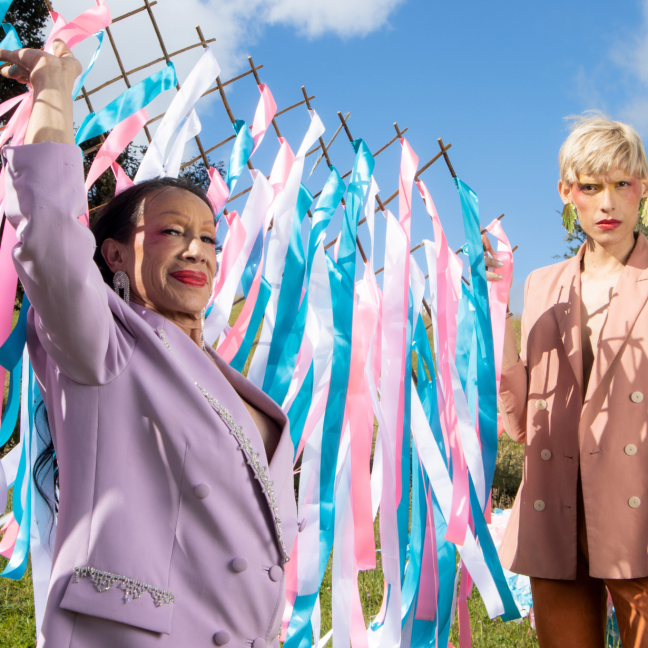
West and Zimmerman argued that, since gender is something we learn to do, and doing gender leads to inequality, it is possible to undo gender inequality, by doing gender in alternative ways that do not punish femininities. The doing/undoing of gender has been an ongoing focus of gender studies, most recently focused on transgender people. I will discuss recent scholarship about how transgender people do gender at work, with a focus on the experiences of transgender women. Social scientists are preoccupied with the idea that transgender people are in a special position to “undo” gender. I want to explore why viewing transgender experiences in this way contributes to the othering of transgender people, by amplifying their difference as a solution to gender inequality. Society can absolutely undo gender, but part of this means addressing the inequalities transgender people experience. This is something that mainstream feminism has yet to fully embrace.
Today is Halloween in Australia. We don’t really celebrate Halloween as a nation, although trick or treating is slowly becoming more common in some areas. (The kids in my court have been preparing all week by walking back and forth to each other’s houses with little Halloween buckets!) So unless you’re a horror lover like myself, you may only see costumes if you got to a Halloween party. But if you’ve ever had to dress up, as I did a couple of months back for my niece’s party, it can be tough to find a costume that doesn’t hyper-sexualise women, unless of course you make your own.
There’s a scene in the Tina Fey movie Mean Girls, where the lead character dresses up in an awesome scary costume and everyone is astonished because she isn’t in a revealing outfit (acceptable outfits featured are “sexy mouse”). In the film, they call this the “slut rule.” From the script:
“In Girl World, Halloween is the one night a year when a girl can dress like a total slut and no other girls can say anything about it.The hard-core girls just wear lingerie and some form of animal ears.”
– Mean Girls
This passage not only shows how society pathologises women’s sexuality (if you’re sexual you must be a “slut”), but it also reflects how women are punished for their sexuality when acting outside of the constrictive social norm (you’re only allowed to be “sexy” on special occasions, like Halloween, and even then you have to follow inane rules about what’s deemed attractive).
Halloween is also a time when people will be culturally insensitive with their costume choices, thinking minorities should be flattered that their culture is sexualised and fetishised for one day of the year.
I love ghouls, so if you can’t revel in horror with your costume choice, women can still have fun and be empowered, like this little girl who dreams of being a scientist working for NASA!
Credits
Image: Jeff Parker. [Text] “Don’t get me wrong, the princess costume is nice, Mum. But this Halloween, I thought I’d dress up as a NASA Mission Commander…”
Storify is closing and over the coming weeks, I will be migrating my posts to my blog. This is an archive of my article first published on Storify on 24 September 2014.
In September 2014, the United Nations, the Geena Davis Institute on Gender in Media, and The Rockefeller Foundation published a study on the representation of cisgender people on film. Here I report on the major findings and include some of my related social media posts.
The study conducted by Dr Stacy Smith, Marc Choueiti and Dr Katherine Pieper included 120 globally released movies in 11 major film regions: Australia, Brazil, China, France, Germany, India, Japan, Russia, South Korea, United States, and the United Kingdom. The study included almost 5,800 speaking or named characters. The researchers find that, globally, only 31% of speaking roles in films are given to women and less than a quarter of films are centred on a woman protagonist (23%).
The study finds that girls and women are slightly better represented in the UK (38% of speaking roles), Brazil (37%) and Korea (36%). Women and girls’ representation in Germany (35%) and China (35%) is relatively worse, but gender inequality is even more entrenched in India (25%) and the USA and U.K. (24%). This is especially alarming since Hollywood is the biggest exporter of films globally and they are clearly leading in the wrong direction.
Only 28 films in the sample (23%) feature a woman or girl in the lead role or otherwise sharing the story with another main character. The study also considers the gender balance of film casts (where 45 to 55% of characters are women or girls). Only 12 films met this criteria (10%). When women characters are featured in the main storyline, they appear in highly femininised genres. For example: women feature in 33% of comedy roles; 34% of dramas; and 29% of animated movies, but they make up only made up 23% of characters in action/adventure films.
The study included 1,452 film makers and people working in key roles behind the scenes. Women make up only 7% of directors, less than 20% of writers, and 23% of producers. The UK (27%) and China (17%) are comparably better, while France, Japan, Korea, Russia, and the USA are below the industry average of 7%.
Around 60% of younger characters (children and teenagers) are boys while 40% are girls. While 34% of men are cast as characters aged 40 to 64 years of age, only 19% of women are depicted as middle aged characters. The researchers find this is especially problematic given that the younger women who do appear in films are highly sexualised.
Women are more than twice as likely to wear sexually revealing clothing (25% of women vs 9% of men). Women are more likely to be thin (38.5%) in comparison to men (16%). Women are also more likely to be partially or fully naked (24% women vs 11.5% of men). Women characters are also five times more likely to have their looks commented upon by others (13% vs less than 3%). Younger women are more likely to wear revealing clothing, but women across the ages of 13 to 39 years are equally likely to be sexualised.
Here’s a satirical look at white male privilege, which refers to the gendered and racist discourses that maintain sexist, racist and heterosexist balance of power society.
Sociology and anthropology have long used the experiences of “third sex” cultures, such as the Native American Two Spirit people, to teach students about the social construction of sex and gender. In many cultures around the world, people are allowed to live their lives beyond conventional binaries; they need not adhere to the biological sex they were born into. These people are usually revered and there are special circumstances where individuals are allowed to shift their gender position. These groups, including the Two Spirit people, are used as examples in the sociology of Lesbian, Gay, Bisexual, Transgender, Queer and Intersexual (LGBTQI) issues. Recent scholarship, however, has questioned this practice, demonstrating that social scientists are applying Western concepts to misunderstand the Two Spirit phenomena.
A couple of weeks a go, a new, so-called “anti-rape” underwear device got quite a bit of international attention. It was invented by a team of Indian students, including two women. The device was designed to give rapists an electric shock. It is also reportedly equipped with a GPS tracking device to alert the women’s parents and police that she is being assaulted. The underlying attitudes that led these engineers to make this device are representative of the problem of rape not just in India, but in other parts of the world. Rape and harassment are not seen as public issues that require social intervention, but rather these are perceived as personal problems that individual women must navigate and manage in their day-today lives. In Australia, women’s public safety is also positioned as a personal issue. Both the Jill Meagher case and the public sexual harassment of Prime Minister Julia Guillard exemplify that women are ultimately forced to fend for themselves, while society does little to acknowledge rape culture as a societal responsibility.
High heel shoes were once a status symbol for powerful men, from horse riding soldiers in 16th Century Persia, to European aristocrats in the 17th Century. Since the Enlightenment period, heels became associated with “irrational” fashion and pornography, and so “impractical” shoes became a symbol of femininity. What changed? Today’s post examines how history and fashion trends related to high heels help us to see how gender is a performance that entrenches inequality. Continue reading What The Sociology of Shoes Says About Gender Inequality
This story is engrossing: Maud Allan was a Canada-born dancer who found fame in Germany in the early 1900s. She performed in the Oscar Wilde play, Vision of Salome, famous for “the dance of the seven veils.” When Allan was in her 20s, her brother was executed for killing two girls. She changed her name to escape this notoriety but later found herself the subject of infamy, drawn into a litigation case defending her name against charges of “sexual perversion.” Allan’s artistic sensuality and the fact that she was a lesbian were weaved into a conspiracy plot involving the highest office of British parliament. The Daily Mail recently reported on Allan’s life as a new play is being produced in San Francisco which is based on this salacious court case.
Allan’s story makes an excellent historical case study of the criminalisation of femininity and homosexuality in Britain at the end of World War I. I discuss the contradictory meanings of Allan’s dancing and her embodiment of the character Salome, a figure that has come to represent the dangerous qualities of female heterosexuality. The cultural significance of Allan’s dancing and her court case takes on multiple meanings in light of Allan’s reality as a lesbian woman in the 1920s.
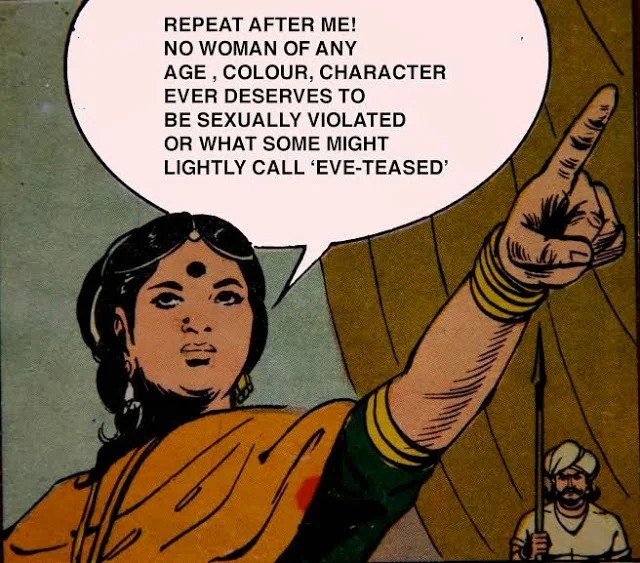
Public harassment of women in India is known as ‘Eve teasing’. I’m using this as a case study to highlight the ‘Western’ media’s divergent constructions of sexual harassment at home and abroad.
In Australia and in Western countries such as the USA, the mainstream media tend to portray sexual violence and gender oppression as a barbaric practice that are culturally entrenched in developing countries. Gender violence is the stuff of others – it is something that members of ‘less civilised’, less enlightened societies do. In comparison, the Western media depict sexual harassment and rape in their own societies as fear-mongering events involving individuals, rather thananindictment of an entire culture. (See my discussion of the sociology of crime reporting in an earlier post.)
Today’s post begins with a case study of Eve teasing in India before moving on to discuss sexual violence on a global scale, including the ‘Slutwalk’ movement. I provide more detail on the USA and Australia to illustrate that gender violence against women is widespread in advanced, liberal democracies, as it is in other parts of the world. As today’s discussion is focused on women, I talk only briefly about sexual violence against men but I will return to this issue in the near future. Here, I will argue that the situation in India is one public expression of broader global patterns of sexual assault.
Eve teasing – an evil. (Via Critical Thinkers)
What is ‘Eve Teasing’?
India is one of the world’s fastest growing economies, and levels of technology and education are rising rapidly (as reported by UNESCO, p. 19). Despite India’s socio-economic advances, the public harassment of women by men is pervasive. This practice is apparently so routine that it has a special name: ‘Eve teasing‘.
The origins of ‘Eve teasing’ came into common use by the police and media in the 1960s (Giriraj Shah 1993: 233). It may seem a strange term given it evokes the Christian concept of Eve in a country where the majority of people are Hindu (around 80%) and Muslim (13%), while Christians are a minority (2%). But this term is also used widely in other South Asian societies, such as Bangladesh, Pakistan and Sri Lanka (Sheila Mitra-Sakar and P. Partheeban 2011). It is also used in Nepal. It may be a colonialist term. Geetanjali Gangoli argues its semantic origins are Anglo-Indian, evoking the idea of original sin, where a ‘temptress’ seduces a man into doing something he doesn’t want to do. Gangoli says that by using the term ‘teasing’, ‘it normalises and trivialises the issue’.
Eve teasing is a blanket term for a range of abuse experienced in public. The media often uses it as a proxy for ‘sexual harassment’ and ‘offensive language and behaviour’ directed towards women (Andreas Sedlatschek 2009). Eve teasing is not effectively legislated, so it is not seriously treated as an offense and it’s rarely reported to police. The media and various blogs use the term Eve teasing for everything from being women being wolf-whistled, having men sit very close and leering over them whilst on public transport, receiving sexual taunts, to more aggressive assault, such as having being pinched, grabbed, smacked, and more. A study of 10 university campuses in Mumbai by K. Jaishankar, Megha Desai and P. Madhava Soma Sundaram (2008) also includes experiences of stalking as a form of eve teasing. For example, unsolicited phone calls, letters and cyberstalking. (The study also incorporates data from Tamil Nadu State and Tirunelveli.)
Eve stalking is a frequent form of harassment on public transport. For example, a study of 274 women carried out by Sheila Mitra-Sakar and P. Partheeban (2011) finds that 66% of them have experienced eve teasing on public transport. Eve teasing is such a problem that railway companies have introduced women-only train carriages, especially in bigger cities. It also occurs when women are at movie theatres, the beach, walking through the park, and beyond Vibhuti Patel (2007) has also studied ‘Eve calling’ in workplaces (see also Jyoti Puri: 1999: 94-96).
Research shows that Eve teasing happens to girls at school when they enter puberty. During this time, young girls also develop ambivalence about Eve teasing. Jyoti Puri (1999) finds that whilst girls and women don’t like this abuse, they feel they cannot change it, so they don’t speak out. Instead, they modify their personal behaviour, dress and routines. Some young girls might feel worried about telling their parents in case their behaviour and clothes are scrutinised. Girls tend to give one another advice and strategies for how to handle Eve teasing.
Some women feel ambivalence. They don’t like the abuse, but they feel it is a demonstration of how attractive they are. Yet many women in Puri’s research say they go out of their way to avoid Eve teasing. They avoid certain places at night. They avoid eye contact. A lot of women ignore the harassment and pretend not to hear the taunts, or they act as if they don’t care that they’re being grabbed, afraid to be subjected to further harassment.
Puri and other researchers find that as women get older, they might begin to show aggression, yelling obscenities or slapping men, but this comes from years of frustration and it still requires that women manage the problem alone. Whatever tactics are used, women are left with feelings of humiliation, anger and fear.
Mohamed Seedat, Sarah MacKenzie and Dinesh Mohan (2006) find that women feel perpetually ‘defensive’. The simple act of walking in public becomes a high ‘energy event’, which is both physically and psychologically draining, because they are constantly monitoring their body language and trying to stay alert in case of abuse.
Vibhuti Patel (2007) finds that the main myth about Eve teasing amongst men is that women enjoy it; men see it as harmless flirting; and that they also say that some women are ‘asking for it’ by the way they dress. However, women are harassed irrespective of how modestly they dress.
In the blog ‘Known Turf’, Annie Zaidi (2006) gave a gutsy account of how she confronted men, after years of this abuse. She found that the men were always surprised. The first time Zaidi fought back was when a man accosted her on the street and said ‘How much?’ She tried to walk away, but he followed her and asked again. She punched him. Surprised, he said ‘What did I do?’ In another instance, while she was standing outside a movie theatre, a man kept touching Zaidi and when he didn’t stop, she hit him. Shocked, he said, ‘I didn’t do anything’ but he ended up apologising by saying ‘Sorry, sister’. Zaidi gives a long list of advice for how women can avoid men’s unwanted attention. Her post has almost 280 comments, mostly from grateful women who find her account and advice useful.
The tactic has worked for Zaidi, but it speaks the dangers that women face when defending themselves against Eve teasing.
Eve teasing has some intersections with class and caste. For example, Aruna R (1999) argues that children who live in poor or rural areas are more likely to take long public transport rides to get to school. This means that they may be more at a higher risk of sexual harassment.
Mrinalini Sinha (1999) locates his historical analysis of Indian masculinity with respect to patterns of colonialism. Making reference to Padma Anagol-McGinn’s (1994) work on Eve teasing, Sinha sees that the ‘skewed urbanisation of colonial India’ influences how modern-day masculinity is constructed. From the late 1890s and up to mid-20th Century, the industrialisation of Indian cities meant that many men moved away from their rural families and lived in places where there was a strong gender imbalance. This began the restricting gender hierarchies, to the point where today men feel validated by acting sexually aggressive towards women in public.
Martyn Rogers (2008) has also studied the connection between caste, colonial history, masculinity and eve teasing amongst Tamil university students struggling to compete with upper middle class students. The study was conducted in an inner-city college in Chennai, Tamil Nadu, in South India. Rogers sees that Eve teasing is way to enact Tamil masculinity and to regain some of their status. These young men are attempting to resist a ‘Westernisation’ of their masculinity, even as they attempt to gain a higher level of education.
For a subjective perspective on how men minimise Eve teasing, see Libran Lover’s blog. He argues that Eve teasing is wrong, but that he takes great exception to the idea that Eve teasing is a power issue. Libran Lover says he ‘indulged’ in a little ‘light Eve teasing’ in his youth, but he says that he was not thinking about dominating individual woman. Instead, he feels that Eve teasing is borne out of sexual frustration. Libran Lover says that because most arranged marriages are delayed until a certain age, some men start to develop sexual feelings during their adolescence and early 20s, but they have no one to direct these feelings towards. So, in Libran Lover’s view, up until men marry, they ‘indulge’ in Eve teasing because they don’t know any better. Libran Lover’s views legitimise sexual violence, by normalising this abuse as a phase, and women as objects to alleviate sexual entitlement.
Srividya Ramasubramanian and Mary Beth Oliver (2003) argue that popular Hindi films have glamorised young men’s expectations of what aggressive sexual attention can do for women. The researchers identify that in Hindi films, acting tough and initially upsetting women by showing them persistent unwelcome attention will eventually win a girl over. This Hindi archetype ‘macho hero’ is how mainstream Indian culture defines masculinity – through aggression, valour and perseverance (see also Swarna Rajagopalan 2005: 46).
While movies may increase male entitlement, the widespread prevalance of Eve teasing and other forms of gender violence suggest that the issue runs deeper than media and individual men.
‘Eve Teasing’ and Sexual Harassment in India
The BBC reports that two young men recently died in Mumbai trying to defend their friends from Eve Teasing. Only now is the law adopting a ‘zero tolerance approach’ to the problem. The death of these men is a very sad loss for these men’s families and their communities which cannot be understated. The tragedy is compounded given that it should not have happened in the first place if social policies and law enforcement had been more proactive.
The Delhi Government’s Department of Women and Child Development already had compelling data that Indian women faced daily sexual harassment, as it had commissioned the UN and other non-government organisations to carry out a study on this topic in 2010. Last year, the BBC reported that the findings from this study ‘confirm what the people of Delhi have known for a long time – that the city is unsafe for women’.
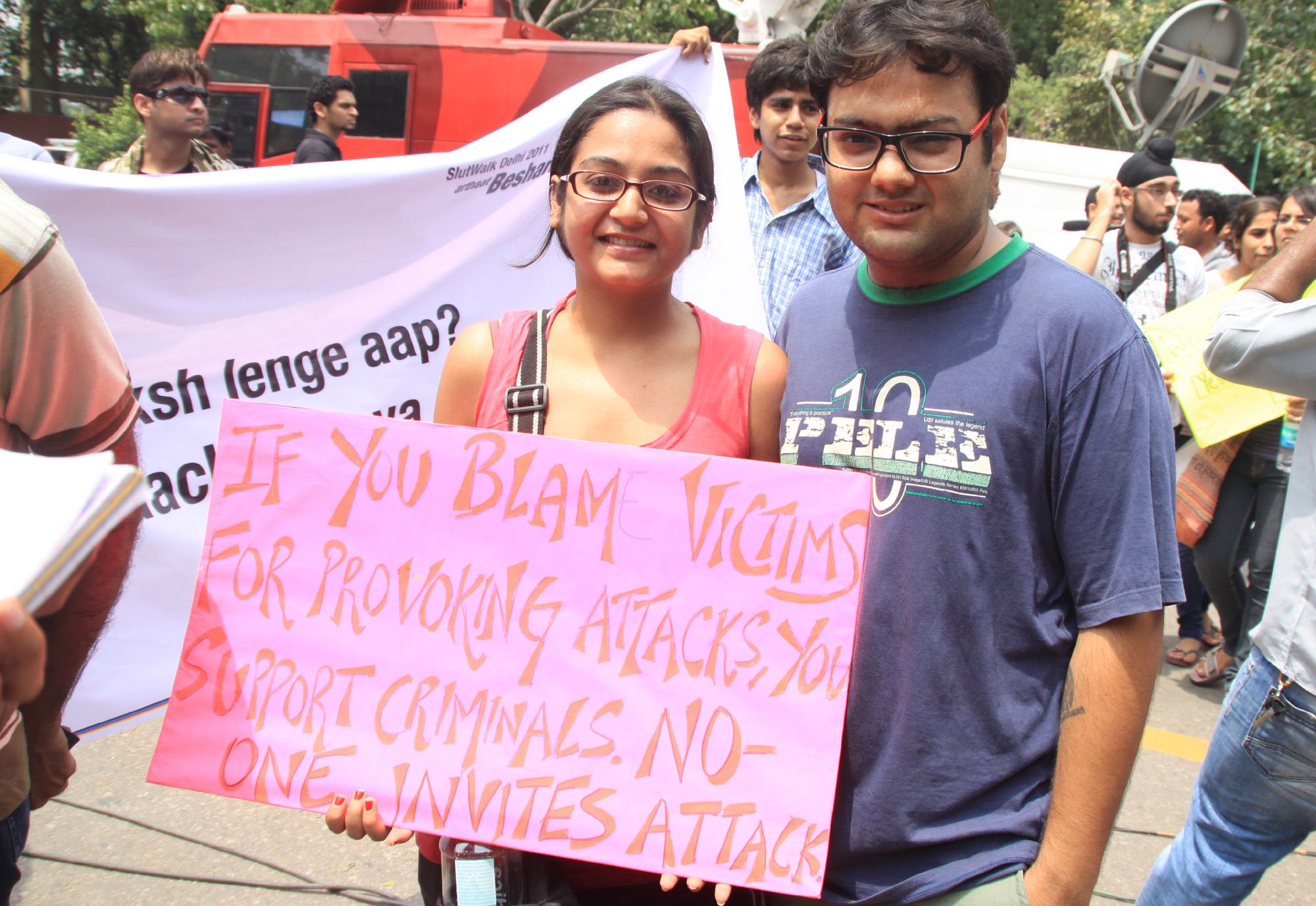
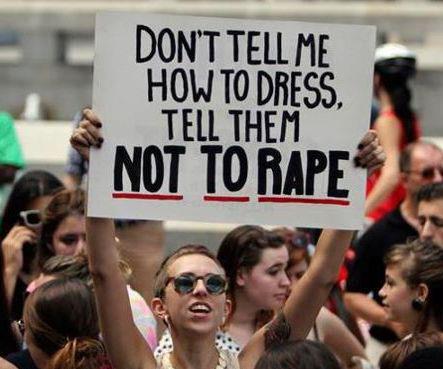
A ‘Slutwalk’ protest (also known as Besharmi Morcha) was held in Delhi at the end of July this year to highlight the daily violence and abuse that Indian women experience. Slutwalk protests began in April, in Toronto Canada. They were in response to the sexist comments that a police constable made to a group of students at York University’s Osgoode Hall Law School during a health safety seminar in late January. The constable said to the students:
You know, I think we’re beating around the bush here… I’ve been told I’m not supposed to say this – however, women should avoid dressing like sluts in order not to be victimised. (Via The Guardian).
These remarks sparked a series of protests in various cities around the world. The Slutwalk Toronto website mobilised the global action. The organising group explained in late February:
We are tired of being oppressed by slut-shaming; of being judged by our sexuality and feeling unsafe as a result. Being in charge of our sexual lives should not mean that we are opening ourselves to an expectation of violence, regardless if we participate in sex for pleasure or work. No one should equate enjoying sex with attracting sexual assault.
SLUT WALK Delhi (Via Facebook)
The Slutwalk movement is not without its controversies, especially in Delhi (see the suggested readings below). Nevertheless, the idea behind this social movement goes to the heart of Eve teasing and its hidden sociological causes. Sexual harassment betrays a simmering culture of sexual violence. Whether it is in the form of a careless joke, a sexist comment or a public taunt, sexual harassment perpetuates a sense of fear. Public harassment requires urgent social intervention because it can be a precursor to escalated violence.
Specifically, there is a connection between public forms of harassment and rape. The BBC reports that the National Crime Records Bureau in India recorded around 22,000 rape cases in 2008, which was 18 percent higher than four years prior. As one of the Slutwalk Delhi protesters told the BBC:
There are a lot of problems for women in Delhi because a lot of women do face sexual harassment and just a couple of weeks ago the chief of police of Delhi said that if a women was out after 0200 she was responsible for what happens to her, and I don’t think that’s the right attitude.
Eve teasing may seem extreme and it may even play into stereotypes that people in advanced nations have about gender violence: that it is something that happens in countries that have a highly traditional gender structure. For example, Australians hear and read stories about rape, torture and imprisonment of women in other countries, but these travesties of justice evoke pity or indignation for other women in distant lands, rather than reflection about sexual violence everywhere.
The United Nations reports that half a million women were raped during the 1994 Rwandan genocide; 5,000 women are victims of so-called ‘honour killings’ annually; and 140 million women and girls have undergone female genital mutilation. Women are jailed for speaking out about rape, such as in Afghanistan. Since 1999, over 3,000 women have been attacked with acid in Bangladesh alone, with thousands more cases in other South Asian countries.
These examples are rightful cause for international outrage and political action. The violation of women’s freedom and safety needs to remain in the spotlight as an international human rights issue that requires collective lobbing and support.
At the same time, as the media sensationalises sexual violence and gender oppression in other countries, harassment and abuse seem like something that other people do in other distant places. International data suggests otherwise. Sexual harassment and sexual violence is pervasive all over the world.
Brief Overview of Sexual Harassment Around the World
As I previously reported on Sociology at Work, the United Nations finds that up to 70% of women and girls around the world will be beaten, coerced into sex or abused in their lifetime. The UN also finds that women aged 15 to 44 are more likely to experience rape or domestic violence than they are at risk of developing cancer, being in a traffic accident or contracting malaria – one of the world’s deadliest diseases.
Rape is a weapon of war and a form of social control all over the world. A study published in June this year in the American Journal of Public Health finds that over 1,000 women are raped every day and 400,000 women are raped annually in Congo. The UN estimates that the rate is closer to 200,000 since 1996. Mass rapes happen in high numbers in wars such as in Rwanda, Bosnia, the Former Yugoslavia, Sudan and Iraq.
The highest rates of sexual violence which end in death occur in ‘fragile states’ (as defined by the Freedom Report). This includes South Africa, where one woman is killed every 6 hours by an intimate partner. In Guatemala, two women are murdered daily. Ciudad Juárez, Mexico has one of the highest rates of women homicides per capita in the world. The official count is close to 400 women dead since the mid 1990s, but local residents think the figure is closer to 5,000 as these other women have gone missing and their cases are unsolved. This violence is connected to the USA’s ‘war on drugs,’ as this town is a central point for drug exchanges (there is also a high rate of drug-related murders for men). Additionally, these women are placed in an unsafe situation as they are bussed into secluded industrial areas working on American-owned companies that exploit their labour and take no responsibility for their workers’ safety.
Moreover, the UN reports that out of the 800,000 people trafficked annually, 80% are trafficked for sexual purposes, and 80% of these ‘sex slaves’ are women, many of whom are exploited by sexual tourists and clients from advanced nations.
In high-income nations, rates of gender violence are also high. The UN reports that one-third of women murdered annually in the USA are killed by intimate partners. The National Organisation for women reports that almost 1,200 women were murdered by an intimate partner in the USA, which is an average rate of three women per day (higher than the rate for Guatemala). Citing data from 2007, the National Institute of Justice puts the murder of women by an intimate partner at 40–50 percent. The UN also reports that 83% of American girls aged 12 to 16 experienced some form of sexual harassment in public schools. In the European Union, 40-50 percent of women experience sexual harassment at work.
Yesterday, The New York Times reported on an American study which finds that sexual violence is widespread in the USA. The National Intimate Partner and Sexual Violence Survey was conducted by the National Centre for Injury Prevention and Control at the Centre for Disease Control and Prevention (CDCP). The study surveyed a nationally representative sample of 16,507 adults. It found that around 20 percent of the women reported that they had been raped or that they had experienced an attempted rape. A quarter of the women had also been beaten by an intimate partner, and another 16 percent had been stalked.
In Australia, the latest figures by the Australian Bureau of Statistics (ABS) find that there were almost 17,800 victims of sexual assault reported to the police in the year 2000 alone. The overwhelming majority of recorded victims are women (85%) and a quarter of these victims were children aged 10 to 14 years. (To read more on combating child abuse, see my post on Sociology at Work.)
Governments and law enforcement agencies rely on population surveys rather than simply on official statistics in order to gauge a more representative estimation of the number of people who are assaulted. This is because violence and abuse often go unreported via official channels. The ABS reports on the Australian component of the International Violence Against Women Survey. The study was conducted during 2002 and 2003. It included 6,677 women aged between 18 and 69 years. The study found that close to 60 percent of these women had experienced at least one sexual or violent crime. Around a third the women had experienced sexual violence by a former or current partner (34%), a third by close family or friends (27%), and one fifth was attacked by an adult figure during their childhoods (16%), or by a parent (2%). One percent of these women were raped by a stranger. Only 14 percent of the women who experienced violence by an intimate partner reported it to the police and 16 percent of those who experienced violence by a non-partner reported the crime to the police.
Men are also victims of rape, sexual and domestic abuse. The CDCP study finds that one in seven men report experiencing severe violence by an intimate partner and up to two percent report being been raped, predominantly as children aged under 11 years. The ABS data show that 15 percent of sexual assault victims in 2010 were male. Male are less likely to report sexual violence due to added social stigma attached to male rape victims, so official figures underestimate its prevalence. As mentioned, I will tackle this issue separately in a later post. For the time being, I’ll address the simple ways in which the average person can tackle sexual harassment, and how sociologists can progress broader social change.
How Does Sexual Harassment End? How Can Sociology Help?
Clearly, the Delhi data from 2010 and the Slutwalk protest in India earlier this year should have been taken more seriously by the Indian Government. It’s shameful that it has taken the death of two men for officials to take the sexual harassment of Indian women more seriously.
Speaking from Australia, media images and stories such as this makes it seem as if violence against women is a bigger problem in ‘other’, ‘less civilised’ parts of the world. Yes, class and caste inequalities are deeply embedded in Indian society, but class inequality is an issue all over the world. Poverty is not an adequate explanation for sexual harassment. Rape and public assaults on women happen in India’s largest cosmopolitan cities where affluence, technology and education are rising. Public shaming, name calling and harassment may seem to be out of control in India, but Eve teasing is actually indicative of global gender practices. Law enforcement officials and researchers in America, Australia and elsewhere agree that sexual assault and domestic violence crimes are alarmingly high, and yet we know that many of these crimes go unreported.
Sociology can help in the first instance by making the data I’ve discussed part of an ongoing public dialogue about the reality of sexual violence. The main way sexual assault permeates the public’s consciousness is with respect to extreme gender oppression ‘overseas’ (that is, anywhere but ‘here’). In Australia, America and elsewhere, the media regularly depicts rape and sexual harassment as something perpetrated by strangers, but the scientific evidence shows that sexual violence is a familiar part of many people’s lives that goes unrecorded and unacknowledged.
One percent of women who are raped in Australia are attacked by strangers – that means that 99 percent of women who are raped, beaten or abused are assaulted primarily by their partners, family members, friends or by someone they already know. The travesty is that these figures are not getting through to people. Instead, these crimes are silenced – in up to 60 percent of cases, as inferred by the data I discussed. People continue fearing strangers while victims are forced to live with feelings of shame and fear alone.
It is a cliché for sociology to suggest education is the answer, but this is a truism for good reason. I don’t simply mean by focusing on the next generation going to school, although sexual education in schools should most definitely cover sexual violence. I also mean expanding the boundaries of public discussion through information, honesty and compassion. Media images make sexual violence into something exotic: it happens in ‘bad homes’, to ‘other’ women who are too afraid to leave their partners – but it doesn’t happen to men… or so we are led to believe. It happens, ‘somewhere else’ – in other countries, where people are poor and less educated. Now you know this is not true. Yes, sexual violence occurs in developing nations and some of these gender crimes seem especially horrific (rape, genocide, unjust imprisonment, and mutilation). Sexual crimes in Australia may not seem so extreme by comparison but this is not a useful way to think about the problem. To view some forms of gender violence as more or less severe than others does further violence to victims of sexual crimes everywhere. Culturally moralistic comparisons ensure that sexual crimes become normalised, rationalised and accepted.
Sexual violence and harassment are just as common in advanced nations as they are everywhere else. Sexual crimes happen in blossoming economies, like in India, where technology and general levels of education are growing, and it happens in homes all around Australia and all over America. It happens to men. It happens to children, it happens to adults. Individuals and societies need to move away from the way we view, excuse and silence sexual harassment and violence.
Public education on this issue means working with law enforcement officials to support their work with local communities, to help them establish empathy and rapport, so that victims might feel more confident in coming forward. Sociologists can also work to connect community support groups, government agencies, police, schools and workplaces. Applied sociologists are especially adept at facilitating social exchange between different publics and professional bodies. We are in a prime position to shape social policy through considered engagement with decision-makers. Everyone would agree that sexual and violent crimes should be brought to justice, but this can’t happen when official processes prevent victims from speaking up for themselves, or where rape and violence are constructed as some isolated, foreign event, making survivors too afraid to report their experiences to the police.
Sexual harassment and sexual violence are not simply something that happens in faraway places. The shame and stigma heaped upon victims of Eve teasing in India is but one manifestation of the sexual and physical abuse that women, men and children live with every day all over the world. Thinking that some forms of gender or sexual violence is more or less barbaric than another doesn’t help. Talking about sexual harassment, assault and rape in an open, respectful and honest way does help.
This is the first of many future contributions that I will make towards breaking down the ‘otherness’ of sexual violence. (By otherness, I mean the negative attribution of difference and the marginalisation of minority or less powerful groups). I’ve got a couple of posts lined up about youth sexuality and pornography, which I hope will further demystify the shame that societies heap upon sexual behaviour and the misinformation about sexual coercion. I hope that if you read this – even if you disagree with me in any way – that you will tell at least one other person and get a conversation started. The next time you see a media report that drums up the gravity of gender violence in another country, have a chat with someone about it. When a crime report focuses on perpetuating a fear of rape solely directed at strangers, remember this post. Then have another conversation with someone else. And keep that conversation going because sexual harassment and violence doesn’t go away by pretending it’s not happening right here, right now.
Watch and share the United Nations video: Youth Voices on Ending Violence against Women.
Eve teasing
For a different perspective than the one I’ve presented, read a passionate piece on Eve teasing by young bloggers on Critical Thinkers.
Slutwalk Toronto
Explore the Slutwalk Toronto link I referred to above and read how the organisers conceived the re-appropriation of the word ‘slut’ for their social movement. The rest of the blog is worth reading to see how they’ve expanded their focus to other issues such as bullying, religious condemnation of queer sexualities, and a wonderful reflection on the meaning of social ‘privilege‘ and how it affects various marginalised groups.
Lisa Wade provides another useful analysis of the Slutwalk movement in North America on Sociological Images.
Slutwalk Delhi/Arthaat Besharmi Morcha
Check out the Facebook page used by organisers of the event and he Facebook video that promoted it – note that the focus of the campaign was not just on women, but also on men who support the cause.
Blogger Nandita Saikia provides a thoughtful analysis of Slutwalk on Cold Snap Dragon, arguing against social critiques that it is a movement for privileged women.
Watch Trishla Singh, Media Coordinator for Slut Walk Delhi, discuss the idea behind the event and the appropriation of the word ‘slut’ in an Indian context. (via Global Voices).
Note
This post was edited to include a section on ‘What is Eve teasing,’ and additional data on sexual violence in response to some questions from commenters.
Several recent articles recreate the idea that beauty aesthetics are based on biological imperatives. The premise of this argument is false – beauty, sex, gender, and the social consequences of their related biological processes are not pre-determined. This line of thinking lumps the complexity of human experience and sexual expression into a uniform category and it provides the false impression that nothing can be done to change human behaviour. Sociology can help unpack how and why so-called “common sense” ideas about beauty become established as commonplace knowledge. Contrary to what mainstream culture may have us believe, beauty ideals can be challenged and transformed. Beauty-based discrimination is not natural, and nor is it unavoidable.






 This story is engrossing: Maud Allan was a Canada-born dancer who found fame in Germany in the early 1900s. She performed in the Oscar Wilde play, Vision of Salome, famous for “the dance of the seven veils.” When Allan was in her 20s, her brother was executed for killing two girls. She changed her name to escape this notoriety but later found herself the subject of infamy, drawn into a litigation case defending her name against charges of “sexual perversion.” Allan’s artistic sensuality and the fact that she was a lesbian were weaved into a conspiracy plot involving the highest office of British parliament. The Daily Mail