Whiteness as Race Adjudicator

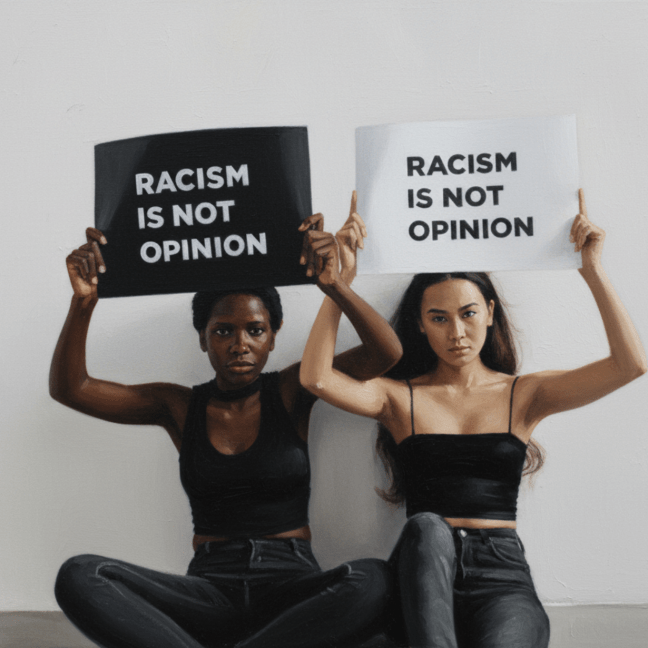
A Black and Asian woman sit on the ground, each holding signs saying: Racism is not opinion

“People look at us without really seeing us. Instead, they simply see our race… the onus isn’t just on us inching past our fear of embarrassing a white person. It’s on white people to learn to make distinguishing faces a priority. Whether they realise it or not, the repeated misidentification broadcasts its own message: I’m Asian, indistinct and not worth remembering.”

Iris Kuo, journalist

“Mistaking” people of colour because “you all look alike” is not just a faux pax. It is racism at work.

In her opinion article for the Washington Post, Kuo recounts examples of herself, friends, and colleagues being mistaken for other Asian people who look nothing alike. It happens at work, and in other social interactions with white people.

“All my life I’ve been mistaken for other people of my race. It’s a degrading and thoughtless error that boils away my identity and simplifies me as one thing: ‘that Asian.'”

She notes she is expected to laugh this off, but it happens so frequently that it has a negative impact. Kuo recognises this happens to other people of colour, who are expected to let the moment pass, so as not to “embarrass” white people. She notes that when people of colour do speak up, the interaction is minimised or ignored. For example, when she complained about multiple incidents of a colleague mistaking her for other Asian people, the manager excused the problem, by saying: “I don’t think anyone here’s got a mean bone in their body.”

When white people get called out for racism, they usually moralise the issue, deflecting to a question of manners, naiveté, or an innocent mistake. They refuse to recognise this as racism, because white people think racism in terms of:

  • Extreme bigotry: racial slurs, yelling, violence
  • Conscious hatred: a personal flaw of an isolated individual
  • Moral failing: being called a racist is seen as a personal character flaw, and a label that is more hurtful than racism itself
  • Adjudicated through whiteness: white ideology defines what is, and is not, racism, according to the values, experiences, and discretion of individual white people, rather than a structural system of inequality

These examples are known as microaggressions – the brief and subtle daily insults that denigrate people of colour. It occurs because whiteness allows white people to take their own race for granted as a universal experience, without acknowledging their biases and prejudice. Microaggressions happen because white people reinforce racial categories, reducing other groups to a monolith “other,” while seeing themselves and other white people as individuals worthy of special attention, decency and respect.

Microaggressions reinforce racial power, because they are a routine reminder to people of colour that they are being racialised (reduced to their racial difference, and therefore lesser than white people).

This also shows how while people “do” race – by categorising “others” into racial categories, and reinforcing the racial hierarchy, that some groups have more power than others to define social reality. If they didn’t “mean to offend” or “didn’t mean any harm” then racial harm is nullified. Race becomes a problem for people of colour to manage, in ways that do not disrupt white people’s dominance.

Read Kuo’s article.

How to stop the sexual harassment of women in science: reboot the system

Two white women scientists are working on machines in a lab

This article was first published in  The Conversation, on January 29, 2016.

The culture in astronomy, and in science more broadly, needs a major reboot following revelations early this year of another case of harassment against women by a senior male academic.

The journal Science revealed earlier this month that the latest case involved Christian Ott, a professor of theoretical astrophysics at Caltech university, in the United States.

Frustrated that Ott was not fired and only placed on unpaid leave for a year, the two female students who raised the allegations took their story to the popular online news outlet Buzzfeed.

Also this month, US Congresswoman Jackie Speier raised the case of Professor Tim Slater, who had been investigated for various sexual harassment incidents that began after he was hired by the University of Arizona in August 2001. Slater went on to the University of Wyoming.

Slater spoke to the news website Mashable and said he had received sexual harassment training as an outcome of the investigation.

But Congresswoman Speier questioned why the investigation into Slater’s sexual harassment was sealed “while he went on with his career”, even though women who were victims lost years of study and career progress due to his conduct.

Read more on The Conversation.

Everyday Racism in Japan and the USA

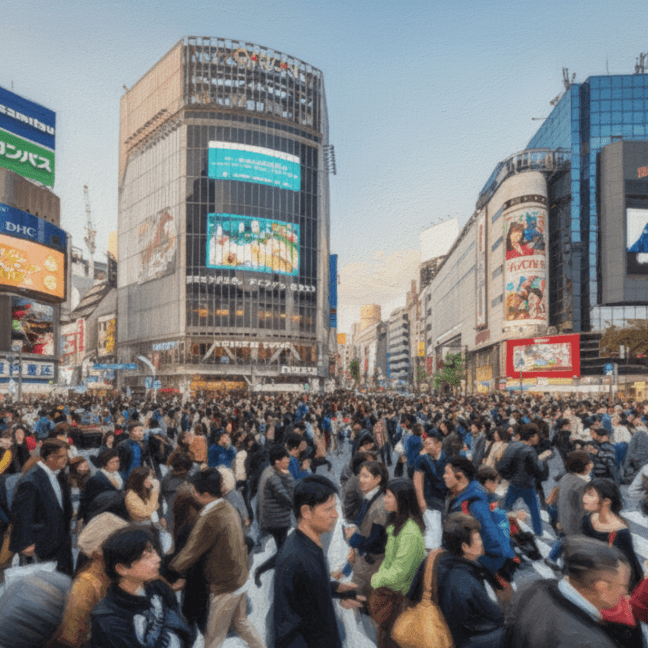
People cross a densely crowded street in a Japanese city

“Over the course of my life, mostly from white people back in the States, I’ve been told I look like a number of black people, from Eddie Murphy to Martin Luther King, so I was aware that other races’ perception of my appearance had a tendency to be warped. Often the people making these observations were unaware they were picking at the scabs of festering wounds of dehumanisation. Nor did they seem aware that their ideas could veer into stereotyping very easily. So, at least for me, this “name-calling” became a sort of indicator of a person’s ignorance or insensitivity level..”

Continue reading Everyday Racism in Japan and the USA

Ai Weiwei: Pop Art to Protest Art

The National Gallery of Victoria in Melbourne, Australia, is currently showing an exhibition of two monumental artists, Andy Warhol and Ai Weiwei, whose work and interests often intersected, even though they were working in different eras. As Weiwei was still studying in the 1970s and early 1980s, a time when Warhol’s star was meteoric. In this post, I only focus on Weiwei’s work.

Ai Weiwei shares Warhol’s scepticism for “high art” and authority, as evidenced in his 1995 classic artwork, “Dropping a Han Dynasty Urn,” which he redid in 2015 with legos (featured in my photos below). Similarly his two installations, Chandelier with Restored Han Dynasty Lamps for the Emperor and Forever Bicycles (both 2015) make a comment on the cultural artefacts that are revered at a later point in time, even though they were once everyday household items with little value.

This slideshow requires JavaScript.

Continue reading Ai Weiwei: Pop Art to Protest Art

“Secret histories” of Australia

Ongoing human rights crimes have been committed against Indigenous Australians, starting with dispossession and colonisation. This post features museum and dance works addressing Australia’s colonial history and its ongoing aftermath: the “Secret Histories” exhibition at the Australian Museum, as well as Bangarra Dance Theatre’s latest work, “Spirit of the Patyegarang.”

Continue reading “Secret histories” of Australia

Addressing Sexism in Scientific Publishing

Three women of colour sit and read textbooks

Barely a few days have passed since the last gender bias in science crisis, and the scientific community is already dealing with yet another high-profile example of gender discrimination. This time, the issue is with sexism in science publishing.

Dr Fiona Ingleby, a postdoctoral researcher in evolutionary biology from the University of Sussex, took to Twitter to express her frustration over sexist comments by a reviewer from a journal by PLOS ONE, an open access publishing network. Dr Ingleby and her colleague, evolutionary biologist Dr Megan Head from the Australian National University, are both women. They had submitted a manuscript based on their research on gender differences amongst students moving from PhDs to postdoctoral roles. The reviewer rejected their manuscript on the basis of the researchers’ gender, suggesting the data would be more fit for publication if they included a male author. In other words, the science of gender bias can only be “objective” if a man is involved. I’ve previously noted that women’s research on gender bias in science is often rejected by men, who, despite scientific evidence to the contrary, will argue that gender bias either does not exist, or if it does, it is is skewed in women’s favour.

Continue reading Addressing Sexism in Scientific Publishing

Publication: Sexism in Science Reporting

This article was first published in DiverseScholar, on 20 April, 2015.

In my previous DiverseScholar article, I showed why the study behind The New York Times Op Ed (claiming the end of sexism) was methodologically flawed and ideologically biased [Zevallos 2014]. I showed that a focus on an individual choice narrative to explain why women are disadvantaged in STEM (Science, Technology, Engineering and Math) is fundamentally unsound when understood alongside the long-standing empirical evidence from the social sciences. Here, I will review several science controversies related to the editorial and institutional decisions within STEM. These patterns show that everyday interactions contribute to gender inequality, from the use of images, to dress, to the way distinguished women scientists are described in the media. I start with a selected timeline of events highlighting gender inequality in STEM. Continue reading Publication: Sexism in Science Reporting

The Myth About Women in Science? Bias in the Study of Gender Inequality in STEM

The Myth About Women in Science? Bias in the Study of Gender Inequality in STEMA new article on CNN by psychology professors, Wendy Williams and Stephen Ceci, boldly proclaims that gender bias in Science, Technology, Engineering and Mathematics (STEM) is a myth. Their research has been published in the Proceedings of the National Academy of Sciences (PNAS). Unfortunately, their work has a flawed methodological premise and their conclusions do not match their study design. This is not the first time these researchers have whipped up false controversy by decrying the end of sexism in science.

Williams and Ceci write on CNN:

Many female graduate students worry that hiring bias is inevitable. A walk through the science departments of any college or university could convince us that the scarcity of female faculty (20% or less) in fields like engineering, computer science, physics, economics and mathematics must reflect sexism in hiring.

But the facts tell a different story…

Our results, coupled with actuarial data on real-world academic hiring showing a female advantage, suggest this is a propitious time for women beginning careers in academic science. The low numbers of women in math-based fields of science do not result from sexist hiring, but rather from women’s lower rates of choosing to enter math-based fields in the first place, due to sex differences in preferred careers and perhaps to lack of female role models and mentors.

While women may encounter sexism before and during graduate training and after becoming professors, the only sexism they face in the hiring process is bias in their favour.

Williams and Ceci’s data show that, amongst their sample, women and male faculty say they would not discriminate against a woman candidate for a tenure-track position at a university. Sounds great, right? The problem is the discrepancy between their study design, that elicits hypothetical responses to hypothetical candidates in a manner that is nothing like real-world hiring conditions, and the researchers’ conclusions, which is that this hypothetical setting dispels the “myth” that women are disadvantaged in academic hiring. The background to this problem of inequality is that this is not a myth at all: a plethora of robust empirical research already shows that, not only are there less women in STEM fields, but that women are less likely to be hired for STEM jobs, as well as promoted, remunerated and professionally recognised in every respect of academic life.

Continue reading The Myth About Women in Science? Bias in the Study of Gender Inequality in STEM

#SOSBlakAustralia: Colonialism of Indigenous Australians in 2015

Genetics research shows Aboriginal Australians are descendants of the first people to leave Africa. They represent the oldest continuous culture. #SosBlakAustralia
#SosBlakAustralia

The Australian Government is actively sustaining cultural violence against Indigenous Australians. The Abbott Government is trying to force 150 Aboriginal Australian communities off their lands in Western Australia. This would displace up to 12,000 Aboriginal Australians, effectively making them refugees in their own ancestral lands. This comes after months of ongoing campaigns to address:

  • The removal of 15,000 Indigenous children: The Grandmothers Against Removals group have been fighting for the return of Aboriginal children who live in so-called “out of home care,” away from their families. This practice goes back to early colonialism, where Indigenous children were removed from their communities and forced to give up their culture.
  • The denial of basic services to remote Indigenous communities: as shown in the Utopia Homelands in the Northern Territory, an Indigenous community that lived without clean water for two months in late 2014.

Continue reading #SOSBlakAustralia: Colonialism of Indigenous Australians in 2015

Rethinking the Narrative of Mars Colonisation

Rethinking the Narrative of Mars ColonisationBiologist Dr D. N. Lee has been doing an amazing job educating on how enthusiastic narratives of “colonising” Mars are problematic. On her Twitter, Lee notes that the dominant ways of talking about colonisation add to the marginalisation of under-represented minorities in Science, Technology, Engineering and Mathematics (STEM). If we want to make science more inclusive, we need to better understand how the stories we tell about STEM may exclude and damage under-represented groups we are trying to support.

Continue reading Rethinking the Narrative of Mars Colonisation