The 13 February 2017 was the ninth anniversary of the Australian Government’s formal apology for the Stolen Generations. From 1910 to 1970, up to one third of all Aboriginal and Torres Strait Islander children (100,000 children) were forcibly removed from their families and sent away from their communities. They were classified according to their skin colour and put into Christian missionaries where they suffered abuse and neglect, or they were placed with White foster families who did not understand their needs. These children were forced to forget their language, culture and spirituality, and in many cases they were not told of their Indigenous heritage.
The Bringing Them Home report of 1997 gathered evidence of the impact this cultural genocide had on Indigenous Australians, showing that it led to intergenerational trauma, poor health, and socio-economic issues. The report made 54 important recommendations to end the cycle of violence against Indigenous Australians.
Twenty years later, Indigenous children are being removed from their families up to four times the rate.
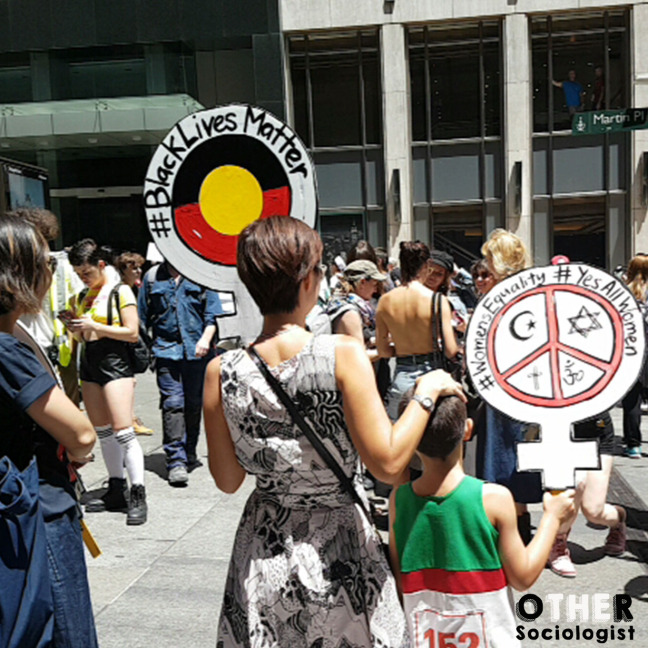
On the 21 of January 2017, I joined up to 10,000 Sydney-siders at the Women’s March, and 2.5 million people globally. I initially had reservations about the March. As I recounted last week, the march started as an idea by a woman activist in Hawaii and it was soon taken over by White women from Pantsuit Nation, a group that has no commitment to anti-racism. Bob Bland, a White woman from Washington, wanted to rectify the direction of the event and soon invited three women of colour to shape the Washington March: Tamika Mallory; Linda Sarsour; and Carmen Perez. The Women’s March Washington had a special focus on intersectionality; addressing how gender inequality is impacted by racism and other forms of discrimination such as homophobia, transphobia, ableism (the discrimination of people with disabilities), and more. The Washington March was the model for the other local and international marches. As more White women became involved in discussions at the national and international levels, this mission was drowned out. Women of colour were made to feel excluded from planning groups whenever the issue of intersectionality was raised.
So when the Sydney March was announced I first felt trepidation. As the final line up of speakers was announced, it became clearer that the Sydney organisers were making the event more consciously supportive of intersectionality. The organisers regularly focused their social media posts on inclusion, thereby reaffirming their commitment to diversity and inclusion. There were some limitations as I’ll discuss later. For example, transgender women seemed to lack representation amongst speakers at the event and best practice for the inclusion of women with disabilities may have been improved.
For me, the big draw card was Aboriginal activist, Jenny Munro, who has dedicated her life to advancing the human rights of Aboriginal people. Her activism and life’s work has a strong focus on Aboriginal sovereignty, children and housing. She leads the Redfern Tent Embassy and is a living legend. She did not disappoint; but I’ll get to that!
The day led to many useful discussions on diversity and how to disrupt patriarchy. I shared highlights of my day on Twitter and I bring these to you in this post as well as additional photos and video I wasn’t able to share on the day. The quotes are not strictly verbatim – treat them more as field notes to flesh out my visual sociology. I will also address the ongoing global conversations about the Women’s Marches and in particular, the critiques about the exclusion of women of colour, transgender women, sex workers and women with disabilities from various overseas events, with a focus on the USA. I’ll draw some qualified lessons on intersectionality from the USA to Australia and I wrap up with a discussion of why intersectionality is important.
This one minute video includes some of the footage I shot at the Sydney Women’s March and draws out the key lessons on intersectionality.
Djiringanj Dancers, a group of women cultural performers, singing about the “West Wind” at the Corroboree grounds, during the Yabun Festival.
The Yabun Festival is a celebration for Survival Day. The 26 of January is a national holiday that marks the day British ships arrived in Australia and began the genocide of Indigenous Australians. Survival Day is a day led by Indigenous Australians who affirm the resilience, creativity and excellence of First Australians. This year, the Invasion Day Protests, which aim to change the date and meaning of Australia Day, ended by protesters joining Yabun at the end of the march to enjoy music, stalls, cultural performances, speeches and more.
No pride in genocide! I am in Sydney, land of the Gadigal people of the Eora Nation, who have looked after these lands for over 75,000 years. I pay my respects to elders past, present and emerging.
The 26 January is a painful day for Aboriginal and Torres Strait Islander people. It is a date commemorating the day British ships (”the First Fleet”) arrived on Aboriginal and Torres Strait Islander lands. It is a day that marks the decimation of First Australians; the dispossession of their land; the removal of children to be raised in Missions and in White foster homes with no ties or knowledge of their culture (“the Stolen Generation”); amongst many other human rights crimes. This history impacts Indigenous life chances in the present-day.
On the 26th, I joined 10,000 people in Sydney who marched in solidarity with Indigenous Australians to tell the Australian Government to change the date of Australia Day so that First Australians aren’t being excluded through a national holiday making genocide. Another 50,000 people marched in Melbourne, and tens of thousands more did the same in cities and town around Australia.
Below, you can read my tweets of the protest as it unfolded.
This is the first of a two-part reflection on the global Women’s March that occurred on 21 January 2017. It reflects the tensions between the initial goal of the Women’s March in Washington, which aimed to be inclusive of intersectionality, and the White women who wanted to attend the March, but objected to this aim.
Despite many positive outcomes, the issues discussed here that centre on whiteness continued to affect the attendance, experience and discussions of the marches after the event. This post examines the attitudes of White women as discussed in an article by The New York Times, which reflect the broader dissent expressed by white women who continue to oppose intersectional conversations about the Women’s March.
The issues here remain relevant not simply as women around the world reflect on the racism and exclusion they faced at the marches, but also because one of the co-organisers, Linda Sarsour, is currently facing racist backlash only days after the event.
The second part to this discussion is forthcoming and it will be a visual reflection of my attendance at the Sydney March.
‘The term “white privilege” is misleading. A privilege is special treatment that goes beyond a right. It’s not so much that being White confers privilege but that not being White means being without rights in many cases. Not fearing that the police will kill your child for no reason isn’t a privilege. It’s a right. But I think that is what “white privilege” is meant to convey, that Whites don’t have many of the worries nonwhites, especially Blacks, do. I was talking to a white friend of mine earlier today. He has always lived in the New York City area. He couldn’t see how the Michael Brown case had anything to do with him. I guess that would be an example of white privilege.
‘Other examples of white privilege include all of the ways that whites are unlikely to end up in prison for some of the same things blacks do, not having to worry about skin-color bias, not having to worry about being pulled over by the police while driving or stopped and frisked while walking in predominantly white neighborhoods, having more family wealth because your parents and other forebears were not subject to Jim Crow and slavery. Probably all of the ways in which whites are better off than blacks in our society are forms of white privilege. In the normal course of events, in the fullness of time, these differences will even out. But the sudden killings of innocent, unarmed youth bring it all to a head.” – George Yancy and Naomi Zack on The New York Times.
“White privilege is like an invisible weightless knapsack of special provisions…” – Peggy McIntosh
Educator Peggy McInotsh introduced the idea of white privilege, the special benefits, protections and access to power conferred onto White people, which allows them to advance in life without conscious awareness of racial discrimination. She came to this concept as she reflected on her feminist practices. She noticed that even when male colleagues were willing to support women’s efforts to increase gender equity, they were not willing to give up their own status and power. Having tried to include women of colour in her feminist activities with little successful engagement, she came to see how she, as a White woman, had also been reticent to give up her own benefits to make feminism truly inclusive of racial minorities. She notes that educated White people like herself are raised to notice the “bad” aspects of racism, but not the benefits that make her life easier.
She came to realise that Whiteness was like an invisible knapsack she carried around with her, which protects her from noticing the advantages of race. Noticing her racial privileges, she understood the myth of meritocracy, for in the bag of Whiteness, she finds the key to open many doors that women of colour cannot access. Her skin colour was “an asset” that helped her secure a better education; it made it easy to take for granted that she belonged to the broader culture that facilitated her success, despite the gender inequalities she fought.
I have come to see white privilege as an invisible package of unearned assets that I can count on cashing in each day, but about which I was “meant” to remain oblivious… Whites are taught to think of their lives as morally neutral, normative, and average, and also ideal, so that when we work to benefit others, this is seen as work which will allow “them” to be more like “us.”
McIntosh began to recognise that “privilege confers dominance.” She came to see that her feminism was oppressive, even though she wasn’t conscious of the benefits of her race; but this is the point: by not being aware of race, she was contributing to inequity. She had failed to notice how the benefits she enjoys are part of a system that disadvantages people of colour. Just as patriarchy positions men as the universal norm, requiring women to adjust their behaviour and expectations to the needs and interests of men, McIntosh recognises how Whiteness pushes her to view the world through a racial lens. She’s encouraged to leave undisturbed the norm that Others should be more like White people, instead of challenging the system.
Read more on White privilege and related concepts on my resource, Sociology of Race.
White supremacy is an ideology promoting the racial superiority of white people. One of the key ways white supremacy retains its power is through language that “naturalises” white dominance, making the current social order seem natural, normal, and logical. The recent editorial direction by the New York Times of how to refer to the “alt right” plays into white supremacist ideology, by sanitising its political aims and making its ideology more palatable.
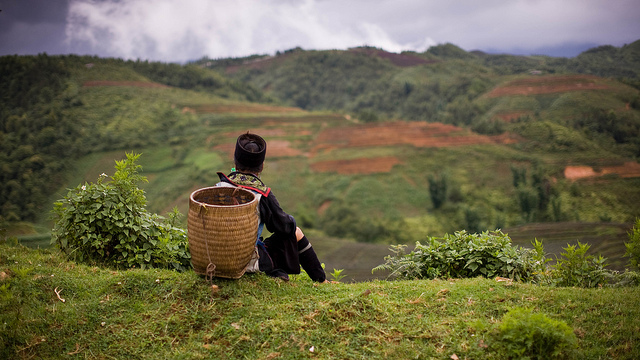
By 2013, Vietnam had halved malnutrition by investing in small scale (family) farming in just 12 years. Can the same happen in other nations? The United Nations believes so. What are some of the sociological considerations to boost the success of small scale farming? While this agricultural enterprise may be able to help families reduce hunger, it may not necessarily help households rise above the poverty line, unless social issues such as gender inequality are also addressed.
One of the themes of my visual sociology is the representation of science. Conservation is as much about social practices as it is about earth science, biology and other natural sciences. Today’s post is about the sociology of the National Arboretum, which sits on Ngunawal country. Ngunawal people are the traditional custodians of this part of Acton, west of the city in Canberra. Less than a seven minute drive central business district, this is one of the world’s largest arboretums for rare and endangered trees. I am no arborist. I cannot even claim to be a fan of gardening. I was interested in the Arboretum first in an attempt to capture a visual sociology of Canberra, and second to see how people interact with this place as a science centre. The focus of my post today is on the social dynamics of the Arboretum, especially on community aspects of conservation and the trees that drew the greatest interest amongst the crowds I saw: the Bonsai and Penjing Collection .
The latest Pew Research Centre survey shows that white people do not recognise institutional racism as the main cause of racial inequalities. Instead, they focus on individual prejudice, family, and lack of role models. White people are also half as likely to say Black people are treated unfairly at work and by police.








 The Other Sociologist