Publication: Better Leadership through Diversity

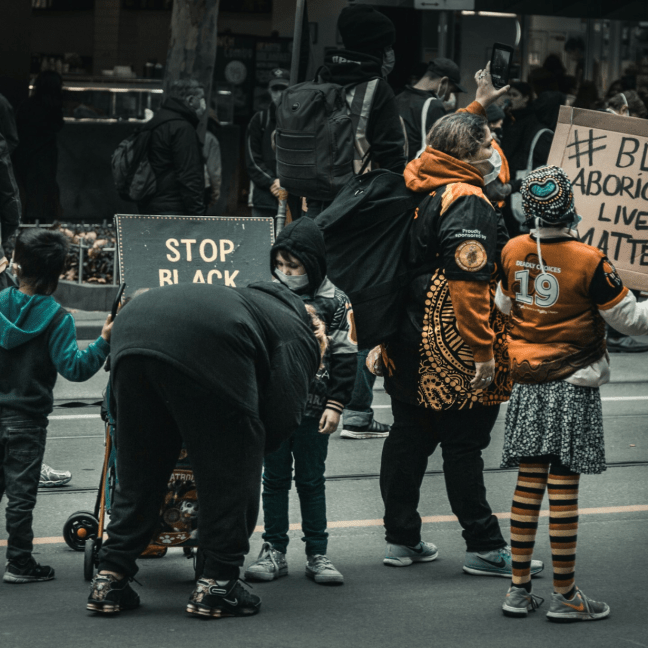
Protesters watch speeches at the March for Science, Sydney

Excerpt from my latest for The Humanist:

Here is where the March for Science, like so many other science activities, fell short.

In failing to take responsibility for diversity in a methodical and transparent manner, the March for Science leadership made four major errors. First, the organizers attempted to set up the march as “apolitical” without having thought about equity, inclusion, and accessibility. The organizers failed to connect with diversity experts and activist groups. Their diversity statement was first released due to criticism from underrepresented scientists (using the hashtag #marginsci, started by Dr. Stephani Page). In reaction to growing critique, the initial diversity statement would be revised another three times. Continue reading Publication: Better Leadership through Diversity

Australia’s Unfair and Inhumane Refugee Policies

Untitled (refugee girl) by Mohammed. Via Safdar Ahmed and the Refugee Art Project

Whilst in London a couple of years a go, I came across a sign which reads, “Begin your dream today, emigrate to Australia!” (see below). A warm invitation indeed: unless of course you are an asylum seeker – in which case our Government will revoke this welcome and abscond its responsibility to the United Nations Convention Convention relating to the Status of Refugees.

Since 2001, the Australian government has passed several laws that allow the detention of asylum seekers in offshore centres located on the islands of Nauru and Manus. This was first established by excising islands from Australia’s territory; attempting to pay off people smugglers; and a series of other policy changes known as the “Pacific Solution.” In the first seven years of the scheme, over 1,600 people were held in detention. They arrived predominantly from Afghan, Iraqi and Sri Lankan backgrounds. While this program was initially wound back by 2008, it was reintroduced in 2010. Offshore detention reached its peak in 2014, with over 2,400 people held in detention centres, including 222 children. At the end of March 2016, almost 1,000 people remained in Manus and up to 1,200 people on Nauru.

These actions contravene international law, with our “paltry commitment to the Refugee Convention” deemed one of the worst in the world. Detention makes little sense, given that 90% of cases are found to be “genuine refugees.” The majority of asylum seekers have been in detention for at least two years. Even after they were released into the community, they were initially not allowed to work.

In 2014, the Government offered migrants up to $10,000 to go back home to face certain persecution; a scheme that was resolutely condemned by human rights experts. The Government simultaneously cut legal aid to refugees, making it even harder for them to receive informed support.

The ensuing health damage suffered by asylum seekers is woefully inhumane. Australia’s humanitarian program has been criminally pared back, along with our collective morality. We must not accept this unfair system in the name of so-called “Australian values.”

In London, emigrate to Australia sign is in the foreground, and people walk in the background
Your bridge to Australia. Your bridge to Australia. Begin your dream today.

Continue reading Australia’s Unfair and Inhumane Refugee Policies

Publication: Making the Most of Diversity Lessons

This article was first published on Women’s Policy Action Tank on 24 April 2017.

Despite its special focus on diversity, the evolution of the March for Science shows that diversity has been an afterthought. Science and academia continually places scientists from underrepresented groups in the position of arguing for our rights. The issues for the global March for Science, as well as the national marches in Australia, are fundamental to issues of diversity in STEM around the world. The march is a microcosm of the battle to create a more inclusive culture in STEM that truly values and promotes diversity. 

Over the weekend, thousands participated in the March for Science, both in Australia and globally. Influenced by the Women’s March, the March for Science has struggled with reflecting the highly diverse scientific community. In today’s post, sociologist Zuleyka Zevallos provides a brief history of the controversies, explains why diversity in science is important, and provides practical suggestions for moving forward on stronger footing. 

March for Science crowd at Martins Place Sydney

Diversity is a quintessential tool in science

Continue reading Publication: Making the Most of Diversity Lessons

Interview: March for Science Sparks Broader Discourse About Science Activism

I was interviewed by Dr Heather Goldstone for Living Lab Radio, along with my colleague Dr Caleph Wilson:

Two dozen researchers from Woods Hole, MA, traveled to the flagship march in Washington, D.C.
Source: Heather Goldstone/ WCAI

“They [March for Science Los Angeles] Tweeted in February that they’d been hearing from scientists that there might be problems with violence in connection with their focus on diversity,” said Zuleyka Zevallos (@OtherSociologist), a sociologist at Swinburne University. “That’s a dangerous historical connection that they are making from having minorities attend a science event to having it lead to violence. There’s actually no correlation between the two.”

Zevallos walked away from the March, as did Caleph Wilson (@HeyDrWilson), a biomedical researcher and digital media manager for the National Science and Technology News Service. They took to Twitter, instead, helping build hashtags – #marginsci and #AltSciMarch – that have developed into a vibrant public discourse about diversity and equity in science.

“One of the things that the hashtags were able to do is allow people to have those conversations in a way that can be visible,” said Wilson. “We could see each other having these conversations, as well as we could point the March for Science to these conversations.” […]

Zevallos says there is a silver lining, though.

“I do think that there’s a positive momentum in that these conversations have been happening for a very long time,” Zevallos said. “Underrepresented minorities have been doing activism for decades. But I guess the hashtags, in particular, allowed these conversations to converge, and for different networks from different parts of the world to join their voices together.”

As March for Science organizers work to foster a more lasting science activism movement, Zevallos and Wilson hope that the conversations started by the March can be leveraged into more awareness and meaningful changes in the science community’s prevailing attitude toward diversity and inclusion.

Read more and listen to the interview on Living Lab Radio.

Interview: Why Memphis Has Two Marches for Science

March for Science animated logo
Source: Wired

I was interviewed by WIRED on the disunity caused by scientists who have tried to split the March for Science from social justice activism. The case study in this article is the appalling treatment of organisers in Memphis, USA. Scientists split from the Memphis March to form a separate rally in the same city. Both groups have scientists but the March has centrally been led by women of colour activists with more experience in social movements, and they incorporate a focus on inclusion of minority communities. This is symbolic in their decision to march to an historically Black university. Participation of minorities in science is not mutually exclusive to the goal of enhancing evidence-based science policies. I’ll point out what I said in my interview: scientists from underrepresented groups have always been part of, and learned from, social justice movements.

“Both groups feel that their work isn’t done—and with the perception that science is under attack in the US, they wish they could show a united front. But ‘that in itself is a false picture of science, because we are not united,’ says Zuleyka Zevallos, a sociologist at Swinburne University in Australia who has studied the online reaction to the March for Science’s shifting messaging. Saturday’s marches, rallies, and other events around the world will surely pull some science supporters together. But they’re just as likely to highlight the clash over science’s priorities. Should the science community focus on fighting back against a hostile administration? Or on improving itself from within?”

Read more on WIRED.

SciComm Cycle of the March for Science

Woman of colour reads her phone in front of a laptop

Over the next couple of days, in the lead up to the March for Science, happening globally on 22 April 2017, I’ll be republishing a few of my articles and analyses of the March here on my blog.

On 13 April 2017, an article in Science Magazine featured the academic research planned about the March for Science, and interviews with one of the march co-chairs. The journalist reported that George Mason University was seeking email addresses of supporters for a planned study.

image
George Mason University requests email addresses of march followers: Source screengrab via Science Magazine

Scientists around the world who have been holding the march organisers accountable criticised the ethics of such a proposed study. This eventually led to the organisers requesting a correction from the journalist.

How did this major error happen?

Two days later, on 16 April, the March for Science was forced to issue a public apology after appropriating African American Vernacular English (AAVE) in a now-deleted tweet (below). This was heavily critiqued, especially by Black researchers, who pointed out the hypocrisy of using AAVE when Black scientists had been marginalised by the march, and received abuse for speaking out on inequalities within the march. Black scientists were also ignored when they encouraged the organisers to work with established social justice groups, including Black Lives Matter. Cultural appropriation of AAVE is doubly offensive in given these patterns of exclusion.

These are just two recent examples in a long line of problems. The organisers have established a damaging cycle of communication failures and weak apologies since the March for Science was first promoted.

image

Continue reading SciComm Cycle of the March for Science

Interview: Scientists and Activists Look Beyond the March for Science

I was interviewed by the The New York Times on issues of equity and diversity in the March for Science:

Protesters at a rally holding signs promoting science
Source: The New York Times

“‘It set off alarm bells,’ said Zuleyka Zevallos an applied sociologist from Swinburne University of Technology in Australia. ‘How can we trust them to look after inclusion and accessibility if they are going to buckle under pressure?'”

The statements from the organisers in this article are easily disproved from public record. For example, the organisers resisted the idea that science is political, and they have created a series of sexist, racist and ablesit problems (discrimination against people with disabilities). They have completely ignored the needs and representation of LGBTQIA scientists. Most tellingly, several women have left the organising committee due to a toxic organisational culture.

As I’ve said from the beginning: the problems with the march reflect broader issues of discrimination in science and academia. This includes a lack of awareness about the structural barriers inhibiting the full participation and success of minorities and White women in research. The march is also plagued by ineffective leadership, policy and practice responses to diversity, which is another troubling hallmark of science. We must do better to ensure everyone can achieve their full potential in science.
 
Read more on The New York Times.

Analyzing the March for Science Diversity Discourse

Analyzing the March for Science Diversity Discourse

This article was first published on DiverseScholar, on 27 March 2017.

Given the high profile of the Women’s March against the Trump Administration on January 21, 2017, the March for Science (MfS) seeks to rally against the science policy changes, funding cuts, gag orders, and the administrative overhaul of science organisations by the Trump Government.

The March for Science is scheduled to occur globally on April 22 in over 400 cities. The aims and functions of the march have been drastically altered in the first two months of its existence, especially as the organisers began to receive critique from the scientific community regarding diversity issues. By setting up the march as being “not political” and by reproducing various problems of gender inequality, racism and other forms of exclusion, the march organisers have inadvertently created an anti-diversity discourse, which has been subsequently adopted by a vocal majority of the MfS supporter base.

In sociology, the concept of discourse describes how language comes to convey and justify dominant ways of thinking, talking, and behaving. Discourses are built around the social identities, values, interests, and power of dominant groups. This means that the stories we tell about “why things are the way they are,” reinforce the status quo, and thus justify the reasoning, policies, and practices of groups that already have institutional control.

The idea that White men are the taken-for-granted norm of what it means to be a scientist is learned early in school, and then reinforced throughout education, career progression, prestigious prizes, and the publication and funding systems. Institutional mechanisms in science serve to reinforce a discourse that naturalises White men’s dominance in science.

My article on DiverseScholar shows how the MfS organisers have come to reproduce the existing discourse of science, by normalising the interests of scientists who are White and from majority backgrounds. I present an analysis on public reactions to the third (of four) MfS diversity statements that reflect this position.

I analysed 354 comments and over 3,300 reactions to the MfS diversity statement. There were two broad response types to the March for Science diversity statement on the public Facebook page: comments were either discouraging or encouraging of the MfS diversity statement.

The discouraging comments fell into four sub-groups: people who felt that diversity was either politicising or dividing the practice of science; and those who felt that diversity was depreciating or distracting from the goals of the march more specifically.

The encouraging comments included individuals who felt uniquely positioned to be informing others about why diversity is important to the march, and supporters who thought that diversity is enhancing science more generally.

Discourses reflect the history, culture, identity, and politics of those in power. To make the MfS truly inclusive, the organisers need to think more strategically about how to manage misconceptions about science. They will also need to be more proactive in promoting a new discourse about the march.

Read more on DiverseScholar. Cross-posted on my website.

Analyzing the March for Science Diversity Discourse

Interview: Bill Nye And The Science March

I was interviewed for this article by BuzzFeed on March for Science:

Bill Nye, Dr Lydia Villa-Komoroff, and Dr Mona Hanna-Attisha
Source: Buzzeed

“It took one tweet by one high-profile male scientist for the organisers to completely retreat from the diversity statement that they put out” Zuleyka Zevallos, a sociologist at Swinburne University in Australia, told BuzzFeed News. “It’s important because it shows that there’s a wavering commitment to diversity that is swayed by the status quo in science.”

I welcome the news of the three new honorary co-chairs of the march: Bill Nye, Dr Lydia Villa-Komoroff, and Dr Mona Hanna-Attisha, however there is a lot of work ahead to address diversity within the march. The news is also soured by the fact that Nye was going to be announced solo.

I was interviewed twice as a result. In my first interview I conveyed strong disappointment at the decision to make a White man the face of the march and noted that a woman of colour would have been a step forward. I also argued that the organisers needed to appoint transgender women and women with disabilities to address key gaps in leadership. Around this time, the STAT News article came out (for which I was also interviewed) and caused more controversy and so the organisers held off on announcing Nye. And so while these two accomplished women of colour scientists are wonderful leaders, they are, nevertheless, an afterthought. Their inclusion is also an outcome of strong negotiation by one of the women of colour on the committee and public lobbying by underrepresented scientists. Nye’s comments in this article are counter-productive:

“With respect to diversity — is that the key word here? There’s a diversity committee on the march, and they’re working this problem. I was born a dorky white guy who became an engineer. I’m playing the hand I was dealt. We can’t — this march can’t solve every problem all at once.”

The only reason Nye can make this argument – that diversity can wait and that it’s someone else’s problem – is because he’s a White man. His comments are ill informed and will only feed the detractors. Moreover, Lydia Villa-Komaroff and Mona Hanna-Attisha are practising scientists who have made a huge impact on pressing issues (insulin research and exposing lead poisoning in the Flint water crisis, respectively). It goes to the heart of problems in science that a White male personality gets top billing over more accomplished women of colour researchers.

Looking forward to better leadership moving forward, and for the march to make concrete progress on equity, inclusion and accessibility.

The March for Science Can’t Figure Out How to Handle Diversity

The March for Science Can’t Figure Out How to Handle Diversity

This article was first published on Latino Rebels on 14 March 2017.

Inspired by the impact of the Women’s March, March for Science (MfS) emerged from a series of social media conversations. The ScienceMarchDC Twitter account was set up on January 24, and a Facebook page three days later. Their follower base ballooned from a couple of hundred people to thousands. At the time of writing, the Twitter account has 337,000 followers, the public Facebook page has more than 393,000 likes, and the private Facebook community has over 840,000 members. There are currently 360 satellite marches being organized in various American states and in many cities around the world.

The MfS organizers go to great pains to separate science from politics, and science from scientists, as if practice and policies are independent from practitioners. For example co-chair and biology postdoctoral fellow Dr Jonathan Berman says: “Yes, this is a protest, but it’s not a political protest.” Another co-chair, science writer Dr Caroline Weinberg, recently told The Chronicle: “This isn’t about scientists. It’s about science.” These sentiments strangely echo other highly publicized opposition to the march, and are being replicated in some of the local marches. The idea that a protest can be “not political” and that science can be separated from scientists are both political ideas. These notions privilege the status quo in science, by centring the politics, identities and values of White scientists, especially White cisgender, able-bodied men, who are less affected by changes to the aforementioned social policies.

The topic of diversity has dominated online conversations between many scientists across different nations who are interested in making MfS inclusive.

Even as the movement gained swift momentum, the leadership and mission were unclear in one key area: diversity.

Discussions over the march are important not just due to the planned demonstration. The debates matter because they reflect broader issues of diversity in science.

Read more on Latino Rebels.

March for Science Can_t Figure Out How to Handle Diversity