Sociology of the National Arboretum

Playground at the National Arboretum Canberra

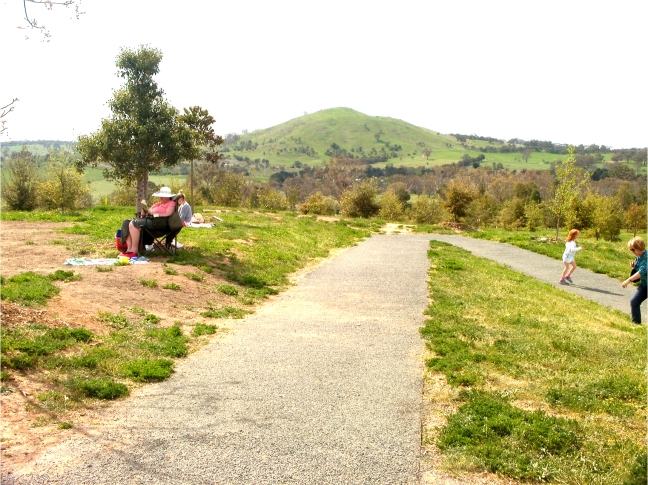
One of the themes of my visual sociology is the representation of science. Conservation is as much about social practices as it is about earth science, biology and other natural sciences. Today’s post is about the sociology of the National Arboretum, which sits on Ngunawal country. Ngunawal people are the traditional custodians of this part of Acton, west of the city in Canberra. Less than a seven minute drive central business district, this is one of the world’s largest arboretums for rare and endangered trees. I am no arborist. I cannot even claim to be a fan of gardening. I was interested in the Arboretum first in an attempt to capture a visual sociology of Canberra, and second to see how people interact with this place as a science centre. The focus of my post today is on the social dynamics of the Arboretum, especially on community aspects of conservation and the trees that drew the greatest interest amongst the crowds I saw: the Bonsai and Penjing Collection .
National Arboretum (18)

Continue reading Sociology of the National Arboretum

Ways to Enhance Gender Equity and Diversity in STEMM

At the Kiwi Foo ‘unconference,’ I spoke about Informed and Practical Ways to Enhance Gender Equity and Diversity in Science, Technology, Engineering, Mathematics and Medicine (STEMM).

Ruby Payne-Scott. Photo via Peter Gavin Hall, Wikipedia
Ruby Payne-Scott. Photo via Peter Gavin Hall, Wikipedia, CC 3.0

I started my talk at Kiwi Foo by telling the story of Ruby Payne-Scott, a pioneer in radio astronomy whose work led to major technological innovation and scientific knowledge. She supported top secret science on radar detection in the 1940s during the war, and she was a women’s rights activist. During the 1930s and 1940s, she worked for Australia’s premier government research agency, CSIRO, at a time where women were not allowed to be married and working in the public service. So she secretly married in 1944 and subsequently lost (but fought hard to keep) her permanent position at CSIRO. She was finally forced to resign in 1951, a few months before the birth of her son, Peter, as her pregnancy was no longer able to be hidden. Her career in science was effectively ended because her family status was deemed unlawful for the public service.

Ruby Payne-Scott, third from the right, at the 1952 International Union of Radio Science conference, University of Sydney
Ruby Payne-Scott, 5th from the right, at the 1952 International Union of Radio Science conference, University of Sydney. Photo: Wikipedia, CC 3.0

Women scientists and allies who care about gender equity in STEMM tell Dr Payne-Scott’s story often, though it is a shamefully unknown story by broader Australia. My point in beginning my talk with this lamentable tale is that Payne-Scott’s historic impact lives on for the wrong reasons. In Australia, the shameful employment discrimination she endured overshadows her scientific achievements in many ways. More sadly, while women in the present day are no longer discriminated in the same overt way, other structural inequalities make it difficult for women to remain in science, especially after they have children. So Payne-Scott’s legacy remains perennially relevant, 70 years later.

Continue reading Ways to Enhance Gender Equity and Diversity in STEMM

Sociology of the Anti-Vaccination Movement

The state of Victoria in Australia is facing a measles outbreak due to parents in relatively progressive suburbs choosing not to vaccinate their children. The anti-vaccination movement has its roots in Western societies in the myth that vaccines cause autism. The science demonstrating that there is no link between autism and vaccines is peer-reviewed and well-established. The original paper that made the assertion that such a link existed was retracted by the original publisher, The Lancet, due to fraud by Andrew Wakefield and his team. Given that the myths of vaccines have been thoroughly debunked, what is behind the anti-vaxxer movement? I start by discussing the scientific evidence about the fraud that inspired the anti-vaxxer movement before providing a broad sketch of the public who don’t believe in vaccination. Sociology of the Anti-Vaccination Movement Continue reading Sociology of the Anti-Vaccination Movement

How to stop the sexual harassment of women in science: reboot the system

Two white women scientists are working on machines in a lab

This article was first published in  The Conversation, on January 29, 2016.

The culture in astronomy, and in science more broadly, needs a major reboot following revelations early this year of another case of harassment against women by a senior male academic.

The journal Science revealed earlier this month that the latest case involved Christian Ott, a professor of theoretical astrophysics at Caltech university, in the United States.

Frustrated that Ott was not fired and only placed on unpaid leave for a year, the two female students who raised the allegations took their story to the popular online news outlet Buzzfeed.

Also this month, US Congresswoman Jackie Speier raised the case of Professor Tim Slater, who had been investigated for various sexual harassment incidents that began after he was hired by the University of Arizona in August 2001. Slater went on to the University of Wyoming.

Slater spoke to the news website Mashable and said he had received sexual harassment training as an outcome of the investigation.

But Congresswoman Speier questioned why the investigation into Slater’s sexual harassment was sealed “while he went on with his career”, even though women who were victims lost years of study and career progress due to his conduct.

Read more on The Conversation.

Addressing Sexism in Scientific Publishing

Three women of colour sit and read textbooks

Barely a few days have passed since the last gender bias in science crisis, and the scientific community is already dealing with yet another high-profile example of gender discrimination. This time, the issue is with sexism in science publishing.

Dr Fiona Ingleby, a postdoctoral researcher in evolutionary biology from the University of Sussex, took to Twitter to express her frustration over sexist comments by a reviewer from a journal by PLOS ONE, an open access publishing network. Dr Ingleby and her colleague, evolutionary biologist Dr Megan Head from the Australian National University, are both women. They had submitted a manuscript based on their research on gender differences amongst students moving from PhDs to postdoctoral roles. The reviewer rejected their manuscript on the basis of the researchers’ gender, suggesting the data would be more fit for publication if they included a male author. In other words, the science of gender bias can only be “objective” if a man is involved. I’ve previously noted that women’s research on gender bias in science is often rejected by men, who, despite scientific evidence to the contrary, will argue that gender bias either does not exist, or if it does, it is is skewed in women’s favour.

Continue reading Addressing Sexism in Scientific Publishing

Publication: Sexism in Science Reporting

This article was first published in DiverseScholar, on 20 April, 2015.

In my previous DiverseScholar article, I showed why the study behind The New York Times Op Ed (claiming the end of sexism) was methodologically flawed and ideologically biased [Zevallos 2014]. I showed that a focus on an individual choice narrative to explain why women are disadvantaged in STEM (Science, Technology, Engineering and Math) is fundamentally unsound when understood alongside the long-standing empirical evidence from the social sciences. Here, I will review several science controversies related to the editorial and institutional decisions within STEM. These patterns show that everyday interactions contribute to gender inequality, from the use of images, to dress, to the way distinguished women scientists are described in the media. I start with a selected timeline of events highlighting gender inequality in STEM. Continue reading Publication: Sexism in Science Reporting

Sociology of Gender Bias in Science

Sociology of Gender Bias in Science
Sociology of Gender Bias in Science. Photos: Texas A&M University-Commerce, CC 2.0

A new study by Dr Corinne Moss-Racusin and colleagues has analysed the public’s comments in response to a prominent study on gender bias in Science, Technology, Engineering and Mathematics (STEM). The researchers find that men are more likely to post negative comments in response to scientific findings about sexism in STEM careers. To provide a flipside illustration, I share some examples of what it is like to be a woman moderator of a large, international science community on Google+. This case study will illustrate the recurring arguments used to invalidate the science on inequality in STEM. These arguments are focused on biological (mis)understandings of gender; stereotypes of what motivates men and women; and a desire to police the boundaries of science. Denying that sexism exists is a common tactic to invalidating the science on gender bias in science, and attacking the social sciences is concurrently used to discredit findings on inequality, as well as support the idea that inequality does not exist in STEM.

Continue reading Sociology of Gender Bias in Science

Science Inequality in the News

I recently published the first of a three-part series of articles for Minority Postdoc exploring gender inequality in science reporting. My series demonstrates how social science can improve media discussions about gender in Science, Technology, Engineering and Mathematics (STEM). Continue reading Science Inequality in the News

Motherhood Penalty in Academia

In late 2014, two sociologists were featured in the New York Times (NYT) talking about the “cultural bias against mothers” in the paid work force. Professor Michelle Budig’s research finds that high income men with kids enjoy the biggest career benefits while low-income women suffer as a result of having children. In part, this is because employers think that marriage and children makes men more stable, while women with children are stigmatised as being less reliable (employers see mothers as “flaky”). This stereotype goes back to the traditional male breadwinner model that arise during the Industrial Revolution, which became solidified in post-WWII period during the 1950s. People presume the model we know today has always existed but that’s not the case. Marketing and economic relations have made it seem as if married men are ideal workers, while women are supposedly made for care-giving. This is not the case, when we look to institutional barriers and employer biases.

Motherhood penalty
Motherhood penalty

Continue reading Motherhood Penalty in Academia

Science Fellowships and Institutional Gender Bias in STEM

Women of colour speaking and doing science. Text reads: Science Fellowships and Institutional Bias

You may have read in late September that the ratio of women receiving Royal Society funding has “plummeted from one in three in 2010 to one in 20 this year.”  While the Society also awards the Dorothy Hodgkin Fellowships to early career women researchers, this award exists to boost women’s participation in science, not to augment or mask the issues in the Society’s mainstream Fellowship program.

The Royal Society was silent for a couple of days after its list of fellows list was made public, despite a large outcry by the scientific community on social media and opinion columns in the media. The Society President, Sir Paul Nurse, finally announced an investigation a couple of days after the fact. The question is: why did the Society wait until it was made public to assess their program?

I want to stress that while I’m using the Royal Academy’s Fellowship outcomes as a case study, the issue I am illustrating is the reactionary treatment of gender bias in all fields of Science, Technology, Engineering and Mathematics (STEM). The point here is to tease out institutional patterns and to make the case that institutional approaches are needed to address gender inequality. While this point may seem obvious, the fact is that inequality in science, as with other spheres of social life, is still treated as a surprise. This is because, on the whole, organisations (and society in general) remains reactionary to addressing gender inequality. Diversity is an afterthought, when it should be a proactive and ongoing project at the organisational and societal levels.

This is the first in a series of articles I’m writing on why the scientific community, inclusive of various disciplines, needs to re-examine its position on the problem of inequality in STEM. The picture I am building up is one of methodological rigour and interdisciplinary collaboration in order to better work towards gender inclusion.

Continue reading Science Fellowships and Institutional Gender Bias in STEM