Excuse me while I migrate various content to a central place on my blog! This post was first published on 11 July 2017.
I was interviewed by Buzzfeed, about a new study by Professor Kate Clancy and colleagues, showing women of colour scientists are more likely to experience race and gender harassment. Women of colour scientists are also excessively critiqued for being either too feminine or masculine enough, they have their physical abilities questioned, and they are more likely to miss professional opportunities like conferences, fieldwork, classes and meetings because their workplaces are unsafe. My comments from the interview:
“The study really reinforces a lot of what the literature already tells us — that women of colour are more likely to experience multiple forms of harassment and feel more acutely the impact of a hostile work environment in the sciences,” Zuleyka Zevallos, a sociologist at Swinburne University in Australia, told BuzzFeed News.
Although this isn’t the first study to show evidence of the “double bind” of racial- and gender-based harassment, some critics continue to deny that the effect is real.
“A lot of the pushback that we see in the individual scientific communities —astronomy or any other science — is that scientists want data,” Zevallos said. “And even though there’s a plethora of data, it’s like they need to see more data for themselves.”
In their study, Clancy and colleagues surveyed women and men from various racial backgrounds, focusing on academics working in the field of astronomy and planetary science. The study finds that 88% of their respondents heard negative language from peers at their current job, 52% from supervisors, and 88% from other people at work. Thirty-nine percent report experiencing verbal harassment at their current position and a further 9% experienced physical harassment. Around a third of the overall sample feel unsafe at their current role (27%), however, women of colour were the most likely group to feel unsafe in their place of work due to their race, gender, and religion (although the latter was not statistically significant).
Breaking this figure down by race, 40% women of colour and 27% of White women, feel unsafe in their current role due to gender. Further, 28% of women of colour feel unsafe due to race.
Clancy and colleagues note a meta-analysis of 343 studies has established that people are less likely to participate in counterproductive workplace research. This suggests that, despite their stark findings, people are likely to underreport negative experiences for fear of professional repercussions. So experiences may be far worse in reality.
The study concludes that astronomy creates an hostile environment with profound impact on junior scholars, White women, and the greatest problems for women of colour.
The study proposes four solutions to workplace inequity.
- A code of conduct/education for all trainees and employees at all levels;
- Diversity and cultural awareness training on challenges faced by women of colour and underrepresented minorities;
- Leaders need to model appropriate behaviour;
- Swift, just and consistent sanctioning for perpetrators of harassment in the workplace.
Moreover the study concludes that better support networks for women of colour are needed.
Both in the academic literature and in my professional equity and diversity work, experts see a reticence in equity programs to deal with racism alongside gender imbalance. As I’ve detailed elsewhere, the astronomy community, along with other disciplines, deals with sexual harassment and gender inequity in haphazard ways, but still ignores racism. The present study by Clancy and colleagues might be used to better shape policy and programs. Bias awareness training is the bare minimum needed; to make positive changes to attract, retain and promote women of colour, structural reform is necessary.
Too many scientific societies feel that tackling gender equity is “a good start” but still see diversity and inclusion of people of colour and other underrepresented minorities is the “next step.” Some leaders perceive that diversity work undermines gender equity programs. This study, and many others before it, show that intersectionality is pivotal in making lasting change. Intersectionality describes how gender inequality is impacted by racial inequality and other forms of disadvantage like sexuality, disability, class and beyond. We cannot address gender inequity separate from racial inequity as both issues impact one another, as well as increase other problems for minority groups.
Read about the study and comments by lead author Professor Clancy on Buzzfeed.
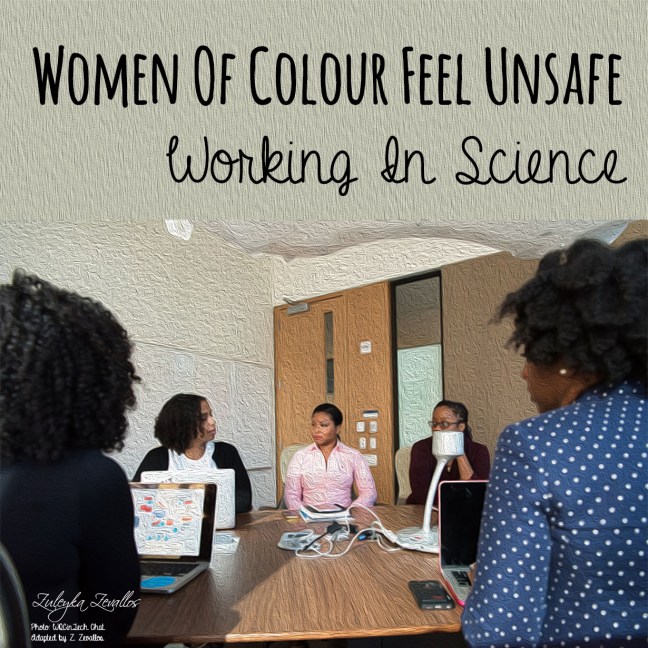
Photo credit: WOCinTech Chat, CC 2.0 via Flickr. Adapated by Z. Zevallos.



 The Other Sociologist