Indigenous Women’s Leadership

This past week, Australia celebrated NAIDOC Week (8-15 July), a time to recognise the leadership, culture and achievements of Aboriginal and Torres Strait Islander people. Originally standing for National Aborigines and Islanders Day Observance Committee, NAIDOC Week has historically reflected the ongoing resistance to genocide, assimilation and land dispossession, famously culminating in the annual Day of Mourning in 1938 (a protest against Australia Day on 26 January). The NAIDOC committee emerged in 1956, and has in recent decades coordinated local and national events and awards to promote Indigenous excellence. This year’s theme is Because of Her We Canpromoting the multiple leadership roles of Indigenous women for their families and communities, as they push for social justice and human rights at the local community and national levels.

I share with you two events I attended that highlight the role of Aboriginal and Torres Strait Islander women in academia, journalism, business, law and social policy. Continue reading Indigenous Women’s Leadership

Dark Emu by Bangarra Dance Theatre

Two dancers reach up while jumping and twisting their arms

Guess who had front row tickets to Dark Emu by Bangarra Dance Theatre?

Based on Bruce Pascoe’s wonderful and important research into Australia’s pre-history – the agrarian and aquaculture innovation by Aboriginal and Torres Strait Islander people people prior to invasion.

Continue reading Dark Emu by Bangarra Dance Theatre

Challenging the March for Science: Intersectionality at the Coal Face

This is the first of two talks I was invited to give in New Zealand in September 2017. It is fitting to share this today, on the second March for Science event happening in over 200 cities around the world, including Australia. I have throughly documented the equity and diversity issues with the last year’s March for Science. This talk was a reflection on the problems and costs of this volunteering work that I and many other people of colour, disabled scientists, and lesbian, gay, bisexual, transgender, queer, intersex and asexual (LGBTQIA) researchers did to try to make the marches more inclusive. I note that Black women scientists bore the worst abuse both within the March for Science movement and by the public advocacy they did.

I’m afraid that discussions this year were no better. Last week, I was one of a few Australian women reflecting on issues from last year’s March for Science, and the lack of transparency over plans for this year’s event. On my Twitter threads, in discussion with other minority women, organisers from the Sydney, Melbourne and Canberra marches reproduced many of the problematic arguments detailed here, all over again.

Some of the organisers of this year’s march blamed the lack of diversity amongst the committees and speakers on the low number of volunteers, while also insinuating that minority people should have volunteered in greater numbers. I noted that the same issue was raised last year to deflect minority researchers’ concerns with equity and diversity. In fact, the minorities who did volunteer and offered countless hours of free advice and public resources (as in my case) were met with anger. Women of colour were especially made to feel unsafe and unwelcome. Other organisers of this year’s march said they valued diversity but didn’t know how to improve things. I noted that there had been a plethora of free resources published last year as well as other resources that exist on how to make events more inclusive.

There is really no excuse for reproducing inequality in science or academic events, and in other spheres.

So with all these wounds freshly scratched opened, below are the notes for the talk that I gave at the University of Auckland, titled: Challenging the March for Science – intersectionality work at the coal face. I was a guest of the The Women in Science Network. Throughout this post, I provide tips for how to make science events (and other events and protests) more inclusive. At the end, I include a visual resource that summarises some tips for best practice that you can print off as a reminder. Feel free to put it up at your home office, work, school, university, or any other community space!

Continue reading Challenging the March for Science: Intersectionality at the Coal Face

Barangaroo and the Four Thousand Fish

Two people walk along the foreshore. In the background, other groups gather at the pier taking photos and looking around, while others are near a giant vessel. The sun shines brightly as it sets over the water

My Weekends With A Sociologist series is going to start coming to you more frequently and completely out of sequence. I will share with you my visual sociology adventures from different places, at different points in time, showing you what has captivated my sociological imagination most recently, through to what has lingered with me over time. The purpose of this series is to showcase what it is to see the world through a sociological lens. (For visually impaired readers, descriptions in the alt.) So let’s get started!

What better way to restart our journey, than with the enduring legacy of a strong Aboriginal woman, Barangaroo.

Beginning in the first week of January, Sydney annually hosts the Sydney Festival, with various sites around town housing performances, public art and sculptures, including many interactive installations. The best this year was the artwork, Four Thousand Fish, curated by Emily McDaniel, artist from the Kalari Clan of the Wiradjuri nation in Central New South Wales. The artwork blends sea song, visual story telling, sound, lighting, sculptures, landscape photography, music and of course, a beautiful nawi (bark canoe).

Held at the Cutaway in Barangaroo, every weekend this past January, the site was transformed into a public art sculpture that was set ablaze nightly at dusk. I attended an event hosted by the beloved street photographer, Legojacker (formerly from Melbourne, they had moved to Canberra in recent months).

Barangarro is named after the mighty Cammeraygal woman of the Eora nation, who defied colonialism in Gadigal, her homeland (also known as Sydney).

Continue reading Barangaroo and the Four Thousand Fish

Tech Inclusion

On 13 February 2018, I participated in the Tech Inclusion Melbourne conference. Bill Nicholson, Wurundjeri elder gave the Welcome to Country (below). He talked about using treaty to build economic capacity and sovereignty amongst Aboriginal and Torres Strait Islander people.

My overview of the conference starts with the panel discussion that I took part in. I then reflect on the other presentations. (Note: click on images for further detail)

Continue reading Tech Inclusion

Invasion Day 2018

The 26 January is a public holiday nationally known as Australia Day, however, for decades, Aboriginal and Torres Strait Islander people have protested against this day, as it commemorates genocide and dispossession. Last year’s Invasion Day rallies were attended by over 61,000 people around Australia. This year’s rally had around 80,000 people marching across all capital cities, including 60,000 people in Naarm (Melbourne) and between 15,000 to 20,000 people in Gadigal (Sydney).

A child holds a sign showing the ongoing significance of the Day of Mourning

This year marks 230 years since the British invaded Australia, leading to the decimation of Aboriginal and Torres Strait Islander people, with inequities continuing to this day. It is also the 80 year anniversary of the Day of Mourning protests, organised by the Australian Aboriginal Progressive League.

Today’s post reflects on the protests on the lands of the Gadigal people of the Eora Nation (Gadigal is the city now known as Sydney). I then provide a visual sociology of the culmination of the protest march, which ended at the Yabun Festival.

https://twitter.com/OtherSociology/status/956670694586073089

Continue reading Invasion Day 2018

Anti-Indigenous Racism by Other People of Colour

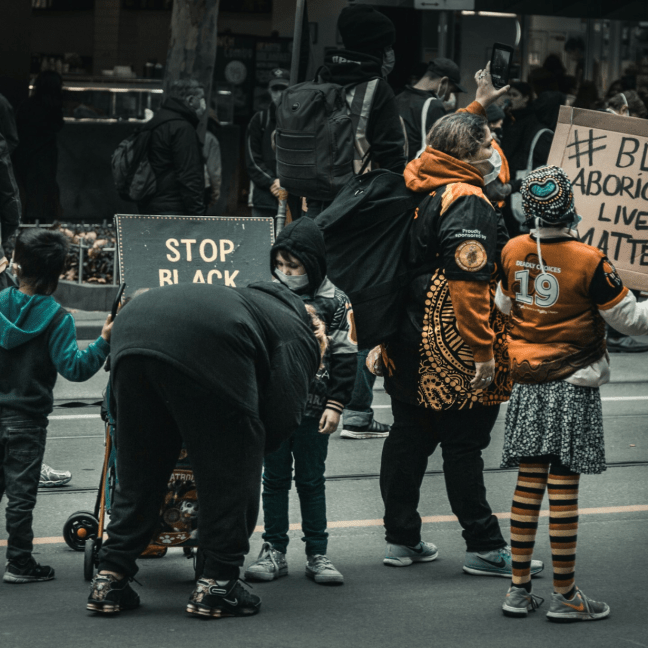
People at a protest hold signs that that #BLM Aboriginal Lives Matter

In July 2017, a young family tried to get a taxi after they marched for NAIDOC Week, a week of events recognising the cultures, languages and achievements of Aboriginal and Torres Strait Islander people, in Naarm (Melbourne). Five cab drivers refused to take them, making up the same excuse that they had just dropped someone off, or that they were waiting for another passenger, only to drive off alone. It is illegal to refuse a fare. The two drivers in the video shared below are non-Indigenous people of colour.

Continue reading Anti-Indigenous Racism by Other People of Colour