Gender, Race and Ableism in ‘Joker’

Arthur is in full Joker make-up. His face is painted white with crass red lips overdrawn over half his face. He has large red eyebrows painted high on his forehead. His eyes are framed by two blue triangles. He smiles and raises his eyebrown as he exhales

Let’s talk about representations of gender, race and ableism in Joker and how to situate a critical reading in the local Australian context. I saw the film last night in Newtown, Sydney, where the mostly White audience erupted in rapturous clapping. We’ll explore this reaction.

Spoilers ahead. (N.B.: Read this as a gif-free version in PDF)

Arthur is shirtless, with his back to the audience. He is watching Thomas Wayne, a White man in a suit, speaking on television‘Joker’ presents a racialised and gendered view of class. Thomas Wayne (Gotham’s White male, super rich aspiring Mayor, played by Brett Cullen) is the antagonist. Wayne refers to protesters with contempt (jokers) and he punches Arthur (before his reincarnation as The Joker, played by Joaquin Phoenix) while he’s emotionally vulnerable. Whiteness prevails in this exchange, because the conflict between the two men is not really about class, as the film attempts to position. Their tension is about masculine power.

Continue reading Gender, Race and Ableism in ‘Joker’

Thelma

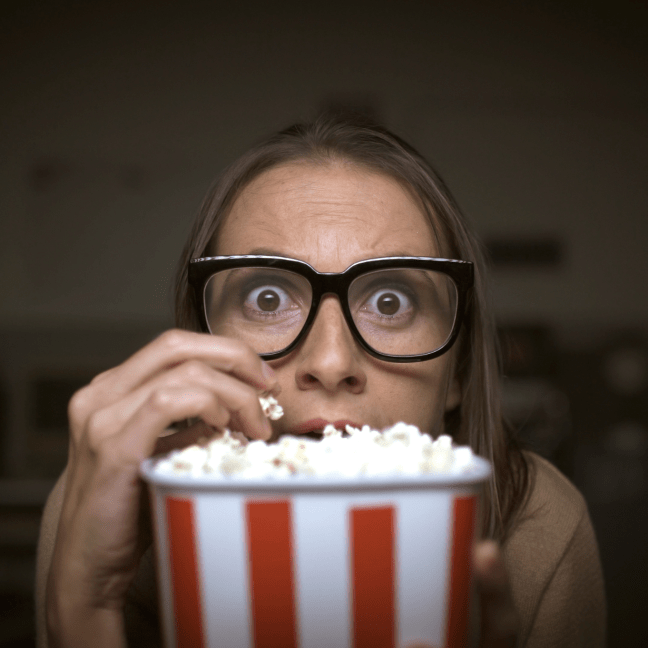
Young white woman wearing glasses hides behind a bucket of popcorn

Let me tell you about Thelma, screening at the Scandinavian Film Festival. A young woman, the titular Thelma, has led a sheltered and conservative Christian upbringing in the country. She rocks up to university having never really partied, including no alcohol or drugs, and without experience with dating. While she has a strong bond with her parents, especially her dad – with whom she shares all her deepest thoughts – she is very lonely in her new environment. That is until she meets the vivacious Anja.

Continue reading Thelma

What Keeps You Alive

Two metal cups resting on a log, with a tent in the background

I have a rule of faith when it comes to film festivals – I don’t watch trailers or read reviews. I read the program and decide to see movies based on the blurb. I make an effort to see movies written or directed by women first and foremost (documentaries or dramas especially), or about minority groups and women in general in the second instance. Third, I try my hardest to see horrors because they’re rarely released in Australian cinemas.

Continue reading What Keeps You Alive

Woodpeckers

A woodpecker on a tree hangs from a perfect hole. It has a red head, white breast, and black and white body

Another Cine Latino film: Woodpeckers (Carpinteros). Unsettling but excellent Dominican film entirely focused on Afro-Latino characters. Julián (Jean Jean) is awaiting sentencing when he’s put into one of the “less hellish” prisons in Najayo. That is to say, an overcrowded, filthy and violent place where many prisoners sleep on the concrete floor. Julián is second generation Haitian-Dominican. In a terse exchange with his brother, we learn he is an entrepreneurial “low level” criminal who doesn’t want to be locked into a low-paid menial job.

Continue reading Woodpeckers

You’re Killing Me Susana

A man's fingers holds a block with a person icon. The blocks are arranged around a wooden love heart

At CineLatino, the Latin American film festival, I watched, You’re Killing Me Susana, starring Gael Garcia Bernal. As always, his performance is charming and the movie has an abundance of affable comedy. But his character and the story is not endearing. He is an unfaithful and selfish husband who does not take any interest in his wife and her writing. He is disparaging of her teaching, which supplements her writing aspirations. He has repeatedly talked his wife out of going away on writing trips because he is suspicious and jealous.

Continue reading You’re Killing Me Susana

Women and Girls on Film: “Inequality is Rampant”

Storify is closing and over the coming weeks, I will be migrating my posts to my blog. This is an archive of my article first published on Storify on 24 September 2014. 

In September 2014, the United Nations, the Geena Davis Institute on Gender in Media, and The Rockefeller Foundation published a study on the representation of cisgender people on film. Here I report on the major findings and include some of my related social media posts.

The study conducted by Dr Stacy Smith, Marc Choueiti and Dr Katherine Pieper included 120 globally released movies in 11 major film regions: Australia, Brazil, China, France, Germany, India, Japan, Russia, South Korea, United States, and the United Kingdom. The study included almost 5,800 speaking or named characters. The researchers find that, globally, only 31% of speaking roles in films are given to women and less than a quarter of films are centred on a woman protagonist (23%).

The study finds that girls and women are slightly better represented in the UK (38% of speaking roles), Brazil (37%) and Korea (36%). Women and girls’ representation in Germany (35%) and China (35%) is relatively worse, but gender inequality is even more entrenched in India (25%) and the USA and U.K. (24%). This is especially alarming since Hollywood is the biggest exporter of films globally and they are clearly leading in the wrong direction.

Only 28 films in the sample (23%) feature a woman or girl in the lead role or otherwise sharing the story with another main character. The study also considers the gender balance of film casts (where 45 to 55% of characters are women or girls). Only 12 films met this criteria (10%). When women characters are featured in the main storyline, they appear in highly femininised genres. For example: women feature in 33% of comedy roles; 34% of dramas; and 29% of animated movies, but they make up only made up 23% of characters in action/adventure films.

The study included 1,452 film makers and people working in key roles behind the scenes. Women make up only 7% of directors, less than 20% of writers, and 23% of producers. The UK (27%) and China (17%) are comparably better, while France, Japan, Korea, Russia, and the USA are below the industry average of 7%.

Around 60% of younger characters (children and teenagers) are boys while 40% are girls. While 34% of men are cast as characters aged 40 to 64 years of age, only 19% of women are depicted as middle aged characters. The researchers find this is especially problematic given that the younger women who do appear in films are highly sexualised.

Women are more than twice as likely to wear sexually revealing clothing (25% of women vs 9% of men). Women are more likely to be thin (38.5%) in comparison to men (16%). Women are also more likely to be partially or fully naked (24% women vs 11.5% of men). Women characters are also five times more likely to have their looks commented upon by others (13% vs less than 3%). Younger women are more likely to wear revealing clothing, but women across the ages of 13 to 39 years are equally likely to be sexualised.

Continue reading Women and Girls on Film: “Inequality is Rampant”

Noble Savages and Magical Pixie Conquests: Colonial Fantasies in Film

Via Wiki: Detail from Benjamin West’s The Death of General Wolfe (1771). This painting is an example of an idealised vision of the “noble savage” in North American art.

By Zuleyka Zevallos

I wanted to do a follow up on my post from a couple of months a go, on Hollywood racism. I analysed George Lucas’ claim that big Hollywood studios were reticent to back his film Red Tails because there were no white leading actors in the script. I used the idea of the Magical Negro Trope to explain how mainstream Hollywood films stereotype African-Americans as either thugs or benevolent, self-sacrificing figures who exist only to teach the white character a life-affirming lesson. I showed that this trope extends to other minorities who are people of colour, through the Noble Savage Trope. Today I want to focus on the sexualisation of Noble Savage trope. The Noble Savage is a term describing the over-simplified stereotype of Indigenous people on film. I will focus on gender and sexuality issues in big-budget Hollywood films depicting Indigenous and minority cultures during early colonial and “frontier” times.

Today I will draw a comparison between Avatar and other Hollywood films that depict Indigenous and minority women as savage conquests. Women in general are rarely cast in complex roles in big-budget Hollywood releases. They are usually romantic or sexual diversions to help portray the male lead in a sympathetic light. Minority women are even more simplified, especially in stories involving Indigenous cultures. Indigenous and women of colour exist largely as Magical Pixie Conquests:  they are painted as feisty, though ultimately submissive, pawns that help white male characters to dominate the “native tribe”. The fictionalised version of the “Pocahontas” story epitomises how Hollywood both fetishes Indigenous cultures and perpetuates patronising postcolonial fantasies.

Noble savages and magical pixie conquests

Continue reading Noble Savages and Magical Pixie Conquests: Colonial Fantasies in Film

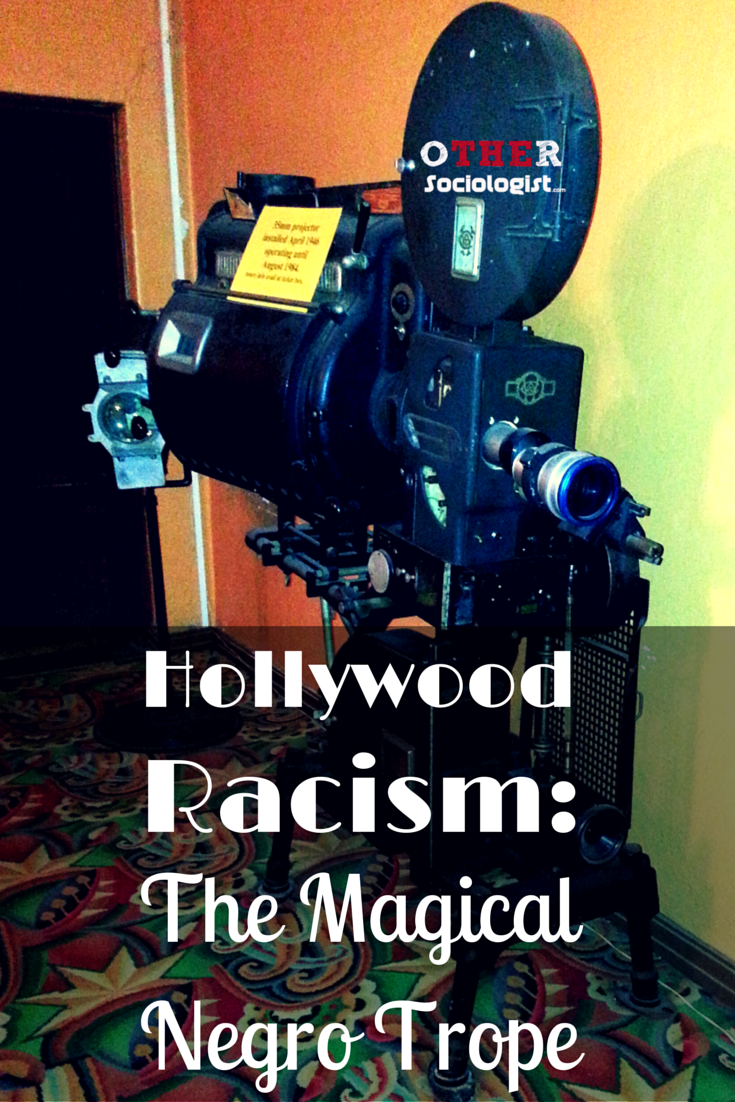
Hollywood Racism: The Magical Negro Trope

By Zuleyka Zevallos

Adam Serwer reports in Mother Jones that George Lucas’ latest film, Red Tails had trouble getting made, partly because the “studios weren’t willing to finance a film without a white protagonist as an anchor”.  Lucas’ claim can be put into wider historical context by examining the entrenched racist practices of big Hollywood studios. In particular, the idea of the “magical negro trope” puts things into perspective. This term refers to the way valiant Black characters in movies exist only as a narrative device to teach the white protagonist how to be a better person. This post explores variations of the “magical negro” and the gendered dimensions of these characters.

Hollywood Racism: The Magical Negro Trope

Continue reading Hollywood Racism: The Magical Negro Trope