Hierarchiology: A Fun Way to Understand Complaints About Work

An older white man with a beard and moustache carries a large pile of files, while a woman works on a computer in the background

Ever heard someone complaining about how people in management roles do not work as hard as those in less senior roles? Years ago, a friend told me that people are promoted to the highest level of their incompetence. This is otherwise known as the Peter Principle, Laurence Peter and Raymond Hull’s satirical view of organisations, as laid out in their 1969 book of the same name. Or as this comic explains, The Dilbert Principle, works just as well.

This 1969 Time Magazine review describes the Peter Principle through the theory of hierarchiology, which is the ‘the study of hierarchies in modern organisations’. The last tenet is: ‘Final Placement Syndrome… [or] what the ordinary sociologist calls “success”‘. Funny stuff.
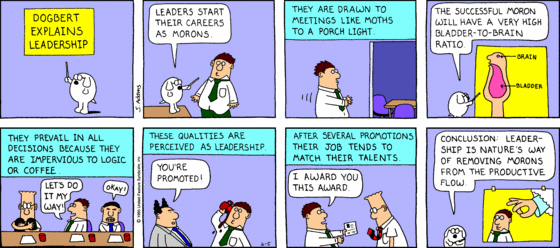
A Dilbert comic strip that explains "Leaders start their careers as morons"
Credit: The Dilbert Principle (1995) http://dilbert.com/fast/1995-02-05/

The Peter Principle and Sociology

The Peter Principle (PP) has longevity. The video below explains how this humorous principle has more serious applications for American governance. The PP is apparently relevant to the modern day business world and in management. It’s been used to critique the Former USA Federal Emergency Management Agency director Michael Brown’s handling of Hurricane Katrina. Physicists have created computational models to study the PP.

Though it was conceived as a satirical application of social scientific analysis over four decades ago, the Peter Principle continues to have useful resonance to serious critiques of organisational hierarchies. The PP simplifies bureaucracy, organisational structures and status in a way that Karl MarxMax WeberTalcott ParsonsPeter Blau and most other social stratification and organisational sociologists may object. Nevertheless, the PP offers an engaging starting point from which to begin unravelling public dissatisfaction – and misunderstanding – of organisational structures.

My opening anecdote was about my friend being frustrated over what they perceive is an unfair, non-merit-based system of promotions in their workplace. This frustration stems from a subjective perception about what knowledge, skills, experience and leadership traits should be rewarded. Subjective perceptions about what is fair, what makes a good leader, and what types of professional competencies are necessary in middle and upper management are going to vary from one organisation to the next, from one society to another, and in different points in time.

Satire and Sociology

The examples I provided about the PP being applied to governance, businesses, natural disaster responses and even computational models by physicists show that the PP provides a way to frame critical analyses of organisational hierarchies. In an earlier post, I reflected on Duncan Watts‘ point that sociologists need to show society our disciplinary strengths – one of which is that we are trained to go beyond ‘common sense’ understandings of the world. My argument was that sociologists still have a long way to go in showing the utility of sociology to wider publics. In the case of the PP, I’m all for starting off with satire and drilling in deeper.

I see that applied sociology is about making sociological insights useful in achieving practical outcomes for particular groups in society. I also believe that we need to do this in easy to understand language rather than relying on sociological jargon. Using comedy, satire and examples that people can relate to are all useful tools to this end. So I say:  viva la PP!

Beauty, Biology and Discrimination

Four young women wear suits and hold hands, one of them is very fair, one woman is Black, and the other two are white women, one of them covered in neck and chest tattoos

Several recent articles recreate the idea that beauty aesthetics are based on biological imperatives. The premise of this argument is false – beauty, sex, gender, and the social consequences of their related biological processes are not pre-determined. This line of thinking lumps the complexity of human experience and sexual expression into a uniform category and it provides the false impression that nothing can be done to change human behaviour. Sociology can help unpack how and why so-called “common sense” ideas about beauty become established as commonplace knowledge. Contrary to what mainstream culture may have us believe, beauty ideals can be challenged and transformed. Beauty-based discrimination is not natural, and nor is it unavoidable.

Continue reading Beauty, Biology and Discrimination

Erotic Capital and the Sociology of Beauty

A young Black woman does the make up for another Black woman who looks unsure, while two while women sput on make up on either side of them

Catherine Hakim’s latest book, “Honey Money: The Power of Erotic Capital” argues that women should use their sex appeal to get ahead in life. The book continues to generate press in the UKUSA and in Australian, such as in The Australian and The Sydney Morning Herald.  The latter alludes to the fact that Hakim’s work distorts French sociologist Pierre Bourdieu’s notion of cultural capital. Hakim’s theory replicates taken-for-granted ideas about sex and gender. Sociology is useful only when it takes apart everyday ideas to help people better understand the social origins, and cultural consequences, of behaviour; in this case, sexuality, desire, and what is considered ‘attractive’.

Continue reading Erotic Capital and the Sociology of Beauty

The Sociology of Unfollowing on Twitter

A new sociological study finds that unfollowing people on Twitter has little to do with frequency of interpersonal contact between two parties. Rather it has more to do with people who break specific social norms of Twitterverse etiquette. This got me thinking about the unique aspects of Twitter connections, as well as the ways in which unfollowing on Twitter might be similar to the way other social networks operate offline.

Comic of Indiana Jones running from rolling rock (from Temple of Doom). He holds a statue and says "Unfollow! Unfollow!" Text at the bottom reads: "Indy had been spending too much time on Twitter"
Agent X Comics (2009)
Continue reading The Sociology of Unfollowing on Twitter

The Wrap Up: Media Coverage of the 10th Anniversary of the September 11 Attacks

Image Credit: 9/11Memorial.org

This is the third and final post in a series covering the lead up to the 10th anniversary of the September 11 attacks. This one focuses on news coverage; technology and social media issues; and media discourses about the so-called ‘Decade 9/11’ and ‘Gen 9/11’.

Continue reading The Wrap Up: Media Coverage of the 10th Anniversary of the September 11 Attacks

Impact of the September 11 Attacks on Australian-Muslims

Image credit: Sailor Coruscant 2010 Im not even sure Flickr

This is the second post in a three-part series reviewing the media and research released in commemoration of the 10-year September 11 Anniversary. Without doubt, the ongoing trauma and health issues faced by the survivors of the September 11 attacks have high ongoing social costs for American society. This article focuses on the impact that the September 11 attacks had on the lives of Australian-Muslims. I was inspired by a SBS Radio vox pop with Muslim and Sikh Australians, which I will go on to analyse.[i] The people interviewed talked about how they managed the increased racism and stigma they have faced since 2001. Ten years after the attacks, studies show that a high proportion of Australians perceive Muslims as ‘outsiders’ who do not fit in with Australian society.[ii] My analysis shows that living with racism requires a lot of ‘emotion work’, particularly because Muslims mostly deal with racist encounters on a one-on-one basis.

Continue reading Impact of the September 11 Attacks on Australian-Muslims

Public Health Impact of the September 11 Attacks

Public Health Impact of the September 11 AttacksThis is Part One of a three-part series summarising some of the public discussions about the September 11 Anniversary. This one focuses on renowned scientific journal, The Lancet, which recently published a special edition on the ongoing health problems arising from the suicide attack in the USA and from the consequent ongoing War in Iraq.

The Lancet reports that in addition to the 3,000 people who died in the September 11 attacks in 2001, there has been a reverberating impact on the physical, mental and public health of over 200,000 Americans.I review papers on the health outcomes on the victims and the rescue crews who worked on the World Trade Centre site. I also discuss findings on the 43,000 suicide attack civilian casualties resulting from the Iraq war and a further 200 coalition soldiers. Finally, I include a brief review of the public health preparedness in the USA. Though this has drastically improved since the September 11 attacks, the ongoing economic crisis remains a challenge.

Continue reading Public Health Impact of the September 11 Attacks