Interview: Science March on Washington

I’ll be sharing with you some recent media interviews I’ve done on issues with diversity in the March for Science. The first is by STAT News.

Source: STAT News

“Australian-based sociologist Zuleyka Zevallos, in an email to STAT, pointed to what she called ‘racist dog-whistling’ by the Los Angeles march chapter in a Twitter post that was since deleted: ‘some scientists [are] concerned with the march turning into [a] political event and losing its focus. What do YOU pledge to do to keep it peaceful?” The leap from ‘political’ to ‘violent’ did not sit well with some minority science advocates.

Last week, Zevallos published an article about the march’s various diversity problems — a move she made after ‘close to two months of equity missteps, and many scientists were fed up by having offered their volunteering, advice and resources, only to be ignored,’ she said.”

This article has many troubling aspects. From how diversity is discussed by one of the March for Science committee members (diversity “diminishes science”); to the revelation post-publication that one of the former committee members quoted (Morris) has a long history of White supremacist and sexist behaviour; to, it seems, possible unethical practices by the journalist (this piece was updated with additional quotes by committee members in response to being misquoted).

What a mess.

Individual Racism Distracts From Structural Change

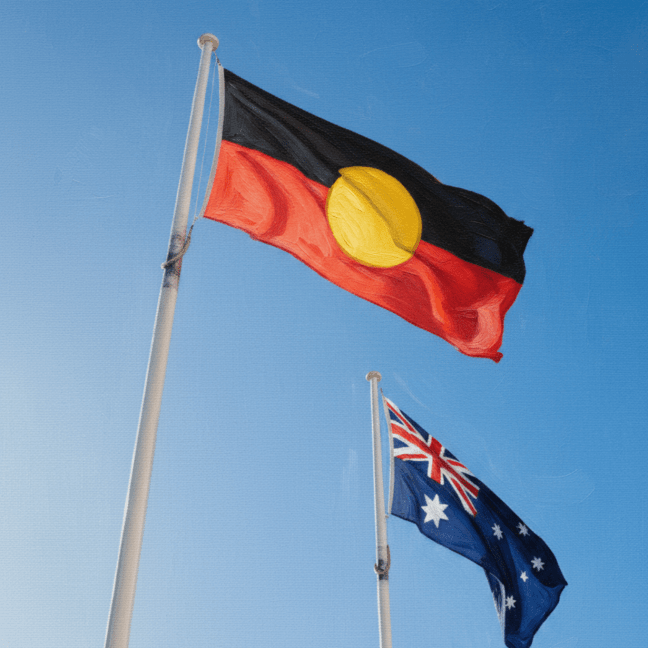
The Aboriginal flag flies in the foreground against a clear blue sky, with the Australian flag in the lower background

“When we focus on the individual, or the individual instance of racism, we actually miss out on looking at society and how it continues to perpetuate these sorts of structures that discriminate against these groups of people… We seem very keen to pin it on individual people rather than actually re-imagining a society that exists and doesn’t elevate these sorts of dialogues.”

Continue reading Individual Racism Distracts From Structural Change

Yabun Festival 2017

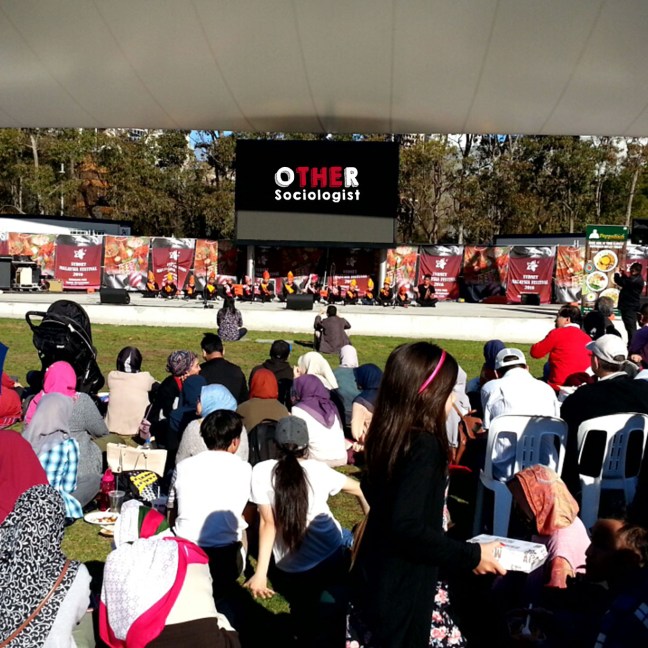
Djiringanj Dancers, a group of women cultural performers, singing about the “West Wind” at the Corroboree grounds, during the Yabun Festival.

The Yabun Festival is a celebration for Survival Day. The 26 of January is a national holiday that marks the day British ships arrived in Australia and began the genocide of Indigenous Australians. Survival Day is a day led by Indigenous Australians who affirm the resilience, creativity and excellence of First Australians. This year, the Invasion Day Protests, which aim to change the date and meaning of Australia Day, ended by protesters joining Yabun at the end of the march to enjoy music, stalls, cultural performances, speeches and more.

Continue reading Yabun Festival 2017

Invasion Day Protest 2017

No pride in genocide! I am in Sydney, land of the Gadigal people of the Eora Nation, who have looked after these lands for over 75,000 years. I pay my respects to elders past, present and emerging.

The 26 January is a painful day for Aboriginal and Torres Strait Islander people. It is a date commemorating the day British ships (”the First Fleet”) arrived on Aboriginal and Torres Strait Islander lands. It is a day that marks the decimation of First Australians; the dispossession of their land; the removal of children to be raised in Missions and in White foster homes with no ties or knowledge of their culture (“the Stolen Generation”); amongst many other human rights crimes. This history impacts Indigenous life chances in the present-day.

On the 26th, I joined 10,000 people in Sydney who marched in solidarity with Indigenous Australians to tell the Australian Government to change the date of Australia Day so that First Australians aren’t being excluded through a national holiday making genocide. Another 50,000 people marched in Melbourne, and tens of thousands more did the same in cities and town around Australia.

Below, you can read my tweets of the protest as it unfolded.

Intergenerational crowd protesting for Indigenous rights on 26 January 2017. Continue reading Invasion Day Protest 2017

Intersectionality and the Women’s March

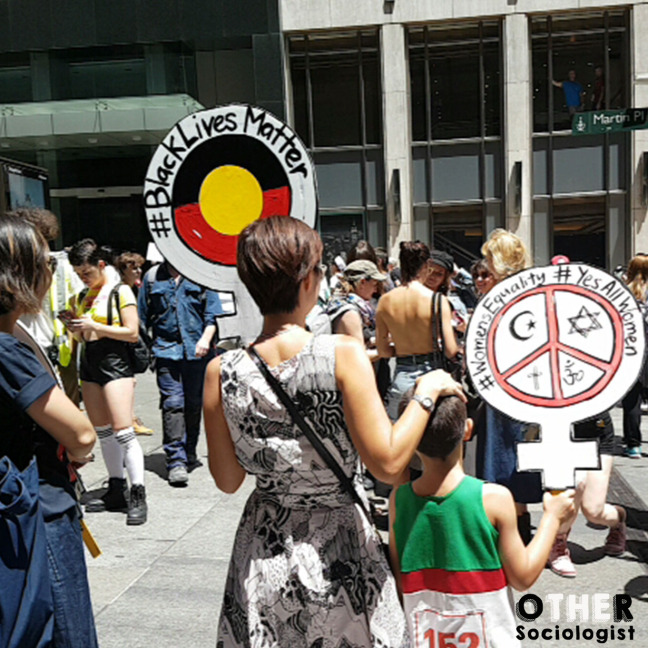
crowd at the Sydney Women’s March, with a woman holding a “Black lives matter” sign bearing the Aboriginal flag, with her hand on the head a young boy who holds a sign made from the symbol for “woman,” bearing religious symbols for Islam, Judaism, Christianity and Hinduism, with the words, #WomensEquality and #YesAllWomen

This is the first of a two-part reflection on the global Women’s March that occurred on 21 January 2017. It reflects the tensions between the initial goal of the Women’s March in Washington, which aimed to be inclusive of intersectionality, and the White women who wanted to attend the March, but objected to this aim.

Despite many positive outcomes, the issues discussed here that centre on whiteness continued to affect the attendance, experience and discussions of the marches after the event. This post examines the attitudes of White women as discussed in an article by The New York Times, which reflect the broader dissent expressed by white women who continue to oppose intersectional conversations about the Women’s March.

The issues here remain relevant not simply as women around the world reflect on the racism and exclusion they faced at the marches, but also because one of the co-organisers, Linda Sarsour, is currently facing racist backlash only days after the event.

The second part to this discussion is forthcoming and it will be a visual reflection of my attendance at the Sydney March.

We support the advocacy and resistance movements that reflect our multiple and intersecting identities. We call on all defenders of human rights to join us
Women’s March organisers: Tamika Mallory; Linda Sarsour [holding a baby]; and Carmen Perez
Continue reading Intersectionality and the Women’s March

Whitewashing White Supremacy

The back torso of a white man in a painter's white overalls, holding a white bucket, getting ready to paint and empty room

White supremacy is an ideology promoting the racial superiority of white people. One of the key ways white supremacy retains its power is through language that “naturalises” white dominance, making the current social order seem natural, normal, and logical. The recent editorial direction by the New York Times of how to refer to the “alt right” plays into white supremacist ideology, by sanitising its political aims and making its ideology more palatable.

Continue reading Whitewashing White Supremacy

White People Don’t See Insitutional Racism

A Black man stands on a low stack of coins. A white man stands slightly higher up, while a white man stands on a stack twice as large

The latest Pew Research Centre survey shows that white people do not recognise institutional racism as the main cause of racial inequalities. Instead, they focus on individual prejudice, family, and lack of role models. White people are also half as likely to say Black people are treated unfairly at work and by police.

Continue reading White People Don’t See Insitutional Racism

Sociology of Kiwi Foo, an Unconference

Kiwi Foo Baa Camp timetable

In March, I travelled to Auckland New Zealand for Kiwi Foo, a two-and-a-half day “unconference” where 150 participants from New Zealand and other parts of the world from a wide range of professional backgrounds self-organise the sessions. This includes people from technology companies, policy and community organisations, as well as academics . The idea behind Foo Camp is to bring together like-minded individuals who might otherwise not meet, and listen to one another and look for ways to connect in our common goal to make the world a better place.

In order to attend, one must be nominated by a previous Foo alumn from Kiwi camp or SciFoo from the UK. You pay for your own travel but all other costs, including food and lodging if you want it, are provided. When you accept the invitation, you nominate three keywords. Upon arrival, in a large hall filled with around three hundred people, each person stands up to introduce themselves by their name, their affiliation and their keywords, without elaboration. It took awhile but it was fun. My three keywords were: gender equity & diversity; science communication; sociology.

Continue reading Sociology of Kiwi Foo, an Unconference

White Supremacy and Islamophobia

A Black man holds a sign that says: No place for hate

Earlier today, 28 May, seven men were arrested, after a racist, anti-Muslim right-wing group crashed an anti-racism protest outside a primary school in Coburg, Melbourne, Victoria. All except one are aged 25 to 33 years, and the other man is 18. One of the men carried three knives. Media reporting focuses on the “violent clash on the streets,” as if the two groups are neutral, or equally oppressive. We know the men perpetrating violence are white because their race is not mentioned. Islamophobia is mentioned as an aside, rather than the catalyst, and the anti-racism focus of the original rally is also not discussed. This illustrates how white supremacy works, by maintain the ideology that white people are superior to people of colour.

Continue reading White Supremacy and Islamophobia