“Where Are You From?” Racial Microaggressions

Racial microaggressions are the brief and subtle daily insults that denigrate people of colour. This term was first conceptualised in 1977 by Chester Pierce and colleagues in a study of racism in television commercials.

“These are the subtle, stunning, often automatic, and non-verbal exchanges which are ‘put downs’ of Blacks by offenders. The offensive mechanisms used against Blacks often are innocuous. The cumulative weight of their never-ending burden is the major ingredient in Black-White interactions.”

Microaggression is a term that Dr Derald Wing Sue and colleagues reinvigorated in 2007, to describe racist dynamics between White therapists and their clients who are people of colour. They note that microaggressions occur because White people lack awareness of how race affects their biases, stereotypes, behaviour and attitudes, and also because they lack an understanding of the experiences of people of colour.

“Racial microaggressions are brief and commonplace daily verbal, behavioural, or environmental indignities, whether intentional or unintentional, that communicate hostile, derogatory, or negative racial slights and insults toward people of colour. Perpetrators of microaggressions are often unaware that they engage in such communications when they interact with racial/ethnic minorities”
Racial microaggressions are brief and commonplace daily verbal, behavioural, or environmental indignities

Microaggressions can be delivered as an insult or an appeal for validation about White person’s beliefs. These may be verbal signs (words or tone) or physical cues (snubs, or dismissive looks, gestures). Racial microaggressions can also build up not by targeting a specific individual but through atmosphere, such as a hostile workplace, where a minority woman is excluded from social events.

Continue reading “Where Are You From?” Racial Microaggressions

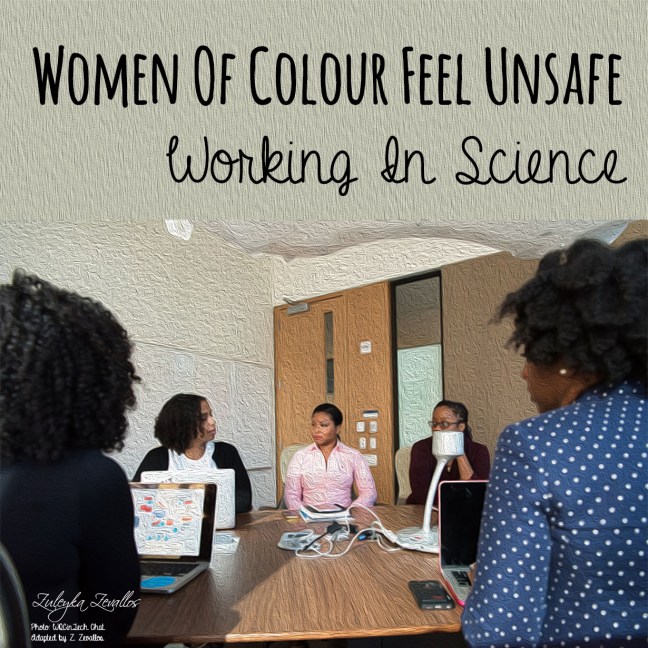
Interview: Many Women Of Colour Feel Unsafe Working In Science

Excuse me while I migrate various content to a central place on my blog! This post was first published on 11 July 2017.

I was interviewed by Buzzfeed, about a new study by Professor Kate Clancy and colleagues, showing women of colour scientists are more likely to experience race and gender harassment. Women of colour scientists are also excessively critiqued for being either too feminine or masculine enough, they have their physical abilities questioned, and they are more likely to miss professional opportunities like conferences, fieldwork, classes and meetings because their workplaces are unsafe. My comments from the interview:

“The study really reinforces a lot of what the literature already tells us — that women of colour are more likely to experience multiple forms of harassment and feel more acutely the impact of a hostile work environment in the sciences,” Zuleyka Zevallos, a sociologist at Swinburne University in Australia, told BuzzFeed News.

Although this isn’t the first study to show evidence of the “double bind” of racial- and gender-based harassment, some critics continue to deny that the effect is real.

“A lot of the pushback that we see in the individual scientific communities —astronomy or any other science — is that scientists want data,” Zevallos said. “And even though there’s a plethora of data, it’s like they need to see more data for themselves.”

In their study, Clancy and colleagues surveyed women and men from various racial backgrounds, focusing on academics working in the field of astronomy and planetary science. The study finds that 88% of their respondents heard negative language from peers at their current job, 52% from supervisors, and 88% from other people at work. Thirty-nine percent report experiencing verbal harassment at their current position and a further 9% experienced physical harassment. Around a third of the overall sample feel unsafe at their current role (27%), however, women of colour were the most likely group to feel unsafe in their place of work due to their race, gender, and religion (although the latter was not statistically significant).

Breaking this figure down by race, 40% women of colour and 27% of White women, feel unsafe in their current role due to gender. Further, 28% of women of colour feel unsafe due to race.

Clancy and colleagues note a meta-analysis of 343 studies has established that people are less likely to participate in counterproductive workplace research. This suggests that, despite their stark findings, people are likely to underreport negative experiences for fear of professional repercussions. So experiences may be far worse in reality.

The study concludes that astronomy creates an hostile environment with profound impact on junior scholars, White women, and the greatest problems for women of colour.

The study proposes four solutions to workplace inequity.

  1. A code of conduct/education for all trainees and employees at all levels;
  2. Diversity and cultural awareness training on challenges faced by women of colour and underrepresented minorities;
  3. Leaders need to model appropriate behaviour;
  4. Swift, just and consistent sanctioning for perpetrators of harassment in the workplace.

Moreover the study concludes that better support networks for women of colour are needed.

Both in the academic literature and in my professional equity and diversity work, experts see a reticence in equity programs to deal with racism alongside gender imbalance. As I’ve detailed elsewhere, the astronomy community, along with other disciplines, deals with sexual harassment and gender inequity in haphazard ways, but still ignores racism. The present study by Clancy and colleagues might be used to better shape policy and programs. Bias awareness training is the bare minimum needed; to make positive changes to attract, retain and promote women of colour, structural reform is necessary.

Too many scientific societies feel that tackling gender equity is “a good start” but still see diversity and inclusion of people of colour and other underrepresented minorities is the “next step.” Some leaders perceive that diversity work undermines gender equity programs. This study, and many others before it, show that intersectionality is pivotal in making lasting change. Intersectionality describes how gender inequality is impacted by racial inequality and other forms of disadvantage like sexuality, disability, class and beyond. We cannot address gender inequity separate from racial inequity as both issues impact one another, as well as increase other problems for minority groups.

Read about the study and comments by lead author Professor Clancy on Buzzfeed.

Photo credit: WOCinTech Chat, CC 2.0 via Flickr. Adapated by Z. Zevallos.

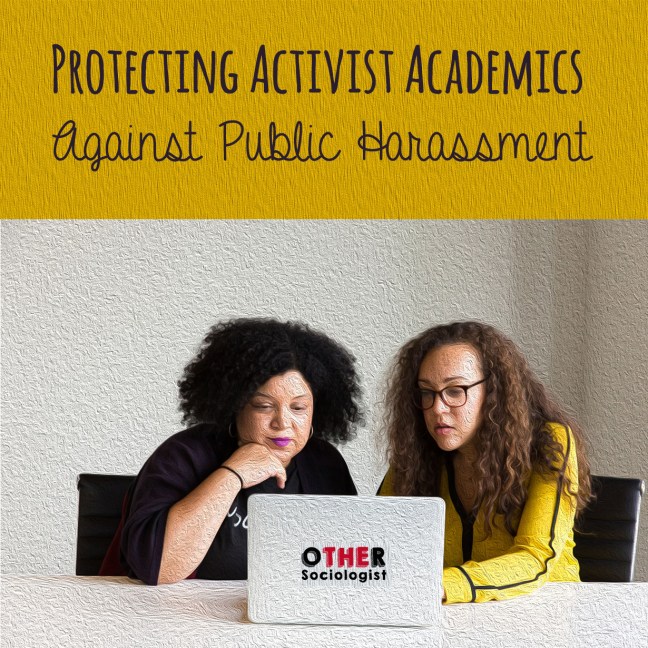
Protecting Activist Academics Against Public Harassment

Two women of colour sit at a desk reading a laptop

There have been an increased number of public attacks on underrepresented academics for their education and activism on social media. The term “activist academic” describes the longstanding tradition across nations where intellectuals engage in conscious protest in support of social justice and dissent against the status quo. Activism by academics asserts that the university has a social function beyond the provision of education and scholarly critique. Activist academics see that their role serves a social purpose to provide independent social criticism through volunteering, program interventions, public engagement outside academia, protests, and beyond. In some circles, the profile of activist academics has declined, particularly amongst White academics from majority groups. This led to the misperception that recent international protests by scientists were novel. This is misguided, as minority academics are often inextricably activist in their pedagogy, not-for-profit service work, and activities.

Sociology is centrally concerned with activism, especially in applied contexts. Our social justice focus is misconceived as bias or as an attack to those not used to having history, culture and politics viewed through a critical lens. Sociology is centrally concerned with social transformation. We do not merely observe the world; we aim to challenge existing power structures and to reduce inequity. Having said that, women academics in general are penalised for their work, and the outcomes are even worse for minority sociologists as they seek senior roles. The stakes for minority activist academics is therefore higher, as I will show below.

One of our first aims must be to collectively reconfigure what ‘counts’ as academic work while simultaneously challenging whether ‘counting’ is necessarily the best way to ensure the efficient use of public resources in any part of the education sector
Activist academics: what ‘counts’ as academic work? – Dr Sandra Grey

Continue reading Protecting Activist Academics Against Public Harassment

Tone Policing People of Colour

When White people try to dismiss Indigenous and other people of colour’s discussion of colonialism and its present-day impact by focusing on “tone,” that’s racism. Consider this exchange. I shared an article by Teila Watson , Birri Gubba Wiri and Kungalu/Gungalu Murri woman artist, who wrote about the impact of colonialism on Australia’s past, present and future. Originally published in The Guardian, Watson was unimpressed that the editors changed the title from White “Australia” Has a Black Future, to “Indigenous knowledge systems can help solve the problems of climate change.” So she chose to self-publish the longer version of her article with the original title on Medium.

A white woman reshared my tweet of this article, adding that she refuses to read the article due to the title, which she sees is “uncivil.”

Continue reading Tone Policing People of Colour

Publication: Ring a Bell? Charles Murray and the Resurgence of Scientific Racism

This article was first published on The Humanist on 15 May 2017. Below is an excerpt.

In his latest podcast episode titled “Forbidden Knowledge,” atheist author Sam Harris guides political scientist Charles Murray through an extensive defence of Murray’s widely debunked body of work, focusing mostly on The Bell Curve. Co-authored with psychologist Richard Herrnstein (who died around the time it was published in 1994), the book was universally critiqued as an example of modern-day scientific racism. Continue reading Publication: Ring a Bell? Charles Murray and the Resurgence of Scientific Racism

Race and the Head Wrap in Brazil

Racism in Latin America is deep and complicated by the way in which colonialism is internalised in national narratives. In Brazil, the official discourse is one of perfect multicultural, multiracial togetherness, however, the fact is that race is intertwined with class inequality. Black and Indigenous Brazilians are treated like second class citizens and their cultures are appropriated and fetishised by the majority groups and elites.

Continue reading Race and the Head Wrap in Brazil

Australia’s Unfair and Inhumane Refugee Policies

Untitled (refugee girl) by Mohammed. Via Safdar Ahmed and the Refugee Art Project

Whilst in London a couple of years a go, I came across a sign which reads, “Begin your dream today, emigrate to Australia!” (see below). A warm invitation indeed: unless of course you are an asylum seeker – in which case our Government will revoke this welcome and abscond its responsibility to the United Nations Convention Convention relating to the Status of Refugees.

Since 2001, the Australian government has passed several laws that allow the detention of asylum seekers in offshore centres located on the islands of Nauru and Manus. This was first established by excising islands from Australia’s territory; attempting to pay off people smugglers; and a series of other policy changes known as the “Pacific Solution.” In the first seven years of the scheme, over 1,600 people were held in detention. They arrived predominantly from Afghan, Iraqi and Sri Lankan backgrounds. While this program was initially wound back by 2008, it was reintroduced in 2010. Offshore detention reached its peak in 2014, with over 2,400 people held in detention centres, including 222 children. At the end of March 2016, almost 1,000 people remained in Manus and up to 1,200 people on Nauru.

These actions contravene international law, with our “paltry commitment to the Refugee Convention” deemed one of the worst in the world. Detention makes little sense, given that 90% of cases are found to be “genuine refugees.” The majority of asylum seekers have been in detention for at least two years. Even after they were released into the community, they were initially not allowed to work.

In 2014, the Government offered migrants up to $10,000 to go back home to face certain persecution; a scheme that was resolutely condemned by human rights experts. The Government simultaneously cut legal aid to refugees, making it even harder for them to receive informed support.

The ensuing health damage suffered by asylum seekers is woefully inhumane. Australia’s humanitarian program has been criminally pared back, along with our collective morality. We must not accept this unfair system in the name of so-called “Australian values.”

In London, emigrate to Australia sign is in the foreground, and people walk in the background
Your bridge to Australia. Your bridge to Australia. Begin your dream today.

Continue reading Australia’s Unfair and Inhumane Refugee Policies

Interview: March for Science Sparks Broader Discourse About Science Activism

I was interviewed by Dr Heather Goldstone for Living Lab Radio, along with my colleague Dr Caleph Wilson:

Two dozen researchers from Woods Hole, MA, traveled to the flagship march in Washington, D.C.
Source: Heather Goldstone/ WCAI

“They [March for Science Los Angeles] Tweeted in February that they’d been hearing from scientists that there might be problems with violence in connection with their focus on diversity,” said Zuleyka Zevallos (@OtherSociologist), a sociologist at Swinburne University. “That’s a dangerous historical connection that they are making from having minorities attend a science event to having it lead to violence. There’s actually no correlation between the two.”

Zevallos walked away from the March, as did Caleph Wilson (@HeyDrWilson), a biomedical researcher and digital media manager for the National Science and Technology News Service. They took to Twitter, instead, helping build hashtags – #marginsci and #AltSciMarch – that have developed into a vibrant public discourse about diversity and equity in science.

“One of the things that the hashtags were able to do is allow people to have those conversations in a way that can be visible,” said Wilson. “We could see each other having these conversations, as well as we could point the March for Science to these conversations.” […]

Zevallos says there is a silver lining, though.

“I do think that there’s a positive momentum in that these conversations have been happening for a very long time,” Zevallos said. “Underrepresented minorities have been doing activism for decades. But I guess the hashtags, in particular, allowed these conversations to converge, and for different networks from different parts of the world to join their voices together.”

As March for Science organizers work to foster a more lasting science activism movement, Zevallos and Wilson hope that the conversations started by the March can be leveraged into more awareness and meaningful changes in the science community’s prevailing attitude toward diversity and inclusion.

Read more and listen to the interview on Living Lab Radio.

Whiteness in Parliamentary Debates of Section 18C of the Racial Discrimination Act

The front of Parliament House, showing a white building, with a colonnade façade and a four-legged steel flagpole, where the Australian flag flies. There is a paved areas and grass on either side

Politicians embody state power. They create laws and are elected to represent democracy, however, many of their decisions maintain racism and social inequality. In this sense, they personify institutional racism. A clear example is former Attorney-General George Brandis, who was one of the key drivers to amend 18C of the Racial Discrimination Act 1975. He worked alongside Prime Minister Malcolm Turnbull (considered a “moderate” Liberal politician), to weaken racial protections.

Continue reading Whiteness in Parliamentary Debates of Section 18C of the Racial Discrimination Act