I was interviewed by WIRED on the disunity caused by scientists who have tried to split the March for Science from social justice activism. The case study in this article is the appalling treatment of organisers in Memphis, USA. Scientists split from the Memphis March to form a separate rally in the same city. Both groups have scientists but the March has centrally been led by women of colour activists with more experience in social movements, and they incorporate a focus on inclusion of minority communities. This is symbolic in their decision to march to an historically Black university. Participation of minorities in science is not mutually exclusive to the goal of enhancing evidence-based science policies. I’ll point out what I said in my interview: scientists from underrepresented groups have always been part of, and learned from, social justice movements.
“Both groups feel that their work isn’t done—and with the perception that science is under attack in the US, they wish they could show a united front. But ‘that in itself is a false picture of science, because we are not united,’ says Zuleyka Zevallos, a sociologist at Swinburne University in Australia who has studied the online reaction to the March for Science’s shifting messaging. Saturday’s marches, rallies, and other events around the world will surely pull some science supporters together. But they’re just as likely to highlight the clash over science’s priorities. Should the science community focus on fighting back against a hostile administration? Or on improving itself from within?”
I was interviewed by the The New York Times on issues of equity and diversity in the March for Science:
Source: The New York Times
“‘It set off alarm bells,’ said Zuleyka Zevallos an applied sociologist from Swinburne University of Technology in Australia. ‘How can we trust them to look after inclusion and accessibility if they are going to buckle under pressure?'”
The statements from the organisers in this article are easily disproved from public record. For example, the organisers resisted the idea that science is political, and they have created a series of sexist, racist and ablesit problems (discrimination against people with disabilities). They have completely ignored the needs and representation of LGBTQIA scientists. Most tellingly, several women have left the organising committee due to a toxic organisational culture.
As I’ve said from the beginning: the problems with the march reflect broader issues of discrimination in science and academia. This includes a lack of awareness about the structural barriers inhibiting the full participation and success of minorities and White women in research. The march is also plagued by ineffective leadership, policy and practice responses to diversity, which is another troubling hallmark of science. We must do better to ensure everyone can achieve their full potential in science.
I was interviewed for this article by BuzzFeed on March for Science:
Source: Buzzeed
“It took one tweet by one high-profile male scientist for the organisers to completely retreat from the diversity statement that they put out” Zuleyka Zevallos, a sociologist at Swinburne University in Australia, told BuzzFeed News. “It’s important because it shows that there’s a wavering commitment to diversity that is swayed by the status quo in science.”
I welcome the news of the three new honorary co-chairs of the march: Bill Nye, Dr Lydia Villa-Komoroff, and Dr Mona Hanna-Attisha, however there is a lot of work ahead to address diversity within the march. The news is also soured by the fact that Nye was going to be announced solo.
I was interviewed twice as a result. In my first interview I conveyed strong disappointment at the decision to make a White man the face of the march and noted that a woman of colour would have been a step forward. I also argued that the organisers needed to appoint transgender women and women with disabilities to address key gaps in leadership. Around this time, the STAT News article came out (for which I was also interviewed) and caused more controversy and so the organisers held off on announcing Nye. And so while these two accomplished women of colour scientists are wonderful leaders, they are, nevertheless, an afterthought. Their inclusion is also an outcome of strong negotiation by one of the women of colour on the committee and public lobbying by underrepresented scientists. Nye’s comments in this article are counter-productive:
“With respect to diversity — is that the key word here? There’s a diversity committee on the march, and they’re working this problem. I was born a dorky white guy who became an engineer. I’m playing the hand I was dealt. We can’t — this march can’t solve every problem all at once.”
The only reason Nye can make this argument – that diversity can wait and that it’s someone else’s problem – is because he’s a White man. His comments are ill informed and will only feed the detractors. Moreover, Lydia Villa-Komaroff and Mona Hanna-Attisha are practising scientists who have made a huge impact on pressing issues (insulin research and exposing lead poisoning in the Flint water crisis, respectively). It goes to the heart of problems in science that a White male personality gets top billing over more accomplished women of colour researchers.
Looking forward to better leadership moving forward, and for the march to make concrete progress on equity, inclusion and accessibility.
Politicians embody state power. They create laws and are elected to represent democracy, however, many of their decisions maintain racism and social inequality. In this sense, they personify institutional racism. A clear example is former Attorney-General George Brandis, who was one of the key drivers to amend 18C of the Racial Discrimination Act 1975. He worked alongside Prime Minister Malcolm Turnbull (considered a “moderate” Liberal politician), to weaken racial protections.
On Twitter, on 21 March 2017, celebrity chef Adam Liaw started a great conversation, by tweeting: “It’s #HarmonyDay so I want to be a bit frank about race.” Australia celebrates multiculturalism on Harmony Day annually, the same day as (the frankly more significant) International Day for the Elimination of Racial Discrimination. Liaw’s conversation was more aligned with this international event. Off the back of proposed changes to legal protections against racism, and two cases of racism in the arts and academia, it’s never been clearer, the importance of maintaining a sustained focus on proactively working to end racial discrimination.
“When we focus on the individual, or the individual instance of racism, we actually miss out on looking at society and how it continues to perpetuate these sorts of structures that discriminate against these groups of people… We seem very keen to pin it on individual people rather than actually re-imagining a society that exists and doesn’t elevate these sorts of dialogues.”
On the 21 of January 2017, I joined up to 10,000 Sydney-siders at the Women’s March, and 2.5 million people globally. I initially had reservations about the March. As I recounted last week, the march started as an idea by a woman activist in Hawaii and it was soon taken over by White women from Pantsuit Nation, a group that has no commitment to anti-racism. Bob Bland, a White woman from Washington, wanted to rectify the direction of the event and soon invited three women of colour to shape the Washington March: Tamika Mallory; Linda Sarsour; and Carmen Perez. The Women’s March Washington had a special focus on intersectionality; addressing how gender inequality is impacted by racism and other forms of discrimination such as homophobia, transphobia, ableism (the discrimination of people with disabilities), and more. The Washington March was the model for the other local and international marches. As more White women became involved in discussions at the national and international levels, this mission was drowned out. Women of colour were made to feel excluded from planning groups whenever the issue of intersectionality was raised.
So when the Sydney March was announced I first felt trepidation. As the final line up of speakers was announced, it became clearer that the Sydney organisers were making the event more consciously supportive of intersectionality. The organisers regularly focused their social media posts on inclusion, thereby reaffirming their commitment to diversity and inclusion. There were some limitations as I’ll discuss later. For example, transgender women seemed to lack representation amongst speakers at the event and best practice for the inclusion of women with disabilities may have been improved.
For me, the big draw card was Aboriginal activist, Jenny Munro, who has dedicated her life to advancing the human rights of Aboriginal people. Her activism and life’s work has a strong focus on Aboriginal sovereignty, children and housing. She leads the Redfern Tent Embassy and is a living legend. She did not disappoint; but I’ll get to that!
The day led to many useful discussions on diversity and how to disrupt patriarchy. I shared highlights of my day on Twitter and I bring these to you in this post as well as additional photos and video I wasn’t able to share on the day. The quotes are not strictly verbatim – treat them more as field notes to flesh out my visual sociology. I will also address the ongoing global conversations about the Women’s Marches and in particular, the critiques about the exclusion of women of colour, transgender women, sex workers and women with disabilities from various overseas events, with a focus on the USA. I’ll draw some qualified lessons on intersectionality from the USA to Australia and I wrap up with a discussion of why intersectionality is important.
This one minute video includes some of the footage I shot at the Sydney Women’s March and draws out the key lessons on intersectionality.
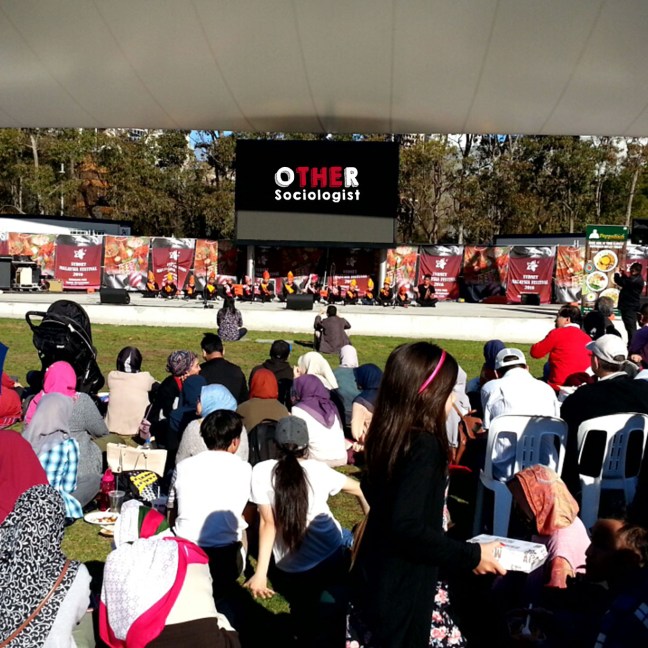
Djiringanj Dancers, a group of women cultural performers, singing about the “West Wind” at the Corroboree grounds, during the Yabun Festival.
The Yabun Festival is a celebration for Survival Day. The 26 of January is a national holiday that marks the day British ships arrived in Australia and began the genocide of Indigenous Australians. Survival Day is a day led by Indigenous Australians who affirm the resilience, creativity and excellence of First Australians. This year, the Invasion Day Protests, which aim to change the date and meaning of Australia Day, ended by protesters joining Yabun at the end of the march to enjoy music, stalls, cultural performances, speeches and more.
‘The term “white privilege” is misleading. A privilege is special treatment that goes beyond a right. It’s not so much that being White confers privilege but that not being White means being without rights in many cases. Not fearing that the police will kill your child for no reason isn’t a privilege. It’s a right. But I think that is what “white privilege” is meant to convey, that Whites don’t have many of the worries nonwhites, especially Blacks, do. I was talking to a white friend of mine earlier today. He has always lived in the New York City area. He couldn’t see how the Michael Brown case had anything to do with him. I guess that would be an example of white privilege.
‘Other examples of white privilege include all of the ways that whites are unlikely to end up in prison for some of the same things blacks do, not having to worry about skin-color bias, not having to worry about being pulled over by the police while driving or stopped and frisked while walking in predominantly white neighborhoods, having more family wealth because your parents and other forebears were not subject to Jim Crow and slavery. Probably all of the ways in which whites are better off than blacks in our society are forms of white privilege. In the normal course of events, in the fullness of time, these differences will even out. But the sudden killings of innocent, unarmed youth bring it all to a head.” – George Yancy and Naomi Zack on The New York Times.
“White privilege is like an invisible weightless knapsack of special provisions…” – Peggy McIntosh
Educator Peggy McInotsh introduced the idea of white privilege, the special benefits, protections and access to power conferred onto White people, which allows them to advance in life without conscious awareness of racial discrimination. She came to this concept as she reflected on her feminist practices. She noticed that even when male colleagues were willing to support women’s efforts to increase gender equity, they were not willing to give up their own status and power. Having tried to include women of colour in her feminist activities with little successful engagement, she came to see how she, as a White woman, had also been reticent to give up her own benefits to make feminism truly inclusive of racial minorities. She notes that educated White people like herself are raised to notice the “bad” aspects of racism, but not the benefits that make her life easier.
She came to realise that Whiteness was like an invisible knapsack she carried around with her, which protects her from noticing the advantages of race. Noticing her racial privileges, she understood the myth of meritocracy, for in the bag of Whiteness, she finds the key to open many doors that women of colour cannot access. Her skin colour was “an asset” that helped her secure a better education; it made it easy to take for granted that she belonged to the broader culture that facilitated her success, despite the gender inequalities she fought.
I have come to see white privilege as an invisible package of unearned assets that I can count on cashing in each day, but about which I was “meant” to remain oblivious… Whites are taught to think of their lives as morally neutral, normative, and average, and also ideal, so that when we work to benefit others, this is seen as work which will allow “them” to be more like “us.”
McIntosh began to recognise that “privilege confers dominance.” She came to see that her feminism was oppressive, even though she wasn’t conscious of the benefits of her race; but this is the point: by not being aware of race, she was contributing to inequity. She had failed to notice how the benefits she enjoys are part of a system that disadvantages people of colour. Just as patriarchy positions men as the universal norm, requiring women to adjust their behaviour and expectations to the needs and interests of men, McIntosh recognises how Whiteness pushes her to view the world through a racial lens. She’s encouraged to leave undisturbed the norm that Others should be more like White people, instead of challenging the system.
Read more on White privilege and related concepts on my resource, Sociology of Race.
White supremacy is an ideology promoting the racial superiority of white people. One of the key ways white supremacy retains its power is through language that “naturalises” white dominance, making the current social order seem natural, normal, and logical. The recent editorial direction by the New York Times of how to refer to the “alt right” plays into white supremacist ideology, by sanitising its political aims and making its ideology more palatable.