I have a rule of faith when it comes to film festivals – I don’t watch trailers or read reviews. I read the program and decide to see movies based on the blurb. I make an effort to see movies written or directed by women first and foremost (documentaries or dramas especially), or about minority groups and women in general in the second instance. Third, I try my hardest to see horrors because they’re rarely released in Australian cinemas.
TW gender violence: ‘A Vigilante’ at the Sydney Film Festival is an affecting film about a woman who has survived intimate partner violence and now rescues women and children from violence.
I was interviewed by Newsweek on the inequalities embedded into the way people imagine colonising other planets. I discussed how the language we use about ‘colonising’ Mars whitewashes the history of colonialism on Earth:
‘“Language is one of the ways in which we shape our social reality,” Zuleyka Zevallos, a sociologist at Swinburne University in Australia, told Newsweek. That means using terms like colonise carries real risks. “The history of colonialism has taught us that there is no democratic way to colonise other lands,” she said. “It is about profit, and profit always marginalises minorities.”’
Read this insightful article featuring other experts, here.
Have you ever wondered why people behave in unexpected ways, often against their own interest? This is because many of our social institutions, including the law, education and economy are built around rules that don’t always take into account people’s social context and their motivations when making decisions. Convention in Western societies is that financial incentives and punitive measures (like fines) can incentivise people to do the right thing. Behavioural science research shows this is not always true. In fact, while money and sanctions work in some situations for some groups, most behaviours are not able to be easily changed through cash and penalties. (These can sometimes backfire!)
Behavioural science is the use of behavioural economics, psychology, anthropology, sociology and other social sciences for the purpose of improving behavioural outcomes. Behavioural insights is specifically the application of this science to improve effectiveness for decision-making, public services and policy. Here’s a case study of behavioural insights in action in education and vocational training.
Using fieldwork research and randomised control trials, the Behavioural Insights Unit (BIU) test low-cost behavioural science changes to issues affecting different groups in society.
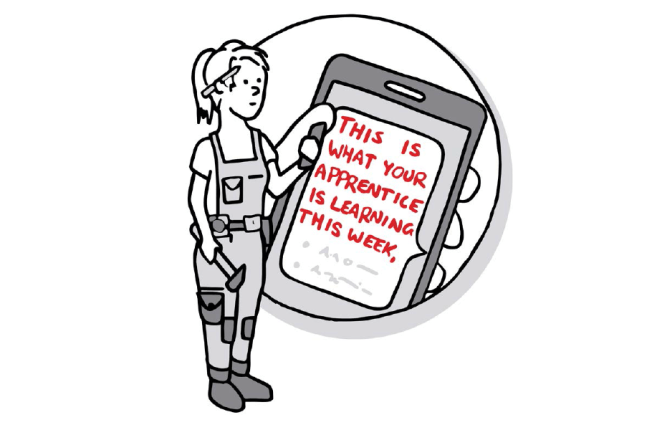
For example, we know that 48% of apprentices in New South Wales cancel their contracts within the first year, and 77% will cancel within two years. That’s a tremendous personal cost to these students, which also translates to $91 million loss of the state’s economy in cancellations alone, and upwards of $348 million in related revenue. BIU’s research shows apprentices who cancel their employment contracts do so because they often feel they are subjected to tough working conditions for little pay (undertaking menial, repetitive tasks and long hours), receiving little guidance about their progress on the job.
Today I’m speaking at the Science Pathways conference. I’m publishing a description of my slides here for accessibility for conference delegates, and for anyone else watching at home.
This is the first of two talks I was invited to give in New Zealand in September 2017. It is fitting to share this today, on the second March for Science event happening in over 200 cities around the world, including Australia. I have throughly documented the equity and diversity issues with the last year’s March for Science. This talk was a reflection on the problems and costs of this volunteering work that I and many other people of colour, disabled scientists, and lesbian, gay, bisexual, transgender, queer, intersex and asexual (LGBTQIA) researchers did to try to make the marches more inclusive. I note that Black women scientists bore the worst abuse both within the March for Science movement and by the public advocacy they did.
I’m afraid that discussions this year were no better. Last week, I was one of a few Australian women reflecting on issues from last year’s March for Science, and the lack of transparency over plans for this year’s event. On my Twitter threads, in discussion with other minority women, organisers from the Sydney, Melbourne and Canberra marches reproduced many of the problematic arguments detailed here, all over again.
Some of the organisers of this year’s march blamed the lack of diversity amongst the committees and speakers on the low number of volunteers, while also insinuating that minority people should have volunteered in greater numbers. I noted that the same issue was raised last year to deflect minority researchers’ concerns with equity and diversity. In fact, the minorities who did volunteer and offered countless hours of free advice and public resources (as in my case) were met with anger. Women of colour were especially made to feel unsafe and unwelcome. Other organisers of this year’s march said they valued diversity but didn’t know how to improve things. I noted that there had been a plethora of free resources published last year as well as other resources that exist on how to make events more inclusive.
There is really no excuse for reproducing inequality in science or academic events, and in other spheres.
So with all these wounds freshly scratched opened, below are the notes for the talk that I gave at the University of Auckland, titled: Challenging the March for Science – intersectionality work at the coal face. I was a guest of the The Women in Science Network. Throughout this post, I provide tips for how to make science events (and other events and protests) more inclusive. At the end, I include a visual resource that summarises some tips for best practice that you can print off as a reminder. Feel free to put it up at your home office, work, school, university, or any other community space!
My Weekends With A Sociologist series is going to start coming to you more frequently and completely out of sequence. I will share with you my visual sociology adventures from different places, at different points in time, showing you what has captivated my sociological imagination most recently, through to what has lingered with me over time. The purpose of this series is to showcase what it is to see the world through a sociological lens. (For visually impaired readers, descriptions in the alt.) So let’s get started!
What better way to restart our journey, than with the enduring legacy of a strong Aboriginal woman, Barangaroo.
Beginning in the first week of January, Sydney annually hosts the Sydney Festival, with various sites around town housing performances, public art and sculptures, including many interactive installations. The best this year was the artwork, Four Thousand Fish, curated by Emily McDaniel, artist from the Kalari Clan of the Wiradjuri nation in Central New South Wales. The artwork blends sea song, visual story telling, sound, lighting, sculptures, landscape photography, music and of course, a beautiful nawi (bark canoe).
Held at the Cutaway in Barangaroo, every weekend this past January, the site was transformed into a public art sculpture that was set ablaze nightly at dusk. I attended an event hosted by the beloved street photographer, Legojacker (formerly from Melbourne, they had moved to Canberra in recent months).
Barangarro is named after the mighty Cammeraygal woman of the Eora nation, who defied colonialism in Gadigal, her homeland (also known as Sydney).